
Tibetan Muslim Community in Srinagar Witness Exhibition on 50 Years of Tibetans in Exile [Wednesday, 26 August 2009, 5:56 p.m.]
 |
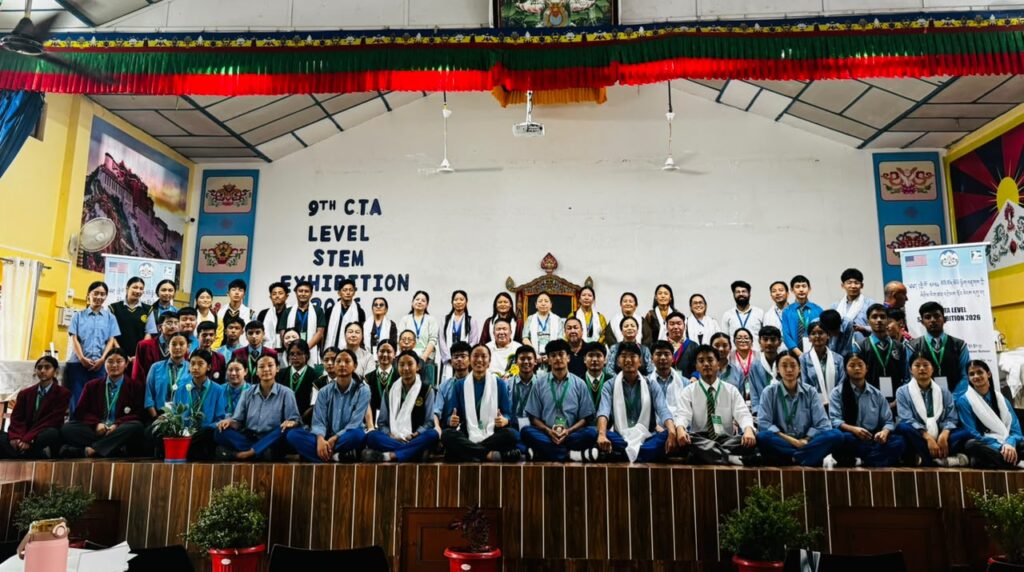
| Schoolchildren from the Tibetan Public School visit photo exhibition on the fiftieth anniversary of Tibetans in exile organised by the Tibet Museum, Central Tibetan Administration, at Srinagar, Jammu and Kashmir, on 17 August 2009 |
Dharamshala:
The Tibetan Muslim community in Srinagar experienced Tibet’s rich
cultural heritage through photo exhibition and documentary movies
organised by the Tibet Museum as part of the commemoration of “Fifty
Years of Tibetans in Exile and Thank You India”, from 17 – 18 August. The
exhibition was held at the Tibetan Public School which is located near
the Tibetan Muslim settlement in the area popularly known as Hawal. The
school was inaugurated in 2004 by Kalon for Department of Education, Mr
Thubten Lungrik.
 |
| Tibetan Muslim women watch documentary film on Tibet during the two-day photo exhibition |
Mr
Aman Malik, Principal of the Tibetan Public School, opened the two-day
exhibition in the school hall, attended by staff members and
schoolchildren. The exhibition features photos on the
successful establishment of democratic administration by the Tibetans
in exile, including settlements, educational, cultural, religious and
medical institutions. Documentary films on Tibet such as
“Kundun” and “Compassion” in Exile were also screened during the
two-day event. A song of tribute to India titled “Thank You India” was
also shown to express Tibetan people’s gratitude to the government and
people of India. Mr Aman Malik expressed his gratitude to the
Tibetan government and His Holiness the Dalai Lama while recounting his
early days in Lhasa before 1959. He said, before the occupation of
Tibet by the People’s Republic of China, the Muslim community in Lhasa
enjoys full freedom like any other Tibetan. Muslim communities at the
time were free to perform their religious activities without any
interference from the government of Tibet. He also said that the
Muslims were not settled at one area, they were scattered all around
Lhasa. During the Muslim holy of Ramzan, a horn bell was used to wake
up Tibetan Muslims in and around Lhasa-Bharkhor to prepare for early
Namaz prayer. Certainly, this could be a nuisance for ailing and
elderly people. But then, nobody ever complained and both communities
lived in a very friendly atmosphere. The religious tolerance towards
other faith by the Tibetan government at that time was exemplary, he
said. Mr Malik recently got the opportunity to have a private
audience with His Holiness the Dalai Lama. “His Holiness has shown
exceptional interest and love to the Tibetan Muslim and spoke in detail
account of the present Tibetan approach towards resolving the issue of
Tibet through dialogue with the Chinese leadership,” Mr Malik said.
More pictures:
 |
 |
 |
 |
 |
 |
 |