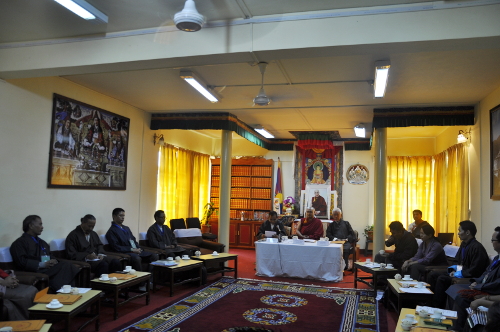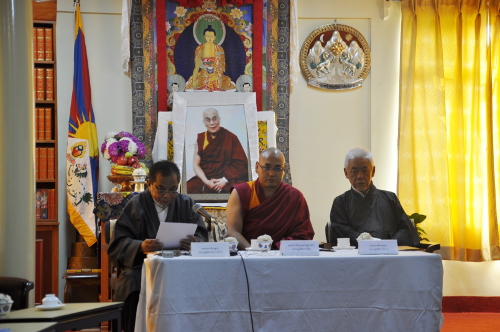
DHARAMSHALA: The fourth judicial conference of the Tibetan people organised by the Tibetan Supreme Justice Commission, the highest judicial organ of the Central Tibetan Administration, began today at Gangchen Kyishong. A new website was also launched on the occasion.
Over 16 justice commissioners and secretaries of local and circuit justice commission from settlements across India and Nepal, including Chief Justice Commissioner Ngawang Phelgyal Gyechen, Justice Commissioner Ngawang Choedak, Secretary Tashi Gyatso are attending the conference.
Khenpo Sonam Tenphel, Deputy Speaker of the Tibetan Parliament-in-Exile, inaugurated the conference and launched the new website on Tibetan judiciary. In his opening address, he underlined the importance of a robust judicial system to create a fully democratic Tibetan polity.
He also highlighted the immense contribution of His Holiness the Dalai Lama, even before 1959, to institute changes in the system of governance to modernise Tibetan society. “His Holiness the Dalai Lama planted the seeds to modernise Tibetan society after being enthroned as Tibet’s spiritual and temporal ruler. However, due to Chinese occupation of Tibet in 1950, these plans were short lived. Since then, after coming into exile in 1959, His Holiness resumed his vision of creating a fully democratic Tibetan society. Therefore, the Tibetan community in exile is currently a role model for other refugee communities,” he said.
Mr. Ngawang Phelgyal Gyechen, the Chief Justice Commissioner, in his address spoke about the current status of the Tibetan Supreme Justice Commission and the role played by the commission in sustaining the rule of law in the Tibetan community by resolving conflicts.
He gave a detailed explanation on the functions of the Tibetan Supreme Justice Commission and its composition of laws and rules, as in, the code of judiciary, the code of civil procedure and the evidence act. He also spoke about the agenda of the conference and introduced new justice commissioners appointed in the past year, to the participants of the conference.
The agenda for the two-day conference include discussions on the need for amendments to existing laws and rules; explore ways of improving the effectivenesses of existing rules and laws; boost legal empowerment through lawyer’s training; and raising awareness on legal rights in the Tibetan community.
The participants will also review the recommendations proposed in the earlier judicial conferences.
The last judicial conference was held in November 2005.