
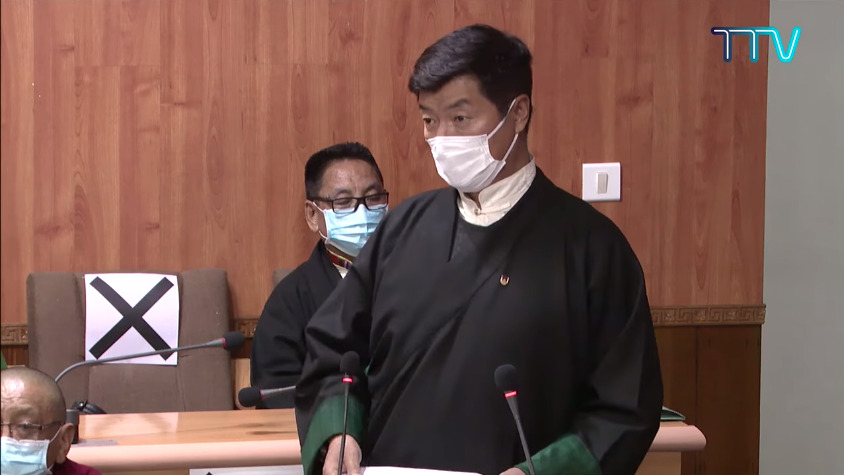
Dharamshala: In Kashag’s clarification at the ongoing Budget session of the 16th Tibetan Parliament-in-Exile, Sikyong Dr Lobsang Sangay spoke extensively on the administration’s wide-ranging efforts over the two consecutive terms that have culminated in the passage of the Tibetan Policy and Support 2020, with the US taking an affirmed stance on issues concerning the reincarnation of His Holiness the Dalai Lama and of other Tibetan Buddhist leaders, China’s worsening repression of Tibetans inside Tibet, the acknowledgement of Sikyong-led Central Tibetan Administration, recognizing the key role of Tibetan plateau and multilateral efforts towards water security, as well as the expansion of funds in aid for the exile Tibetan community.
Sikyong emphatically noted that with the Act, the US government has strongly condemned the Chinese government’s unabated repression in Tibet and appointed a Special Coordinator for Tibet Issues to primarily lead US efforts to promote meaningful dialogue between the People’s Republic of China (PRC) and the representatives of His Holiness the Dala Lama on Tibetan autonomy.
In addition, the provision concerning an establishment of a US Consulate in Lhasa, Sikyong deemed, is a recognition of Tibet’s historically independent status. These interventions as he pointed out places Tibet in a unique position than other oppressed people such as East Turkestan.
Sikyong apprised the house of the Kashag’s tireless efforts in lobbying the Tibet issue, building momentum and overall, maintaining sound ties across party affiliations, while at the same time, mainstreaming Tibetan cause in the global media which has ultimately borne successful results in amassing global support for Tibet despite unprecedented challenges over these years.
Addressing the latest international developments concerning the improving prospects for Tibet, Sikyong briefed on the Quad Alliance which comprises four member countries, namely, the USA, India, Japan and Australia whose shared interest in defence and security represent the Indo-Pacific strategy. The Quad Alliance strives to bring together like-minded democratic nations to uphold the principles of democracy, promotion of peace, stability and prosperity in an increasingly interconnected region.
As other nations from the South-Asian region enter into the alliance, the cultural affinity of Buddhism considering the region’s large concentration of Buddhist countries facilitates raising of Tibet’s issue from a religious freedom perspective, Sikyong asserted.
Sikyong also spoke on recently held US-China bilateral talks in Alaska, where senior Biden administration officials held their first face-to-face meeting with Chinese counterparts to confront the growing strains. Speaking to the house floor, Sikyong said one of the fundamental disagreements between the two largest economies other than trade and coronavirus, was China’s actions in Tibet as well as Hong Kong and East Turkestan. In addition, he noted the multiple references to Tibet in the White House’s ‘Interim National Security Strategic Guidance’ report which invariably places Tibet as an important part of the Indo-pacific strategy.
The 10th session of the 16th Tibetan Parliament in Exile concludes on March 30.