“He was a humble, genuinely good human being, who put on no airs. From the first he was honest and truthful. I visited him several times after our initial encounter and was one of the last to visit him before he passed away. Because of my friendship for him and others here, I have a special place in my heart for the Czech people. The day after tomorrow, I hope to visit his office to pay my respects although he is no longer physically with us, just as I once visited the home in Patna of Rajendra Prasad, First President of India after he too passed away. As I told Havel’s widow and those who knew and admired him, the best tribute we can pay him is to carry on his activities in his spirit.
“I have come to participate once more in Forum 2000, which was founded by President Havel and led by Oldrich Cerny, who has also sadly passed away since I was last here. I have just met his widow and was impressed by the warm smile rather than grief with which she greeted me.
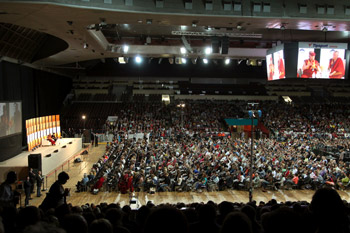
His Holiness began his public talk in his customary way:
“We are all basically the same, mentally, physically and emotionally. We all want a happy life and have a right to achieve it. We have the same emotions, some are destructive, some are positive. I don’t think of myself as anything special; I think of myself as one of you.”
He elaborated that as human beings we are social animals. Like other creatures, ants and bees, for example, our survival depends on the rest of our community. Today’s reality is that the whole world is interdependent. Problems like climate change affect us all, ignoring boundaries. Because of climate change natural disasters are likely to occur, also, natural resources will become scarce and the gap between rich and poor continues to increase. These are challenges we have to face thinking of humanity as one family and working together as one.
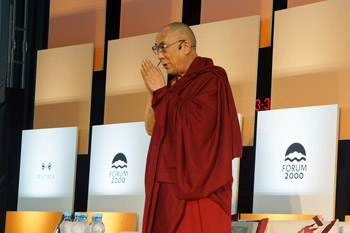
He remarked that women who beautify themselves with cosmetics remind him that while external beauty is one thing, inner beauty is much more important. When a beautiful face wears an angry expression, the beauty is lost. Meanwhile, peace of mind makes for a happy family and a community will be happier if the families within it are peaceful and compassionate.
Occasionally anger may be positive if the motivation is good. Likewise a courageous person needs a strong sense of self; self-confidence is positive. But an over-emphasis on self and selfish concerns doesn’t help, whereas having a compassionate heart is always helpful.
His Holiness suggested that we need a map of our emotions to understand how our emotions work. No one enjoys anger, but everyone appreciates affection. Because warm-heartedness is positive, we need to develop a sense emotional hygiene. The code of ethics that can lead to this needs to be secular ethics. He clarified that when he uses the word ‘secular’ he does so in an Indian context, meaning respect for all religious traditions without bias. The men who contributed to drafting pluralistic India’s secular constitution after Independence – Gandhi, Dr Ambedkar and Dr Rajendra Prasad for example – were all personally religious men. Secular ethics is what is appropriate for our secular education system.
His Holiness reiterated that the essential teaching of all religions is love and once you develop love and affection, you naturally become respectful of others. The key factor is education; education that involves warm-heartedness and takes account of human values.
“If you find any of what I have said interesting,” His Holiness concluded, “please think about it and discuss it with others. Musicians can sing about warm-heartedness. Film-makers, instead of depicting sex and violence, can educate people about the value of simple warm-heartedness and respect for each other. However, if you find what the Dalai Lama says is stale and unrealistic, please, just forget it.”
Among questions from the audience, the first concerned how we know the decisions we take are correct. His Holiness recommended looking at the question not just from one angle, but from many angles. He also said that the mind should be very clear and that unless you take account of reality, your decision will be unrealistic and will fail to bring a result. To another question about fear he replied that there are two kinds of fear: fear with a practical basis like fear of a mad dog and fear that is largely our mental projection.