The Globe and Mail – 28 December 2016
More than one price is being paid to change villages without paved roads, electricity or tap water to a place with Internet, cellphones and cash
The road to the Dalai Lama’s birthplace is perilous from the start. A giant cement truck careers around the corner that leads into the mountains south of Xining, the provincial centre in China’s western Qinghai province. From there, the route is an axle-busting jumble of dirt and potholes.
But the rough conditions aren’t a sign of neglect. They are the temporary inconveniences of a massive construction project. China is building a freeway here, and spending huge amounts of money to transform the area into a new tourist zone.
“Once they’re finished with the road, we should have more restaurants and hotels up there,” a local man walking past the construction says.
In Tibet and its neighbouring provinces, China is transforming a land of mountains and grassland into the world’s largest adventure playground.
Concern about tourists swarming holy places and snapping photos at sacred rites have been swept aside in favour of a swell of people climbing into the rarefied air of the Tibetan plateau.
They come by bicycle, motorcycle, train and plane, encouraged by a Chinese government that sees Tibet as its last unspoiled frontier.
In 2013, according to official statistics, 13 million tourists visited Tibet. By 2020, officials expect 35 million. Those numbers are inflated by Chinese statistical methods; the real number of travellers to Tibet is likely about a third as high. Whatever the real figure, though, it is enormous relative to Tibet’s population of just over three million.
By the end of this decade, tourism is expected to make up fully a quarter of Tibet’s economy.
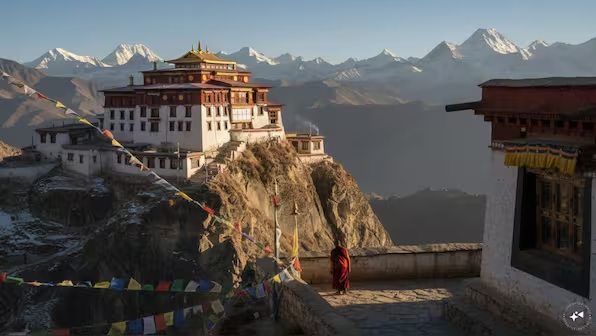
Once a theocratic kingdom, with stunning vistas and ancient temples that, to this day, give it great spiritual significance, Tibet is being remade into a Shangri-La-type destination.
In doing so, China is bringing in a flush of new wealth. Average incomes for Tibetans who join the tourism industry have risen at 15-per-cent rates, officials say. They argue, too, that a strong tourism sector supports the preservation of culture, rivers and mountains.
“This is the last sacred and clean land on earth,” Penpa Tashi, vice-chairman of the Tibet Autonomous Region, said in a quotation of President Xi Jinping. “Tibet is unique in its resources and has huge development potential. … We have the most vivid and lively landscapes.”
Tibet is “one of the best-preserved places on the Earth, in its nature and environment. Now we are developing ecofriendly tourism,” Wang Songping, deputy director of the Tibet Tourism Development Commission, says.
To locals, however, that development has left the views badly altered. The Globe and Mail was allowed into Tibet on a rare tour organized by China’s Foreign Ministry and driven from Lhasa to Bayi, a small city 400 kilometres to the east. Along much of the route, heavy equipment was blasting a path for a new freeway that will, by the end of next year, comfortably whisk tourists between the two centres.
The new asphalt and tunnels come at a cost of nearly $8-billion, but form only one element of a much broader project. Bayi itself, a millennia-old seat of religion, has been paved into the shape of a modern Chinese city, one of the few in Tibet without an urban monastery.
Seventy kilometres away, similar development has happened in Zhaxigang, once a village of 320 people nestled in a spectacular valley, with verdant slopes that descend to a small lake, all of it crowned by soaring peaks. The road here cuts through landscapes that evoke the moss-draped West Coast rainforest and treeless Rocky Mountain valleys. Yaks and horses still graze behind fences of hand-hewn lumber.
But today, the best views come from inside the floor-to-ceiling windows of a five-star hotel. It is the first of five to be built on land once occupied by part of the village, in a $300-million project to construct a new tourist haven. The money has come largely from investors outside Tibet, including property developer Evergrande, arms and real estate conglomerate China Poly Group and the government of distant Guangdong province. In the surrounding hills, much of the nascent restaurant and retail industry is operated by people who have come from far away, few of them Tibetan.
“Tibetans will have shops to sell small things, like biscuits or sweet tea,” Tu Hong, an official with the local government’s foreign affairs department, said.
Moments later, she takes journalists into one of the new hotels, where a freshly installed prayer wheel breaks when it is touched.
More serious cultural indignities have happened elsewhere, with tourists running around sacred mountains and snapping photos of sky burials, the Tibetan funerary rituals where bodies are cloven and consumed by birds.
“There’s no doubt that people do feel their personal space and their sacred space is being violated,” Gabriel Lafitte, a former journalist who has written on tourism in Tibet, said. Though Tibetans often hold hope that tourists will gain a better understanding of their culture, the sheer number of people descending upon Tibet is also “quite overwhelming, there is no doubt about it,” he said.
For Tibetans, the tide of outsiders is a mixed blessing, coming as the latest grand plan by a country that has used development to “tame” Tibet, according to Emily Yeh, a geography professor at the University of Colorado at Boulder.