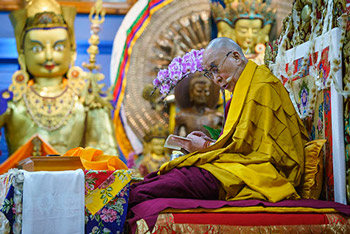
Thekchen Chöling, Dharamsala, HP, India, 6 October 2016 – His Holiness the Dalai Lama began the final day of his current series of teachings this morning by observing that Bodhisattvas are referred to as children of the Conquerors. He said the Buddha had attained enlightenment as a result of developing the awakening mind of bodhichitta, the altruistic aspiration to enlightenment, many times in the course of his previous lives. When the Buddha gave the Perfection of Wisdom teachings, the main disciples were Bodhisattvas who cherish others more dearly than themselves. His Holiness was briefly silent as he reflected on these qualities.
“Although we cannot compare to true Bodhisattvas, we follow their example and engage in the Bodhisattva practices. As the ‘400 Verses’ say:
190.
First prevent the demeritorious,
Next prevent [ideas of a coarse] self;
Later prevent views of all kinds.
Whoever knows of this is wise.
“The demeritorious here refers to unwholesome deeds, deeds that give rise to suffering. To behave in a non-virtuous way but to say we are following the practices of Bodhisattvas would be hypocritical. So the first step is to refrain from unwholesome actions, the next is to put an end to the misconception of self and third is to prevent all kinds of wrong views.
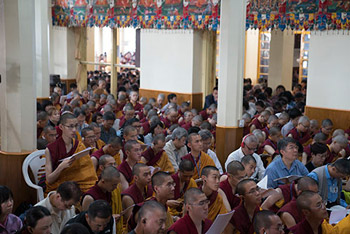
He went on to say that this kind of use of the subtler mind is not taught in the sutra vehicle, it is an instruction from tantrayana. He said a yet subtler state of mind manifests, as he mentioned the day before yesterday, at the time of death. In addition to coarse, subtle and subtlest states of mind there are different levels of energy that support them. Noting that we all have a subtle clear light mind within us, His Holiness stated that the subtlest mind and subtlest energy provide the causes for the Buddha’s mind and body. He repeated that while emptiness is explained in the sutras, the subtlest mind that realises it is explained in the tantras. His final remarks were that it is helpful to keep in mind the route of the path we are taking when we engage in practice.
Turning once more to ‘Aryadeva’s 400 Verses on the Middle Way’, he read steadily through the remaining half of the text: Chapter 9 – Refuting Permanent Functional Phenomena, Chapter 10 – Refuting Misconceptions of the Self, Chapter 11 – Refuting Truly Existent Time, Chapter 12 – Refuting Wrong Views, Chapter 13 – Refuting Truly Existent Sense Organs and Objects, Chapter 14 – Refuting Extreme Conceptions, Chapter 15 – Refuting Truly Existent Characteristics and finally Chapter 16 – Refuting Remaining Counter Arguments.
From the colophon His Holiness read that the book was translated into Tibetan in the Kashmiri city of Anupamapura by the Indian abbot Suksmajana and the Tibetan translator Ba-tsap Nyi-ma-drak. He then read a few lines from Chandrakirti’s commentary with which he had opened the teaching.
Recalling that he has earlier taught Nagarjuna’s ‘Letter to a Friend’ and ‘Fundamental Wisdom’ at the request of the same Taiwanese group, His Holiness expressed appreciation of the effort they have exerted in journeying to Dharamsala to listen to the teachings. He told them that the important thing is to practise, to bring about a transformation within. Laughing he said he had fulfilled his part by teaching the text, putting what they had learned into effect was now their responsibility.