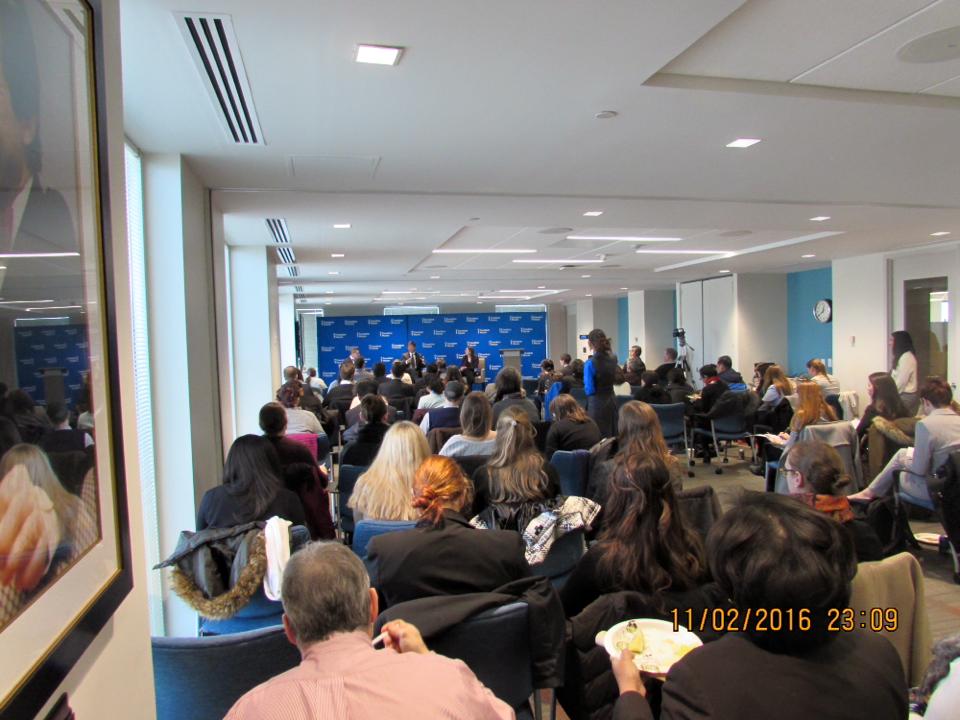

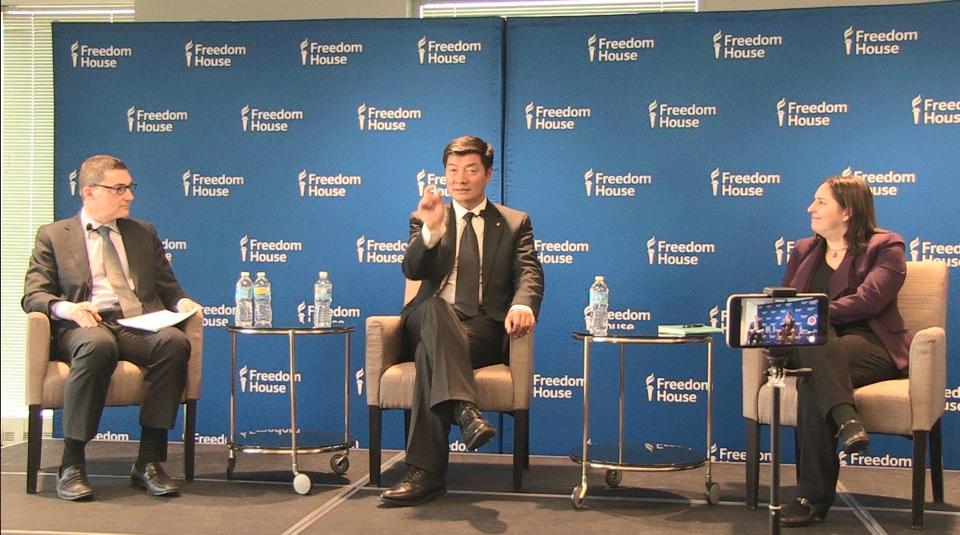
DHARAMSHALA: Sikyong Dr Lobsang Sangay spoke on the topic ‘Tibet: Intensified Crackdown, Popular Resistance’ at an interactive event organised by Freedom House at Washington DC on Thursday, 11 February. Freedom House is an organisation based in the US, dedicated to the expansion of freedom and democracy around the world.
In his address, Sikyong spoke about the critical situation prevailing inside Tibet, explaining in detail the non-violent resistance of the Tibetan people inside Tibet to the intensified crackdowns imposed by the Chinese government.
He said: “Tibet is under occupation. There is economic marginalization, social discrimination, political repression, environmental destruction and cultural assimilation. There is also an ongoing urbanization drive of traditional Tibetan areas under the guise of development which is leading to mass migration of ethnic Chinese people into Tibet.”
Speaking on that note, Sikyong explained that the mass migration of ethnic Chinese into Tibet has overwhelmed both the local population as well as its resources. “Currently in Tibet, almost 75% of the businesses are owned by Chinese businessmen. These businessmen in turn employ mostly Chinese workers and staff, creating a vicious cycle which induces more migration into Tibet leading to Tibetans becoming a minority in their own land,” Sikyong said.
Sikyong also spoke about the high-tech surveillance system, officially known as the grid system of social management, used by Chinese authorities to monitor the activities of the Tibetan people. “Tibetans are forced to carry a card when they travel. The card, which looks like an ordinary identity card, is inserted with a second generation micro chip containing details of the person and their biometrics. When the card is swiped, authorities would know exactly where the particular Tibetan is from and his biography,” SIkyong said.
“One of the main aim of the card is to make it easier for officials to monitor the activities of the Tibetan people which helps identify potential protesters by using intelligence gathered by community workers within areas known as grids (wangge in Mandarin),” Sikyong added.
Sikyong further spoke about the Chinese government’s enforcement of an order banning the display of His Holiness the Dalai Lama’s photographs inside Tibet. “Until recently, photographs of His Holiness the Dalai Lama are banned only in the so called Tibet Autonomous Region. Now, according to reports, they have banned the display of His Holiness the Dalai Lama’s photos even outside TAR,” Sikyong explained, calling it a fresh attempt by the authorities to suppress Tibetan people’s faith and devotion towards His Holiness the Dalai Lama.
Speaking on the Middle Way Approach, Sikyong explained that the Middle Way Approach is the official policy of the Central Tibetan Administration to resolve the issue of Tibet based on dialogue with the Chinese. “The Middle Way Approach seeks genuine autonomy for the Tibetan people within the framework of the Chinese constitution. It straddles a middle path which categorically rejects the present repressive condition while at the same time not seeking complete separation from the PRC,” he said.
Sikyong also spoke about the Sino-Tibetan conferences that he has organised during his days at Harvard University and the growing interest and support for Tibet from within the Chinese public, especially among intellectuals.
The event was attended by journalists, social workers, researchers and freedom and human rights activists.