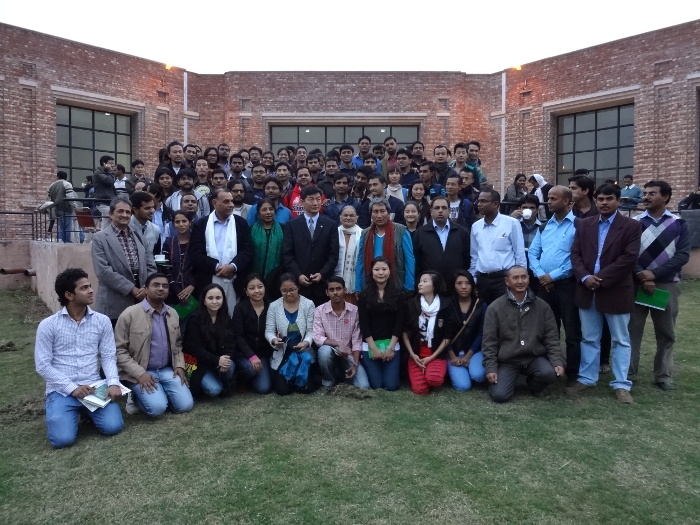

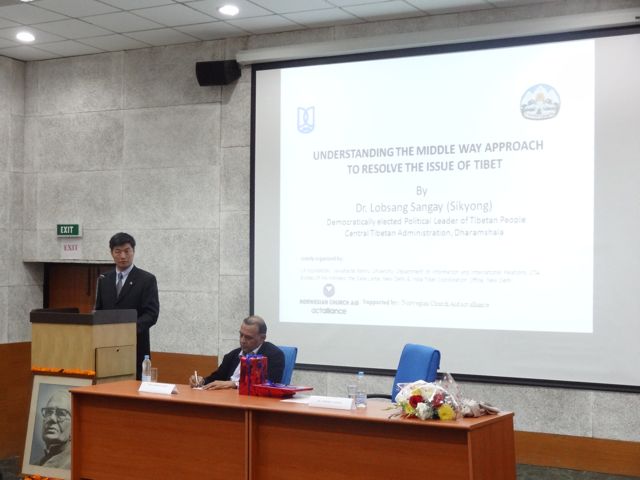
NEW DELHI: Sikyong Dr. Lobsang Sangay, democratically elected political Leader of the Tibetan People, gave a lecture on the Middle Way Policy of the Central Tibetan Administration (CTA) as a solution to the Tibet Question at the Cenvention Centre of the Jawaharlal Nehru University (JNU), New Delhi. The talk was jointly organized by J.P. Foundation of JNU, the Department of Information and International Relations of CTA, Bureau of His Holiness the Dalai Lama, New Delhi and India-Tibet Coordination Office.
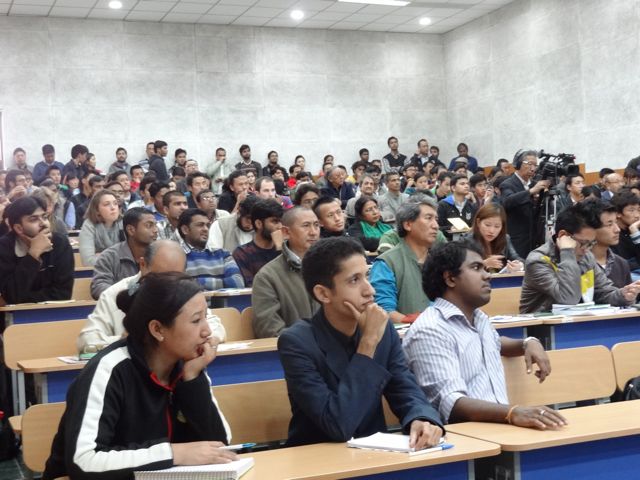
The talk was attended by the students and faculty members of JNU as well as people from outside JNU. Professor Anand Kumar, School of Social Science, JNU chaired the session. Sikyong Dr. Lobsang Sangay once again highlighted the need of the international community to address the Tibet question and called it as the ‘litmus test’ for the international community which reacted so proactively during the Arab spring. He mentioned the 2011 Time magazine report which mentioned that Tibetan self-immolations were among the least reported issues of the world.
He started his speech with the self-immolations in Tibet saying 86 people have self-immolated inside Tibet since 2009 as a last form of protest available to them.
He said, “unfortunately, from the Chinese government side, they have resorted to the usual blame game”, as the Chinese authorities continued to blame the Tibetan administration and His Holiness the Dalai Lama rather than address the causes behind the self-immolations. Then he highlighted the factors behind the self-immolations in Tibet, blaming “continuing occupation of Tibet, political repression, economic marganization, environmental destruction, cultural assimilation and denial of religious freedom” as the main reasons which forced Tibetans to take such drastic steps. He talked about the two aspirations of the Tibetans, the return of His Holiness the Dalai Lama and freedom for Tibetans.
Dr Sangay reminded India again why it is in India’s interest to seek a solution for the Tibet issue. Tibet as a buffer state, will help ease tensions along the Himalayan border. He called India as a steadfast friend which has stood by the Tibetan people in their hour of need. He cited the growing Chinese influence in South Asia which could pose a problem for India. He also touched upon the environmental impact of Chinese activities in Tibet which will further affect South Asian nations as the Tibetan plateau is the origin of some of the most important rivers in the continent.
Sikyong also commented upon the irony of China’s ‘peaceful’ rise as a Superpower as the events in South China Sea and Senkaku Islands/ Diaoyudao Islands suggest otherwise.
He concluded by saying that “the foundation of any movement is its people and the Tibetan cause will be determined by the Tibetan spirit, Tibetan sense of solidarity and Tibetan sense of determination which has never been as strong as now”. Dr Lobsang Sangay then answered questions from the audience who listened to his speech with complete attention. Professor Anand Kumar concluded the session by saying that “we are held guilty by our own past, our own tradition by keeping a very passive attitude about Tibetan question. We have to speak up”.
After the lecture, a short film titled “The Middle Way Policy to Solve the Issue of Tibet” was screened.