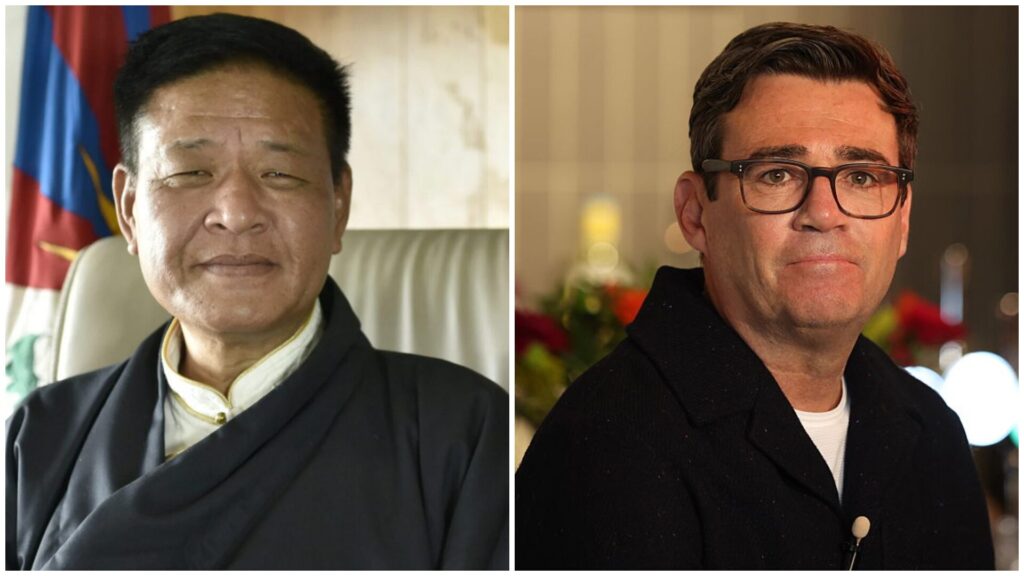
New Delhi, November 30th: Sikyong, Dr. Lobsang Sangay, the democratically elected political leader of the Central Tibetan Administration based in Dharamsala, delivered the prestigious Sixth Dr. K. R. Narayanan Memorial Lecture at Jamia Millia Islamia on the theme ‘Democracy in Exile: The Case of Tibet’.
In his introductory address, Mr. Najeeb Jung, Vice-Chancellor, Jamia Millia Islamia, highlighted the case of Tibet as being that of ‘a special and unique people’ forced out of their homeland. In particular, he was highly appreciative of His Holiness the Dalai Lama and spoke of him as an evolved soul.
Dr. Lobsang Sangay began his talk by attributing the success of the Tibetan democratic experiment in exile to Indian values and traditions. He reminded that Tibet owed its religion to India and owing to its proximity to India physically and spiritually, the Tibetan struggle has conformed to the tenets of ahimsa, dialogue and reconciliation.
He stated that Tibetan democracy, above all, owed itself to the vision of His Holiness the Dalai Lama. He explained that it was on September 2nd 1960 that the first Tibetan parliament came into existence and women found representation in electoral politics in 1963. Dr. Sangay mentioned that in an unprecedented move, the Dalai Lama even introduced a provision in the Constitution that allowed his impeachment by the parliament. In 2000, further reforms made it possible to transfer all executive powers from the Dalai Lama to a political head. Taking the process forward to its logical conclusion, in 2011, the Dalai Lama fully devolved his responsibilities to the elected Tibetan leader (Sikyong).
While efforts at democratisation are apace, as also attempts to seek a negotiated solution to the Tibet issue with the Chinese government, he lamented about the spate of self-immolations that had gripped Tibet since 2009. Around 89 people have immolated themselves so far. He called the situation in Tibet “grim and tragic”. Dr. Sangay voiced amazement at the Chinese reaction that blames the Tibetan leaders in exile for these acts of protest. He suggested that a more appropriate approach would have been to ask “what is forcing the people to take such an extreme step in the first place”. Socio-economic discrimination, political and cultural repression, and lack of freedom of speech and expression were held responsible for the persistence of dissent in Tibet.
Dr. Sangay further spoke at length about the importance of Tibet’s water and ecology, and how they are vital not just to India but to the environmental sustainability of the world. Continued destruction of the natural resources, mindless expansion in the name of development and extensive militarization will only add to global climate worries, he said. He then put forth a very pertinent question at the very core of the development discourse: development for whom?
Dr. Sangay also shared his experience at campaigning for the current position which he recalls as being tumultuous. He calls himself a ‘default’ candidate and shared how his well wishers had even asked him to prepare an honourable exit strategy because they believed that there was no way he would win the elections. Nevertheless, he did contest and won in an unprecedented democratic election in 2011.
It must be mentioned that Dr. Sangay left the audience spellbound with his sense of duty and dedication when he spoke about how he gave up his rather lucrative career at Harvard to work for the Tibet cause even if it meant drawing a meagre salary and travelling second class.
In his concluding remarks he was rather optimistic and added that Tibet’s day of reckoning is not far. The desire to be free, to breath the air of freedom will live on.
The lecture was attended by the senior functionaries of the University, faculties, students and officials from the Central Tibetan Administration.