
Response to Chinese allegationCheated by headlineBy Dhundup Gyalpo[Wednesday, 22 September 2010]
They say,
on average, 8 out of 10 people read headlines, but only 2 out of 10
read the rest. Others say headline is read by five times as many people
who read the entire content. If that is the case, then the copy editors
of Chinese propaganda have been hitting it bang on the head. Earlier
this month, China Tibet Online published an “unsigned” article supplied
by People’s Daily under an unceremonious title of “Religious
Dictatorship of Dalai clique”. Had you clicked on that, to your great
surprise and chagrin, you would have found the actual content to be
entirely a different story altogether. In fact, there was absolutely no
mention of “religious dictatorship”, nor was there anything that could
be seen as directly relevant to the headline. Sounds like the
proverbial case of “hanging sheep’s head to sell dog meat”. “Headlines
in newspapers and magazines were once written with readers in mind, to
be clever or catchy or evocative. Now headlines are just there to get
the search engines to notice,” writes David Carr of The New York Times.
He also gave some interesting examples of how using hot terms can bring
a headline to the top of the heap in online searches. However, the
gurus of headline writing skills still maintain that the headline is
essentially a promise (to readers) that must be delivered in the
ensuing content, if not for anything else than at least for the sake of
one’s own credibility. But, try telling that to the official Chinese
media!? The People’s Daily article in reality turned out to
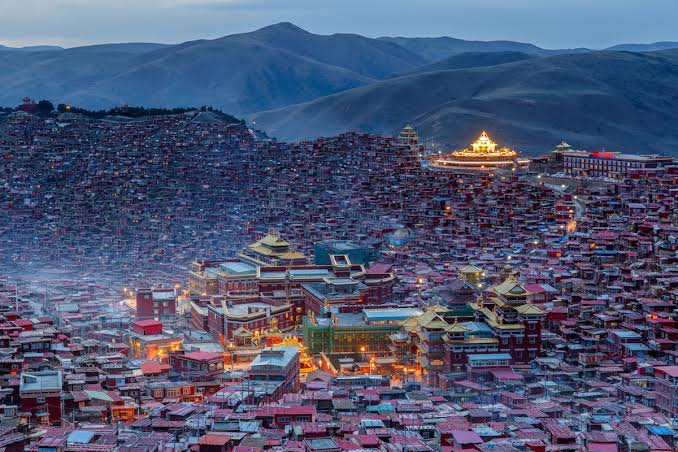
be a standard Chinese propaganda on “democratic management committees”
that are today the virtual lords and masters in Tibetan monasteries.
Quoting Du Qinglin, deputy chairman of the Standing Committee of the
CPPCC and director of the United Front Work Department of CPC Central
Committee, the article claims that the introduction of “democratic
management system” has paved a solid foundation for the modernization
of monasteries and development of Tibetan Buddhism. It is
no brainer that in Chinese jargon “democratic management” is a
euphemistic expression for “control by Chinese Communist Party”. Even
Du Qingling himself had in the past revealed that only those “monks and
nuns who are politically reliable, learned and respected should be
selected to monastery management committees.” DMCs are
thus composed of government-approved, “patriotic” monks and, in some
cases, even party cadres and government officials, who exercise strict
control and surveillance over the administrative and religious life of
the monastery, including enforcement of state indoctrination campaigns
like “patriotic education” sessions during which monks and nuns are
forced to pledge their obeisance and total submission to the CCP,
mainly by slandering His Holiness the Dalai Lama and recognizing the
Chinese-appointed Panchen Lama. Those who refuse to comply are either
expelled from the monastery or in certain cases even thrown behind
bars. No wonder a young monk from Tibet was reportedly
quoted as saying that the so-called democratic management committee has
“hijacked the monastery to serve their own purpose of making a lot of
money from tourists and carrying out propaganda work.” [Read more in When the Sky Fell to Earth: The New Crackdown on Buddhism in Tibet] For
the handlers of Chinese propaganda, it is not an exception but the
standard rule to manufacture rosy narratives by completely whitewashing
or denying the ugly truth behind the facts. The article therefore again
brought home the sheer futility of entertaining any expectation of even
a modicum amount of fairness or objectivity from the official media,
which is, to begin with, a through and through CCP organ. Particularly,
when it comes to political issues in general and the Tibet issue in
particular (which is increasingly portrayed as one of China’s
sacrosanct, non-negotiable, core issues) the official media absolutely
has no option but to be scrupulously dogmatic in sticking to the party
line. As a result, the state-run Chinese media outlets are
afflicted with an uncanny knack for self-delusion and psychotic denial
of obvious facts, largely through harebrained logic and inconsistent
arguments that often run contrary to the rhetoric of their own
propaganda. For example, take another piece published by China Tibet
Online, “Article unveils Dalai Lama’s double tricks on Independence of
Tibet and violence”, which took strong exceptions to His Holiness the
Dalai Lama’s comments during an interview to NDTV news channel. When
asked if the majority opinion within the Tibetan community changes
(from the Middle-Way Approach to independence), will His Holiness be
willing to change his position, His Holiness replied by saying that he
would “have to” as he is not a dictator. Although His
Holiness’s views would have been quite normal and natural in a
democratic society, China Tibet Online lambasted his comments by crying
wolf again, claiming the “change of Dalai’s position has caused great
concern among quite a few international media because it articulates
that he will switch his precious stand to independence of Tibet and
violence.” Well, hold on a second. If we take that
assertion at face value, it clearly implies a categorical
acknowledgement on their part that His Holiness the Dalai Lama at
present is not seeking independence, but a middle-way solution that can
be arranged within the constitutional framework of PRC. Furthermore,
one hardly needs a reminder that China offers a worst-case scenario for
press freedom and free speech. For more than a decade now, China has
been the world’s number one jailor of journalists. Similarly, in their
Worldwide Press Freedom Index 2009, Reporters Without Borders ranked
China 168th (or 8th from bottom) in terms of press freedom. In
a ridiculous twist of irony, it is none but China itself that has been
scowling and howling against the alleged biases in the Western media,
particularly on the Tibet issue. The jury however is still out on
whether the Western media has been guilty of biased coverage. Even
though the Western media is not infallible, in terms of its overall
standard of accuracy, fairness and objectivity, there is still no case
for a fitting comparison between Western and (official) Chinese media. Most
important of all, the Chinese idea of “fairness” apparently lies in
their having others saying what they want them to say. Whereas, in
actuality, “fairness” lies in being free to say something different,
whether in agreement or dissent. This is exactly the reason why China,
in light of the abysmal state of its own domestic media, totally lacks
the moral authority to be pointing fingers at foreign media. As they
say, people who live in glass houses should not be throwing stones.-The
views expressed in this piece are those of the author and do not
necessarily reflect the opinion of the Central Tibetan Administration