
Prominent Chinese Writer Receives Light of Truth Award from His Holiness the Dalai LamaWednesday, 8 October 2009, 10:24 a.m.
 |
| Julia V. Taft, then the U.S. special coordinator for Tibet, with His Holiness the Dalai Lama in 2000/AFP |
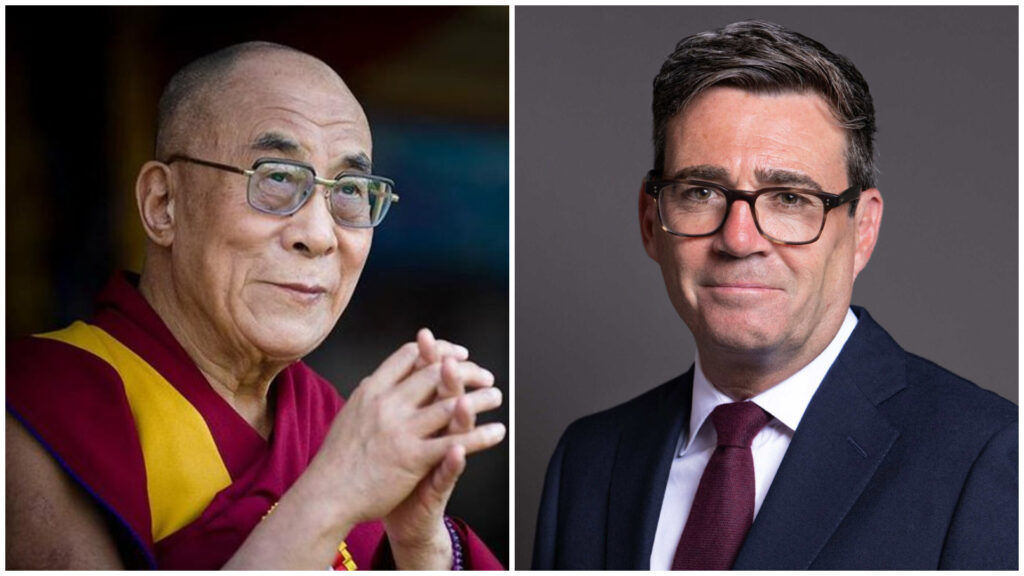
Washington, DC: His Holiness the Dalai Lama on Wednesday presented the 2009 Light of Truth Award to Beijing-based Chinese writer Wang Lixiong, who said in his acceptance speech that “fake propaganda and information blackouts by the totalitarian power is the major long-term impediment to resolve the issue of Tibet”. Wang Lixiong accepted the award on behalf of a remarkable group of Chinese who, at great personal risk, wrote the “Twelve Suggestions for Dealing with the Tibetan Situation” following the peaceful protests in Tibet last year.The International Campaign for Tibet (ICT) also conferred the Light of Truth Award posthumously upon late Julia Taft, a great humanitarian and true friend of Tibet, at a ceremony attended by a galaxy of luminaries at Sidney Harman Hall in Washington DC.The event began with a private lunch with the two recipients of the award, the Taft family representing the late Julia Taft, Assistant Secretary of State and Special Coordinator for Tibetan Issues, and Chinese writer Wang Lixiong, representing the more than 300 signatories of the petition to the Chinese Government in 2008 in the wake of the crackdown on Tibetan demonstrators, and other guests and supporters of Tibet.Earlier in the morning, His Holiness held a closed-door meeting with a group of Chinese and Chinese American scholars. Thereafter, he gave some private audiences in his hotel before departing for the Sidney Harman Center for the Arts, the venue of the International Campaign for Tibet’s Light of Truth award event.Following the lunch, His Holiness proceeded to Sidney Harman Hall for the award ceremony. The program began with a welcome remark by the International Campaign for Tibet’s Vice President Mary Beth Markey. She said, “This is an extraordinary time for Tibet. What happened since the demonstrations began in March 2008 has raised the stakes for each of us who hold the conviction that Tibet matters, and it must raise the stakes for our political leaders in how Tibet is counted within the U.S.-Chinese relationship.”“Tibetan solidarity is stronger than ever, despite determined Chinese government suppression. As the Tibetan poet and essayist, Woeser, has written from Beijing: “Tibetans living under the Chinese political system are breaking through the silence, and there are more and more instances of these voices being bravely raised, and this is encouraging ever more Tibetans.” There are Chinese, too, who are raising their voices for Tibet, and we are privileged to have many of them with us this afternoon.”“From among the strongest voices for tolerance, compassion and human dignity, the Board of Directors of the International Campaign for Tibet has chosen the 2009 Light of Truth Award recipients.”ICT’s Chairman of the Board Richard Gere gave brief welcome remarks.Former US Special Coordinator Paula Dobriansky next spoke to introduce the late Julia Taft, on of the recipients of the award. She spoke of her dedication and how she accepted challenges, including making the arduous trip to Dharamsala in India. Dobriansky said Julia had lots of interests in her life. The award for Julia Taft was received by her husband, William H. Taft IV.Ambassador Winston Lord, who served as the United States Ambassador to China from November 1985 to April 1989, got up to introduce Chinese writer Wang Lixiong.
 |
| His Holiness the Dalai Lama speaks at the 2009 Light of Truth Awards/AFP |
In his remarks, Ambassador Lord said, “I am deeply honored and moved to take part in this assembly. It is always inspiring to be in the presence of a luminary who personifies the destiny of the Tibetan people and the design for a more humane world – His Holiness, the Dalai Lama.“To join in the tribute to Julia Taft who championed similar causes is both melancholy and uplifting. As a colleague on the issues of Tibet and refugees, I witnessed firsthand her gusto and grit, sense of justice and sense of humor.“Introducing Wang Lixiong ignites passion and compassion. He will accept the Light of Truth Award on behalf of 330 brave, mostly Han, Chinese citizens. For decades the Chinese government has sought to keep the world and its own people in the dark about Tibet. The more the Dalai Lama offers a middle way of peace and reconciliation, the more Beijing has vilified him and successfully bullied other governments. Especially pernicious is its campaign to incite Chinese youth and breed nationalistic hostility toward Tibetans. “Thus what crowning valor and significance it is for Wang Lixiong and these eminent writers, scholars and artists to shed the light of truth on Tibet, as they did in their March 2008 petition. In this remarkable document they advocate non-violence and peaceful concord in Tibet. They attack official censorship and propaganda. They unmask those who hide behind “national unity.” They urge dialogue between Chinese leaders and the Dalai Lama. They call on Beijing to make fundamental changes in nationality policies and to “display a style of government that conforms to the standards of modern civilization.”“Ever since last March these intrepid individuals continue to seek to bridge the divide between Han and Tibetans with words and deeds. In so doing they risk their careers, their very freedom.“Wang Lixiong, a distinguished author and scholar, symbolizes the quest for inter-ethnic harmony through his marriage to Woeser, the world’s best known contemporary Tibetan writer. Like so many who question authority, she cannot travel to join us today. This daunting couple has been indefatigable in highlighting the plight of Tibetans and revealing the way to a brighter future. Even more impressive than the breadth of their writings is the depth of their courage.“This award is presented in a year replete with resonating anniversaries in China: Sixty years since the founding of the People’s Republic of China, fifty years since the Dalai Lama was forced to flee his land, thirty years since the establishment of Sino-American diplomatic relations and twenty years since the Tiananmen Square massacre.“Those whom we honor today, and countless others, are striving to fashion happier anniversaries in the future.“Let us hope that:“The Chinese government, which has done so much to lift the prosperity of its people, will one day also lift the horizons of freedom.• The Dalai Lama may return to his home and Tibetans and all Chinese live in harmony.• The Sino-American relationship, which I continue to promote, will be anchored not only on shared interests but shared values.• And the official verdict concerning June 4, 1989 will be overturned so that “hooligans” will become heroes and “black hands” will become harbingers of history.“It is my distinct privilege to introduce true heroes and harbingers of history, Wang Lixiong and his fellow recipients of the Light of Truth Award.”Wang Lixiong then received the award from His Holiness the Dalai Lama. In his acceptance speech, Wang said:“Your Holiness the Dalai Lama; honorable Ladies and Gentlemen.“We are very grateful to ICT for bestowing this group of us with the Light of Truth Award.“At this moment of honor, I remain deeply worried for Mr. Liu Xiaobo who participated in the drafting of “Twelve suggestions for dealing with the Tibetan situation,” and who at this time is being held in a prison in China for the crime of “incitement to subvert state power”.“I must also add that there are 308 public signatories; the volunteers who were responsible for collecting the signatures were threatened by police, they were hounded out of their jobs, and their email accounts were attacked by hackers, leading to the ruin of an un-counted number of signatories. And so there was no way of collecting the names of later signatories. Even though we will never know their names, they should be included among those receiving this award today.“Most of the 308 signatories are from the Chinese mainland, along with overseas Chinese and people from other countries. Most of them are Han, although there are people of other ethnicities; and there are many intellectuals but also workers, farmers, scholars and urbanites. If such a diverse group of people were to be epitomized by a single common feature, it would be “of the people”.“This group of people is in no way what the Chinese police or the Great-Han nationalists profess us to be: anti-China. The opposite: we dearly love China. But loving China does not amount to loving the government. Daring to criticize the government is done for the good of China, but a government that cannot accept criticism can only bring harm to China. “Neither is this group what some critics have accused us being: standing on the side of Tibet. Our position did not arise from choosing camps, it arose from a pursuit of the truth. Just as it is unthinkable that a ship sailing the ocean through the black of night would not seek a beacon of light, so the truth is a light in the darkness for us. And the name of this award, “The Light of Truth”, conveys this meaning exactly.“The fake propaganda and information blackouts by the totalitarian power has made it difficult for the majority of the Chinese people to understand the truth about Tibet, and they have no way of knowing about the Dalai Lama’s Middle Way. This is the major long-term obstacle to resolving the Tibet Question. Removing this obstacle should be the mission of China’s intellectuals, for there is no greater knowledge than the truth.“The Tibetan uprising still hadn’t subsided when the turmoil in Urumchi rocked China once more. The ferocity of the conflict between Han and Uyghurs in Urumchi presents a most worrying prospect: that ethnic contradictions in China have now become inter-racial. This disastrous consequence is a creation of totalitarianism, and yet it could completely explode during a period of democratic transition. Totalitarianism uses suppression, whereas suppression is weakened by democracy. “This is an emphatic warning to us: we cannot rely solely on a change of systems to resolve ethnic problems, and we cannot assume that everything will be naturally resolved with the coming of democracy. If we cannot eradicate racial hatred beforehand and achieve peace among peoples, then even if the government changes and even if democracy arises, there will still be animosities between the people, and there will be the possibility of civil wars and massacres alike. “The racial hatred created by totalitarianism has perversely become a reason used by the totalitarians to reject democracy, one which is virulently supported by Great-Han nationalists. This logic of kidnapper and hostage living or dying together is a difficult obstacle to remove along the path to democracy.“Overcoming this difficulty requires promoting the start of dialog between the nationalities. It is only when people of all nationalities resolve hatred and realize unity that the totalitarians’ reason of ethnic conflict for rejecting democracy can be dismissed.“Such civic spaces referred to here need to have sufficient popular scale, with sufficient randomness and coverage, and they need to gain their legitimacy from the operation and expression of the mechanisms of democracy. There is a rare paradox in this: in order to guard against the disastrous consequences of totalitarianism which would manifest with the coming of democracy, democratic groupings and channels of communication first need to be founded under the totalitarian system. Although this is a great challenge to our bravery and our wisdom, all we can do is rise to meet it. For aside from this, there is no other way.“In the face of obstacles placed by totalitarian powers, channels of communication between nationalities within civic spaces will need to rely on new technologies such as the Internet; unprecedented democratic forms need to be discovered and greater organizational structures need to be created. And to this end, we are joining hands. The hardships will be many and there is a lot of work to do. Fortunately, in today’s era of globalization, such just undertakings can seek support from all over the world. Our gathering in this place today is a portrait of these wonderful times.“Thank you, Your Holiness, for your unrelenting search for common understanding with the Chinese people, and for your struggle to find a future where the Han and Tibetan peoples both win; and thank you all of you here for the support you have granted in the past, and for the support you will grant in the future.Speaker of the United States Congress, Nancy Pelosi, next made her remarks to introduce His Holiness the Dalai Lama.She said: “Thank you, Richard Gere, for your warm welcome and for your leadership on behalf of the people of Tibet as Chair of the International Campaign for Tibet. Congratulations to the Light of Truth Award winners: Wang Lixiong and the late Julia Taft. They exemplify leadership in the fight for the human rights and democratic freedom of the Tibetan people.“Today I am honored to be called upon to introduce His Holiness the Dalai Lama. Two years ago, in the Rotunda of the United States Capitol, President Bush and bipartisan leaders of Congress honored the Dalai Lama with the Congressional Gold Medal. In accepting, His Holiness brought luster to the award.“Yesterday, in the United States Capitol, His Holiness was honored with the inaugural Lantos Human Rights Prize. Inscribed on this medal are the stirring words of Tom Lantos: ‘The rights of one are the rights of all.’ Ensuring rights for all people is the life work of His Holiness.“American presidents and the American people have been inspired by His Holiness, who describes himself as a ‘simple monk, no more, no less.’ To Tibetan Buddhists, he is the earthly manifestation of the living Buddha. To them and the international community, he is the leader of the Tibetan people. To millions of believers and admirers, he is a source of wisdom and compassion. To young people, His Holiness is a positive example of how to make the world a better place.“The Tibetan culture, religion, environment, and people are a source of inspiration to people the world over. So too is His Holiness the Dalai Lama a source inspiration for all people.“It is an honor to be in His Holiness’s presence today. Please join me in welcoming His Holiness the Dalai Lama.” In his remarks, His Holiness joked that Speaker Nancy Pelosi had praised him so much that his feet were in the air. His Holiness said that he had been speaking out for women to take a more active role in society and recalled his discussions about this in Vancouver with former Irish President Mary Robinson and others recently when he was termed a feminist.His Holiness talked about his admiration of the late Julia Taft and Wang Lixiong. He also talked about his views of those individuals who supported the Tibetan issue. He said that he considered these people as being pro-justice rather than being pro-Tibet.Among the audience were several Chinese writers and activists, including some of the signatories of the Charter ’08. Following the event, His Holiness had a quick tour of the Laogai Museum, founded by Chinese human rights activist Harry Wu. The museum highlights the Chinese prison system, specifically that of the dreaded Gulag. Harry Wu received His Holiness and gave him a tour and also introduced him to the museum staff.Thereafter, His Holiness went to the United States Congress where he met with a group of new Members of Congress and later with more than a dozen members of the Senate Foreign Relations Committee.His Holiness returned to his hotel thereafter. On 8 and 9 October, His Holiness will be participating in the Mind & Life Conference at the Constitution Hall.Following are more information about the two recipients of ICT’s Light of Truth Awards for this year.Julia Taft1942 – 2008Julia Taft’s remarkable career began in the mid 1970’s when she began working intensely on humanitarian relief in countries devastated by war and natural disasters. In 1975, President Gerald Ford named her director of the Interagency Task Force on Indochina Refugees where Taft managed the resettlement of more than 130,000 evacuees from Cambodia, Laos and Vietnam after the fall of Saigon. From 1986 to 1989, Taft served as the director of the United States Office of Foreign Disaster Assistance. There she coordinated the relief efforts of the State Department and the Pentagon, as well as other government agencies and Private groups. The late Ken Bacon, President of Refugees International, who worked with Mrs. Taft in the Clinton administration, said that it was Taft’s, “…ability to bring order to chaos – plus her willingness to get on a plane, helicopter jeep or riverboat to go almost anywhere – that enabled her to make a difference”Taft was President of InterAction, an alliance of more than 150 nongovernmental organizations focused on international aid and development from 1994 to 1997. From 1997 to 2001, Julia served as the Assistant Secretary of State for Population, Refugees and Migration and from 2001 to 2004, as director of the United Nations Bureau for Crisis Prevention and Recover. In 2002, she led the U.N. task force for recover y efforts in Afghanistan. Among the many organizations Taft served during her career, she left a memorable and significant impact on the International Campaign for Tibet. In 1999, Taft was appointed Special Coordinator for Tibetan Issues where she played a crucial role promoting dialogue between the Dalai Lama and Chinese government. In 2002, Taft eagerly joined ICT’s Board of Directors and remained actively involved in strategy and the organizations advocacy efforts, particularly for Tibetan refugees, for the remainder of her career. Working with ICT, Julia made several trips to India and Nepal to meet with recent arrivals from Tibet and senior Tibetan government in exile officials. In October 2007, she met His Holiness the Dalai Lama during his visit to Washington, D.C. Former Secretary of State Colin Powell said of Julia that she, “was an image of American openness and generosity. Her professional life was committed to people trying to get by on a dollar a day, those who are hungry, with out clean water without medicine, without, homes.”Julia Taft’s extraordinary life of service and advocacy was sadly shortened when she passed away on March 15, 2008. Receiving the award today on her behalf is her husband , The Honorable William H. Taft IV———-2009 Light of Truth Award honoreesSigners of the “Twelve Suggestions for Dealing with the Tibetan Situation”Accepted by Wang LixiongWith the establishment of the People’s Republic of China in 1949, and the subsequent Chinese takeover of Tibet in 1959, the political relationship between the Tibetan and Chinese people experienced a never before strain and deterioration. The Tibetan issues became politicized at the popular level in the Chinese society and, as a result, a sensitive issue to raise. By the 1980’s, the Dalai Lama had established contact with the Chinese leadership resulting in a series of delegations to Tibet and China from Tibetans living in exile. From this, a new and hopeful era emerged for the Tibetan – Chinese relationship. Coinciding with a period of liberalization in China, these interactions and their development resulted in a change in the Chinese people’s image of Tibet and the Tibetans, including an increased appreciation of Tibetan culture, religion and medicine among Chinese in China.Since then, there has been a steady, increasing voice within the Chinese civil society, specifically at the intellectual level, calling for a change in the mindset of the Chinese government and the people on the Tibetan issues. Among those who have been raising their voices on issues relating to Tibetan civil and political rights, was a group of Chinese intellectuals and writers who had a farsighted vision to publicly voice their concerns by signing a petition recommending positive policy changes. In the midst of the ongoing pan-Tibetan demonstrations that took place in March of 2008, they generated “Twelve Suggestions for Dealing with the Tibetan Situation.” While all the suggestions were timely, important and well considered, suggestion Number 12 is one that can significantly contribute to reducing the current tension between the two communities as well as provide a lasting solution to the Tibetan problem. It says:12. We hold that we must eliminate animosity and bring about national reconciliation, not continue to increase divisions between nationalities. A country that wishes to avoid the partition of its territory must first avoid divisions among its nationalities. Therefore, we appeal to the leaders of our country to hold direct dialogue with the Dalai Lama. We hope that the Chinese and Tibetan people will do away with the misunderstandings between them, develop their interactions with each other, and achieve unity. Government departments as much as popular organizations and religious figures should make great efforts toward this goal.The initiative of this group of courageous Chinese individuals has had a strong impact on the psyche of the Tibetan people and also supports the Dalai Lama’s position of relying confidentially on the Chinese people for a lasting solution. The International Campaign for Tibet believes that public release of this petition was a significant step towards reestablishing a peaceful relationship between the Tibetan and Chinese people. ICT and His Holiness the Dalai Lama today recognize this undertaking as a monumental step towards unity and mutual cooperation between the Chinese and Tibetan peoples. Today we honor each individual who has contributed to its composition and partaken in its publication.Wang Lixiong is a Beijing based Chinese writer and intellectual who has been in the forefront in leading public discourse on Tibet in China. He has specially come to Washington, D.C. to receive this award on behalf of all the signatories.