dalailama.com
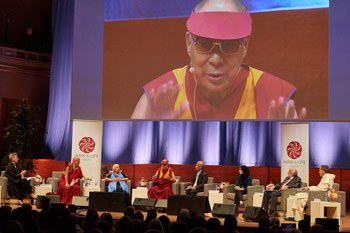
Brussels, Belgium, 10 September 2016 – People patiently and good-naturedly lined the corridors of the Brussels Bozar Centre for Fine Arts waiting to greet His Holiness the Dalai Lama as he arrived this morning for the second day of the Mind & Life conference. During the first day, presenters were mostly scientists. Today they came from more diverse fields. The panel that joined His Holiness in the Henry le Boeuf Hall this morning discussed Power & Care from the perspective of Spiritual and Religious traditions. Moderator Roshi Joan Halifax invited him to say a few words at the beginning.
“Among followers of spiritual and religious traditions we need to reach out and make contact with each other. This includes even those described as fundamentalists, because we are all equally human beings.”
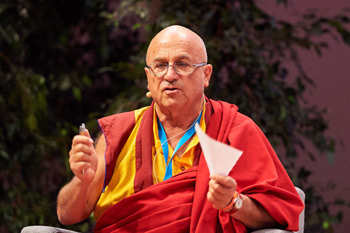
Ven Matthieu Ricard, a Buddhist monk, photographer and humanitarian declared that only when we have wisdom and compassion can we use power properly. He spoke of the Buddhist altruistic aspiration to achieve enlightenment to free others from suffering. This is a proper use of intelligence. He observed that upholding the power of truth and the conduct of non-violence are not, as often perceived, the stance of weakness, but of courage and strength. He concluded that we should use power to reduce suffering and ensure happiness.
Rabbi Awraham Soetendorp, founder of the Jacob Soetendorp Institute for Human Values, told the panel that we need each other to fulfil our common goals. He told His Holiness that he was right to point out the unity among humanity. He proposed establishing a council of conscience and invited His Holiness to be a founding member. Finally, he looked forward to a time when Jews and Muslims, Israelis and Palestinians, Tibetans and Chinese will love each other.
Alaa Murabit, founder of the Voice of Libyan Women, observed that usually power and care are mutually exclusive. She explained that she was not introduced to faith in a mosque, but by her mother who raised 11 children. She remarked her reluctance to refer to religious fundamentalists as if they were fundamentally of the faith, because most of them actually deviate from it. She said that the use of faith as a means of political control is something that needs to be honestly addressed.
Invited to add his comments, His Holiness recalled that since 1975 he has visited others’ places of worship in a spirit of pilgrimage. Recently in Ladakh in India he visited a Buddhist temple, a Sunni mosque and a Shia mosque as a gesture of friendship. He noted that in countries like India, Malaysia and Indonesia children grow up aware of the existence of other faiths, so they do not exhibit such a narrow attachment to their own. He expressed confidence that from consistent wholesome effort, good results will come.
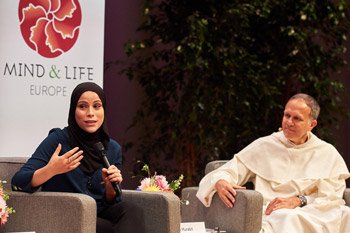
He confirmed his view that women should take more leadership roles, speculating that if more of the nearly 200 nations today were led by women, there really might be more peace in the world. To general acclaim he said, “We’ve had enough of male dominance.” Alaa Murabit took up the point saying masculinity and femininity need to be reassessed. She closed the morning session to loud applause recommending a challenge to structural inequality that would allow everyone equal opportunity, even on the basis of faith.
Economist Uwe Heuser, introduced the afternoon session that was to examine power and care from the perspective of economics and society. He pointed out that economics was originally the study of happiness. He said two economists who talk about changing the world and two activists who actively do it would make presentations.
In intermediate remarks His Holiness stated that he had no knowledge of economics other than an appreciation that it was important. In general he favours a socialist outlook, but has sympathy for Marx’s ideal of equal distribution. He regretted that in contemporary capitalist societies it appears the rich become richer, while the poor remain poor or become poorer still.
Prof Sir Paul Collier of the Blavatnik School of Government noted that economists are by and large deeply conservative, clinging to the model of 19th century physics without recognising that the science has moved on from classic mechanics to quantum physics. His Holiness contributed the notion that we are all interdependent, which is why we now have a global economy. Consequently, we need friends. We find friends where there is trust and trust arises from a concern for others’ well-being.
Sowa asserted that when values are distorted, women get no acknowledgment for what they do. When the international community looks to see where to invest, it routinely ignores the contribution of women. Consequently, she urged in measured tones the need to look at the world in a more equal way. The hall erupted in applause and the audience took to their feet. His Holiness hugged her as he told her how much he appreciated her presentation.
“We all have power which we choose to exercise or not,” she declared.
Finally, His Holiness outlined again his three commitments to promoting human happiness, fostering inter-religious harmony and working to preserve the peaceful culture and natural environment of Tibet. He said that whenever he can he makes these clear to members of the media because they have a responsibility to encourage positive human values and to report more than just what is shocking and negative. He repeated his confidence in our being able to improve education—as that is the real source of hope for the future. Only through education will the world’s population understand that individuals need to contribute to building a better, happier and more just world.
“Each of us has a responsibility to make change work,” he concluded, “please think about what contribution you can make.”