
Tenzinphende
The head of Tibet’s central administration warns against Beijing’s growing influence.
Paris Match. You have invited to Dharamsala a delegation of opponents from Congo-Brazzaville. Why?
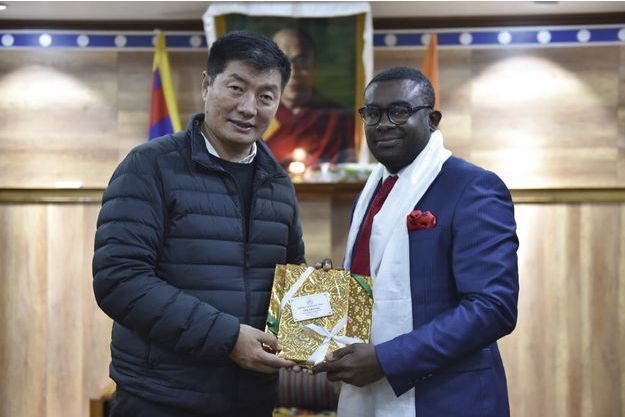
Lobsang Sangay. I met Andréa Ngombet at an international conference abroad. He never went to Dharamsala, so I was very happy to invite to the 29th anniversary of receiving the Nobel Peace Prize by His Holiness the Dalai Lama last December.
You share a common experience with these activists: forced exile. Are there other links between your struggle against China’s occupation of Tibet and what is happening on the African continent?
In February 2018, I was invited to lecture at the Stellenbosch School of Law in South Africa. The organizers have been under enormous pressure from the Chinese embassy, which has threatened to withdraw its investments in the country. In front of the university, a crowd waved signs “One China only” or “No doors open for Tibetan separatists”! This is a clear sign of China’s growing influence in African countries and especially in domestic affairs. China is already in Africa. And we, Tibetans, say to Africans: “What happens in Tibet will happen at home.” The occupation of Tibet is the prototype of the invasion of other countries.
“It is time to realize that the so-called “development programs” are paying a heavy price”
Do you think China supports authoritarian regimes? And that she can, in one way or another, take control of it?
China does not just support authoritarian regimes. It provides the resources necessary for these countries to assert their power. Many think tanks are increasingly worried about how China is providing some states, in Africa and elsewhere, with the very advanced surveillance technology it uses in its own territory. Moreover, the countries most heavily indebted to China may lose their sovereignty and prove unable to make decisions, even at home, without the approval of Beijing. It is time to realize that the so-called “development programs” are paying a heavy price. Some believe that the BRI [Belt and Road Initiative, a new silk road, Ed] is a simple infrastructure project. This is not the case!
White House National Security Advisor John Bolton recently said that Chinese investment projects in Africa were “full of corruption”. Do you see a parallel with the way China operates in other parts of the world?
Yes. China’s investment strategy in Africa, particularly the BIS project, is very similar to the way Tibet has been occupied. In the 1950s, Chinese leaders promised Tibetans a road connecting our two countries that would bring “peace and prosperity”. Once the road was built, Chinese troops arrived with arms and armor, and Tibet was occupied.
Some Asian countries, such as Japan or Malaysia, are trying to counter China’s influence in Africa. Do you have links with them?
The Japanese Parliament has one of the largest support groups in Tibet in the world. We also have close ties with our Taiwanese friends. But these ties are not based on an anti-Chinese sentiment, but rather anti-communist and pro-democracy.
Faced with the progress of China-Africa cooperation, Japan defends its vision
Burkina Faso is no longer in business with Taiwan
On May 24, 2018, Burkinabe Foreign Minister Alpha Barry announced the break of diplomatic relations with Taiwan, after twenty-four years of cooperation, to reconnect with Beijing. “Burkina Faso was automatically excluded from projects and programs that were partially or fully funded by the People’s Republic of China,” said the minister in an interview with “L’Observateur Paalga”. […] These relations with the island of Formosa were a blow for both ourselves and our neighbors. In July, China inaugurated with great pomp its embassy in Ouagadougou. Today, traders in the Burkinabe capital are mixed about the impact of this diplomatic change. Some are delighted, such as Mikael Sandwidi, General Manager of the Fasotech electronics brand. “I’ve been waiting for this for a long time! he said. We can not continue to deal with Taiwan while China is everywhere! This decision will also facilitate the administrative procedures of traders who want to go there. For other business people, anxiety dominates. “In some African countries,
the Chinese observe and analyze the markets, then they go home and get the goods cheaper than us in all areas, “says Christophe Yaméogo, director of an advertising agency. Like him, several traders are worried about Chinese competition in their sectors of activity. “If they see that the sale of patties in the street reports, worries one of them, they will not hesitate to do it! » Olympia de Maismont