
LIVES IN EXILEA saga of strangers in a strange landMarch
’09 marked 50 years of Tibetans in exile. It was in 1959 that 300
Tibetan refugees sought political asylum at Bylakuppe. Krishna Vattam
who visited the camp then, paints a picture of their lives.
 |
“I
imagined them as tragic figures symbolising all the agonies that were
inflicted upon their land of birth by an aggressive nation. I had
pictured them as a dejected lot, devoid of hope and ambition, having
succumbed to destiny. But this was not so. Although traces of misery
have not been wiped out completely and were discernible to the critical
eye, there was a glow of hope.”That was what I had observed on
a visit to the Tibetan Rehabilitation camp in Bylakuppe, fifty miles
from Mysore bordering Kushalanagar in Madikeri district, in 1960.It
was in March 1959, that the Dalai Lama with the concurrent uprisings in
Lhasa and Kham, fled from Lhasa, crossed the Himalayas and came to
India with about 80,000 refugees to seek political asylum. While a
majority of them remained in India, others went to Sikkim and Bhutan.
After a short spell of firm policy on their rehabilitation, the
Government of India decided to accord asylum to the Dalai Lama and this
was conveyed to the Chinese Ambassador also in April 1959.When the first batch arrivedThe
then prime minister Pandit Jawaharlal Nehru wrote to the state’s chief
minister of the time S Nijalingappa to take up necessary steps to
accommodate these refugees in the state and the first batch of 300 of
them landed in Mysore by train and were taken to Bylakuppe, where about
3000 acres of forest land , bordering Kodagu district was allotted .As
I read reports about the events the Tibetan community in India were
planning to mark the 50 years of their exile by organising meetings
in all settlements in the country to thank India, I was conjuring up in
my mind the sequence of events, right from the day they landed in
Mysore, their adapting to a new environment , their perseverance and
determination to shake off the despondency and live as a thriving
community of re-settlers.Settling inThe sweet strains
of their exotic music that I had heard on approaching their camp in the
early days of their habitation, still haunt me. It was a song they sang
as they cleared the jungle to reclaim the virgin land for cultivation
and living. The theme of the song was that “we live to work”.On
seeing us they laid down their pick-axes to greet us. It was a paradox
one could not have missed. A people originally from the icy climes of
Tibet now adapting to the warm weather of the Mysore region.However,
the climate of hospitality of the government and the people of the
country, especially of those living on the periphery of the camp, had
facilitated these people to acclimatise themselves. People who had not
seen pick-axes were handling them deftly , had begun to learn Kannada
and English. I had experienced a pleasant surprise to listen to the
young, chubby Tibetan children reciting numbers in Kannada.Each
family had been allotted five acres of land. The Tibetans had to adapt
to a change in food habits too. Their traditional food was one made of
barley powder. But the cultivation of barley was not feasible here; so
they substituted it with maize and wheat. They popularised maize
cultivation and their native neighbours followed suit.Change has come to BylakuppeThe
face of Bylakuppe , which is the second largest settlement in India,
the first being in Dharamsala in Himachal Pradesh, where the Dalai
Lama stays with about 20,000 of his men, has changed beyond recognition.The
settlement presents a perfect township, accommodating about 18,000
people, who have in a way graduated from the status of refugees to re
settlers. The town planning implemented in phases with infrastructural
facilities to house the schools, hospitals, banks, cooperatives and
shops, happily blends with the spiritual symbols ,which have
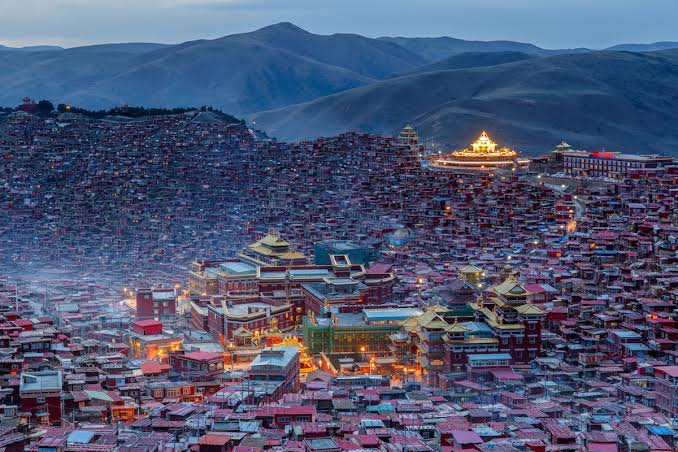
emotionally bound the settlement with its lost home.Bylakuppe
has also become a pilgrim centre with the location of the Buddhist
viharas. The prime attraction here has been Namdroling monastery. The
grand temple here has 60 foot tall statue of Buddha, flanked by his two
equally grand images, which are all covered with gold plates.The
sweet strains of music I had heard on my first visit to the camp fifty
years ago, have been replaced with chants of hymns in praise of
Buddha. Monks in their red robes (of 18,000 Tibetans in the two camps ,
there are 9,000 monks and nuns) go about the town and outside freely
mixing with the Indian neighbours speaking in chaste Kannada.Over
the years, the settlement has seen the birth of second and third
generation Tibetans in exile, brought up in an environment that has
helped them to retain their identity, preserve their culture, religion,
tradition and medicine. Most of the first generation of refugees have
faded away and the youth are all well educated, some of them graduates
and post graduates.With the settlement providing limited
employment opportunities, they have moved to various parts of the
country selling sweaters on roads.In the initial years, they
used to procure wool from outside, knit them locally and sell finished
products. They now purchase the sweaters in bulk from Ludhiana .Someday…According
to Tashi Wangdu, the present representative of the settlement,
Tibetans, barring a minority have not taken up Indian citizenship.
The hope I had observed five decades ago in the first generation of
settlers, I still see in the second and third generations of people, a
hope kept alive by the Dalai Lama, whose pictures continue to adorn the
walls of their houses. —The above article is reproduced from the online edition of Deccan Herald. This column is an open discussion forum for Tibet related issues and the views expressed here does not necessarily reflect those of the Central Tibetan Administration.