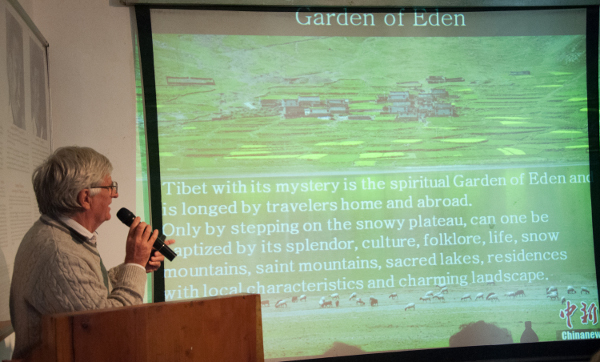
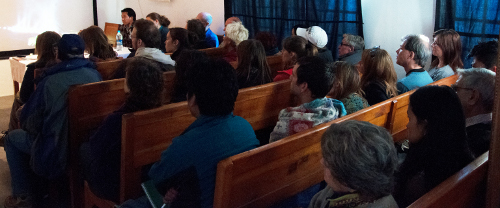
DHARAMSHALA: An audience of more than 50 foreigners and local Tibetans attended The Tibet Museum’s bi monthly Tibet Awareness Talk Series yesterday. Mr Claude Arpi, the guest speaker, gave a talk on the topic “Disney Land of Snow: Hijacking Tibet” at the Tibet Museum, in McleodGanj, Dharamsala.
Mr Calude Arpi is an author, historian, journalist, Tibetologist and director of Tibet Pavilion, Auroville, Puducherry. His presentation focused on the introduction games, activities and festivals in order to promote Lhasa, as well as the effects of tourism on Tibet’s environment and Lhasa Bakhor’s recent renovations.
“China is promoting Tibet to the tourists through innovative ideas such as a cycling tour called ‘Le Tour de Lhasa’, mountaineering, rock climbing and festivals such as the Walnut festival, the Peacock festival, etc. But in reality everything is designed in Chinese style, in order to assimilate and wipe out the rich traditional cultural of Tibet”, said Arpi.
He further mentioned that the Chinese recently started performing an opera about the Chinese princess Wen Chen (Kongjo) and the Chinese power over Tibet during King Songtsen Gampo. The opera is meant to divert and brainwash people into seeing Tibet as part of China.
Mr Arpi also addressed the effects of tourism on Tibet’s beautiful environment. Every year 15 million Han tourists visit “Tibet Autonomous Region” (“TAR”) and knowingly or unknowingly throw their waste at different places. Even pilgrimage sites as Mansarovar are being polluted.
According to Mr Arpi, the introduction of train and airport transportation in Lhasa and other parts of Tibet was intended to facilitate the migration of huge numbers of Han Chinese into Tibet, and thus reduce the Tibetans to a minority in their own country. Another purpose was to ensure that military reinforcement was easily accessible during upheavals. There are already five airports in “TAR” and soon one more to come at Nagchu, one of the main self-immolation sites. Further airports are planned for different other parts of Tibet.
Mr Arpi concluded his talk with a section dedicated to the recent renovations at Bakhor, Lhasa. More than one million signatures were gathered recently for a petition to UNESCO, asking for the preservation of Bakhor as a heritage site. In spite of this, the site is already being renovated. Mr Arpi reminded the audience of China’s re-election to the United Nation Human Rights Council, just a few days before the talk.
Mr Arpi’s conclusion was that all festivals, games and opera were mainly designed for economic benefits and public divertissement. But ultimately, they were meant to wipe out the Tibetan cultural and identity and divert the world’s attention away from current situation inside Tibet.
“Is this good for Tibet?” he asked the audience. The answer is obvious.