A saboteur poured salty water into the museum’s nine sockets and fuse box during renovations. A few dozen protesters gathered outside when it opened. Critics pestered visitors at the entrance.
It hasn’t been easy reopening a museum in Hong Kong dedicated to documenting China’s June 4, 1989, crackdown on pro-democracy protesters in Tiananmen Square, where its armed forces opened fire on student-led, pro-democracy protests — killing hundreds or maybe thousands of people in the center of Beijing.
The museum, on Mong Kok Road, is a reminder that Hong Kong — a refuge for protesters targeted in the wake of the crackdown — still holds onto many of its relative freedoms even as China pushes for an extradition law critics say is aimed at dissenters living in the semi-autonomous financial hub.
In 2016, it was forced to close in its previous location after a fallout with the building’s owners. The museum’s founders are betting that a brick-and-mortar monument will be harder to censor than history books and websites obstructed by what’s known as China’s Great Firewall, which can block online discourse and scrub sensitive historic events.
The ruling Communist Party forbids commemoration of Tiananmen on the mainland. In the run-up to Tuesday’s 30th anniversary, the government has removed social media posts on Weibo and WeChat about the events and blocked Wikipedia.
On Sunday, Defense Minister Wei Fenghe defended the army’s crackdown, telling a security forum in Singapore that it was the correct move and led to 30 years of stability in what is now the world’s second-largest economy.
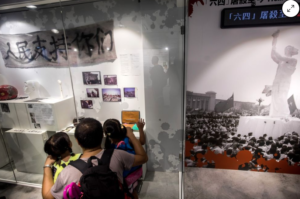
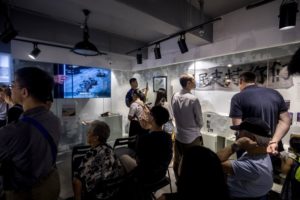
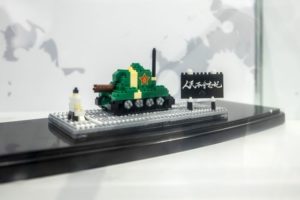
The refurbished museum features artifacts, mostly donated by victims’ families, including a motorcycle helmet replete with bullet holes. A screen loops historic footage of protesters dragging bloody bodies and dodging tanks. There’s even a Lego replica of the iconic image of one man’s standoff with a line of tanks. Some 100 visitors a day pass through — mostly Hong Kong residents, although it also welcomes mainland Chinese.
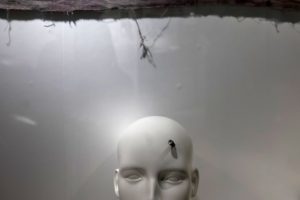
“We have experienced a lot of harassment,” said Mak Hoi Wah, chairman of the museum’s management committee, as he stood next to a model of a victim’s skull with a bullet lodged in it. “But it’s very important for Hong Kong to have that important piece of history. Our interest is to provide students with better knowledge about the event.”
Bloody History
Afraid of suffering the same fate of their counterparts in the collapsing Soviet Union, China’s authorities doubled down on repression to stay in power in 1989, reinforcing party control over the military and implementing manhunts for dissidents, using torture and leveraging their loved ones against them. The events were a turning point for China, leading it to modernize its security state.
Afterward, an underground railroad from the mainland to Hong Kong known as Operation Yellowbird offered an escape route for targeted protesters who had the means to flee. The city has since housed iterations of the museum and holds an annual vigil each June 4. But its status as a refuge for such freedoms is under threat.
Since late May, Chinese authorities have put under house arrest or restricted the movement and communication of several members of Tiananmen Mothers, a group of victims’ relatives, who are feted at the annual vigil. It’s one of the latest actions by China aimed at preempting commemorations of the event, according to a report by Human Rights Watch.
Commemorative Arts
Badiucao, a popular Chinese political cartoonist based in Australia who goes by a pseudonym for safety reasons, said Hong Kong has long been a “lighthouse” of free expression. But he had to cancel his debut Hong Kong art exhibition last year after contacts of his in China received threats.
“Hong Kong is a front in showing China the possibility of resistance,” he said. “Mainlanders after 1989 had completely forgotten what it looks like, tastes like. Hong Kong is a reminder. But Hong Kong is losing that.”
Commemorating Tiananmen isn’t the only form of expression to come under fire since the former British colony’s handover to China in 1997. Protest leaders from the 2014 pro-democracy Occupy Central protests have been jailed in recent years, and sellers of banned books have been detained.
“The great massacre of June 4, 1989, was a turning point,” writes exiled poet Liao Yiwu in Bullets and Opium, his book on the event that was recently published in English. “Before everyone loved their country; afterward, everyone loved money.” In a messaged reply, Liao said his books are “strictly prohibited” in China, but many still acquire them through underground means. Author Louisa Lim had to find a publisher in Taiwan for a recently released Chinese version of her book, “People’s Republic of Amnesia.” It tells stories of those who lived through Tiananmen: A soldier who hitched a ride into the square in a bus loaded with guns and ammunition; a student leader later jailed and tortured, and a protester smuggled out in an ambulance packed with casualties.
“In the current climate, attending the vigil is an act of defending Hong Kong’s freedoms,” Lim said.
– Reported by Blake Schmidt, Bloomberg. Link to the article here.