
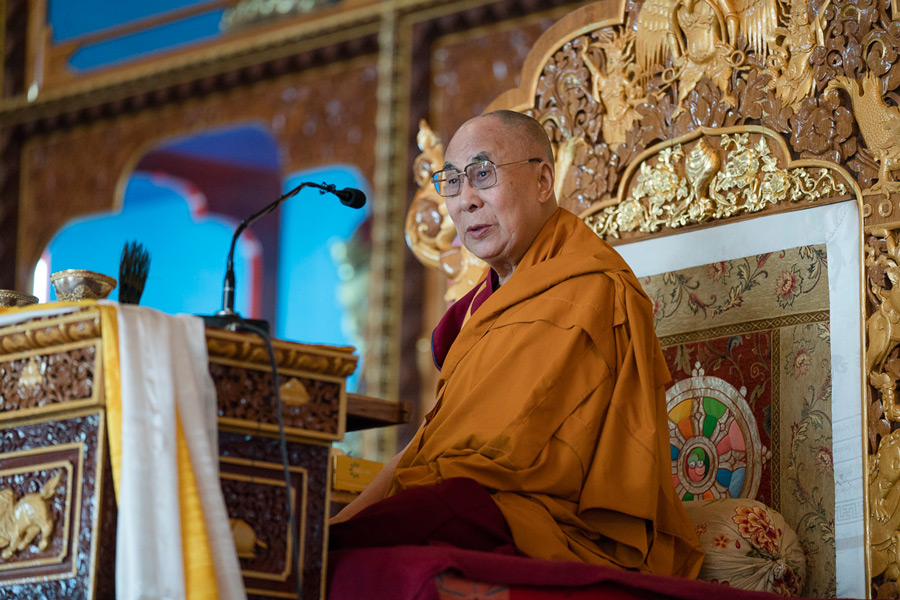
Mundgod, Karnataka, India, 17 December 2016 – Yesterday morning, His Holiness the Dalai Lama took a short flight from Bengaluru to Huballi. He was received as he stepped off the plane by the local DC. The Drepung Tripa and Ling Rinpoche greeted him in the arrival hall, while the Loseling, Gomang and Ratö Abbots were waiting at the door to the airport. His Holiness drove to the Mundgod Tibetan Settlement via Camp No 1, past Ganden Monastery. Tibetans young and old, monastic and lay, lined the road to welcome him. On arrival at Drepung Lachi he took the time to speak to six monks confined to wheelchairs who were waiting to see him. On entering the monastery he was formally presented with a mandala and three representations of the body, speech and mind of enlightenment.
The Nechung Kuten, Medium of the State Oracle, has been the prime mover in the re-establishment of this monastery. About 15 years ago, he began to have vivid and repeated dreams of building a monastery he did not recognise, which surprised him because Nechung Monastery had already been re-established. On one occasion, after a trance, His Holiness asked him about his dreams and he explained. His Holiness remarked simply that it was interesting. It was when he reported what he had dreamt to senior monks at Nechung Monastery that one of them suggested that the monastery in question was Deyang.
Apparently, sometime before this, His Holiness had instructed that the Fifth Dalai Lama’s commentaries on the Perfection of Wisdom and the Middle Way be reprinted. He gave the books to Drepung Lachi where they lay unread because Loseling and Gomang study the works of Panchen Sonam Drakpa and Jamyang Sheypa. Therefore, when the Nechung Kuten told him that his dreams seemed to herald the re-establishment of Drepung Deyang Monastery in exile, he was pleased because one of that monastery’s distinguishing features was that its monks studied these works of the Fifth Dalai Lama. Also, since the time of the Fifth, the young Dalai Lamas, including His Holiness, enrolled first at Drepung Deyang and began their training there.
“I have encouraged institutions like Namgyal and Gyumey Monasteries that used to devote themselves to ritual activities to provide opportunities for their monks to study. So, here too at Deyang, besides the rituals of Nechung, the five-emanation king protector, with which the monks are accustomed, I am encouraging the rigorous study of the curriculum established by the Fifth Dalai Lama, as well as the Third Dalai Lama’s writings on definitive and provisional scriptures, which comment on Tsongkhapa’s ‘Essence of Good Explanation’, and Gendun Drup’s work on logic and epistemology. As is said, ‘By laying the foundation of the two truths, following the two paths of method and wisdom, we achieve the two bodies of form and truth’.”
In a short speech that the Abbot read out in Tibetan and English he praised His Holiness for embodying compassion and for being the guide of all beings. He expressed gratitude to him on behalf of the monks for being their patron, recalling that Ratö Dratsang is a Tibetan Government monastery. In Tibet it was an important monastery under whose auspices, each year, scholars from the Three Great Pillars studied and debated logic at the Jang Kun Chö or Winter Debate Session.
The Abbot also noted that the handful of Ratö monks who had come into exile were too few to re-establish their monastery until His Holiness appointed Chuwar Rinpoche to be its Abbot in 1988. It steadily grew. Now there are 100 monks from Eastern and Western Tibet, as well as from Nepal, Bhutan, Taiwan, America and many parts of India.
Due to the kindness of Drepung Loseling Dratsang, he continued, Ratö monks have been able to study with the renowned Loseling scholars and to debate in the Loseling debate yard, as had been the tradition in Tibet. Consequently, so far, 14 Ratö monks in exile have qualified as Lharampa Geshes. The Abbot concluded with prayers for His Holiness’s long life and the fruition of his prayers for the welfare of all sentient beings.
“This new constitution the Abbot has requested me to unveil today is an important document,” His Holiness began in response. “So too is the inauguration of this debate yard. The Nalanda Tradition we upheld in Tibet reveals the path to enlightenment by employing reason and logic, not merely by accepting it out of faith. In other Buddhist countries, like those that follow the Pali tradition, who are conscientious in observing the Vinaya, and China which follows the Sanskrit tradition, there is no such convention of rigorous study. We Tibetans have been able to study the philosophical texts, apply what they mean and bring about transformation in our minds.

His Holiness the Dalai Lama praised the Ratö Abbot for being a good disciple who had relied well on his teacher and acknowledged that appointing him, an American, Abbot had been innovative. He noted, however, the precedent in old Tibet, where Mongolian scholars routinely achieved positions of responsibility in the monasteries.
“In today’s world, because material development is not enough to be genuinely happy, more and more people are beginning to look into the workings of the mind and emotions in a scientific way. What the Nalanda Tradition has to say about these things we can helpfully contribute to humanity. Consequently, I have given the Ratö Abbot an additional responsibility, in the light of his own education and experience, to examine the extent to which there is interest in studying these fields in an academic way.
“We will not keep alive the knowledge contained in our Buddhist traditions by relying merely on faith, but by careful and thorough study we can. Responsibility for taking this forward will fall on the shoulders of those of you who are still young now.”
There followed a brief but skilful demonstration of debate touching on a range of topics from logic to the Middle Way school of thought and monastic discipline.
There were expressions of thanks to His Holiness for releasing the Monastery’s new constitution and inaugurating the debate yard, and to all the Abbots, former Abbots and other guests for joining this celebratory occasion. Finally, the monastery invited all the guests to enjoy a delectable lunch.