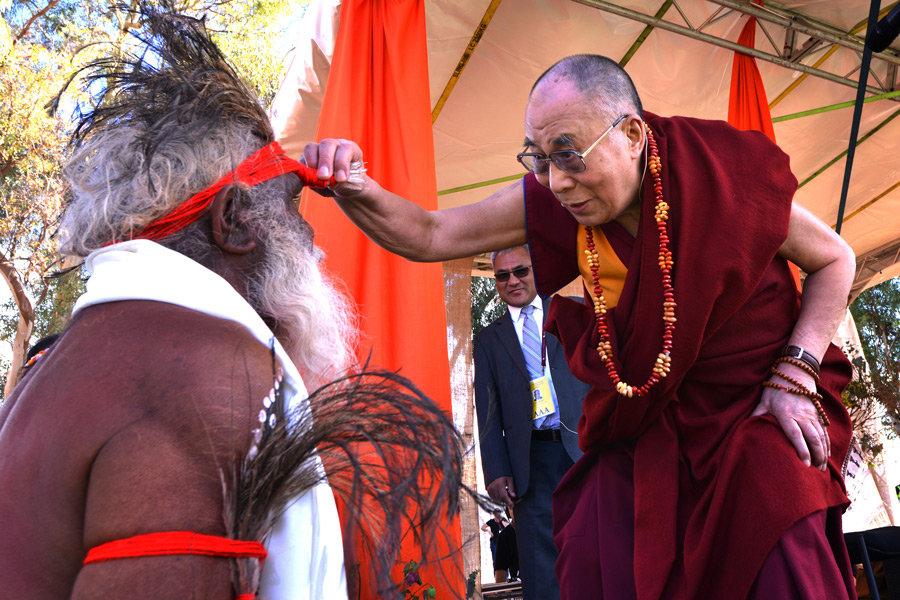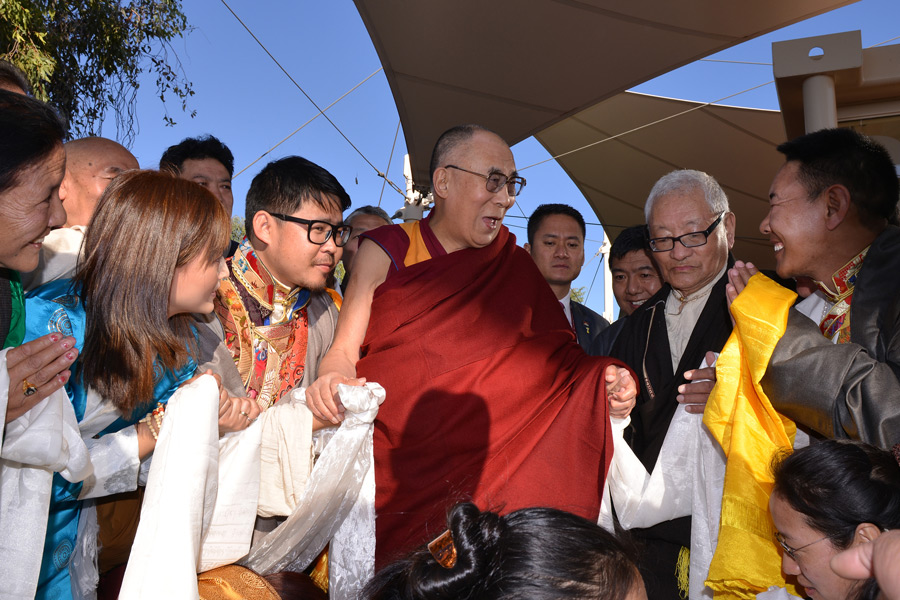

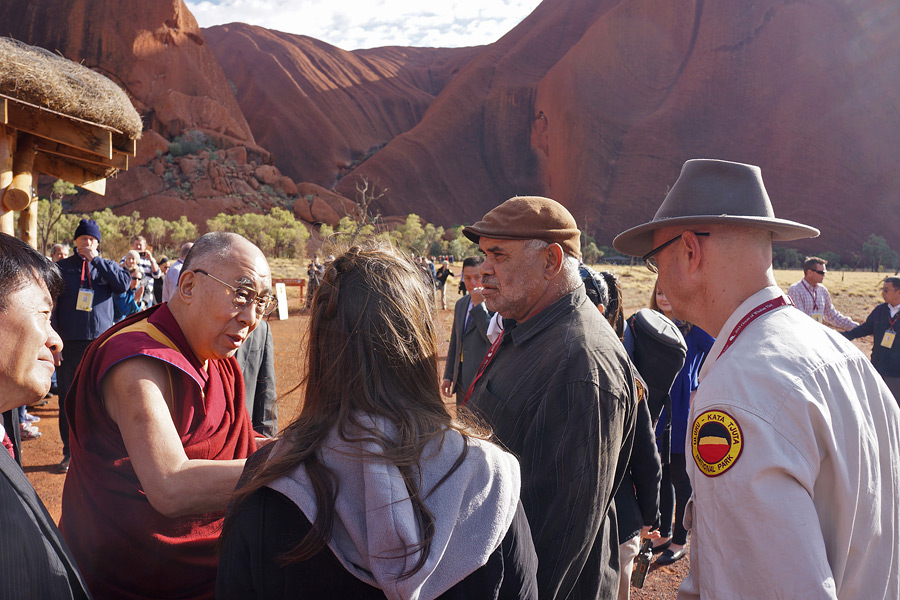
Uluru, Northern Territory, Australia, 13 June 2015 – Many other visitors to Uluru were happy to have the chance to greet, shake hands and take photographs with His Holiness the Dalai Lama this morning as he walked through the grounds of his hotel.
“I always express my respect for indigenous peoples whenever I have the opportunity to meet them. I have great admiration for the way they preserve their culture and language. When we Tibetans had to break our isolation it gave us the opportunity to meet and learn from other people. Now, we try to preserve or traditions without that protection.
A park buggy drove His Holiness and one of the Traditional Owners back to the parking place. Speaking to waiting journalists he said that as a Buddhist monk he’s trained to take a curious, investigative view of things and that he would also be interested to hear what scientist have discovered about Uluru. He spoke about different indigenous peoples he has met around the world whose values and heritage have been shaped by local environmental conditions. Some prefer to keep their isolation; others like the Sami of Lapland have maintained their heritage while embracing modern education and some technology.
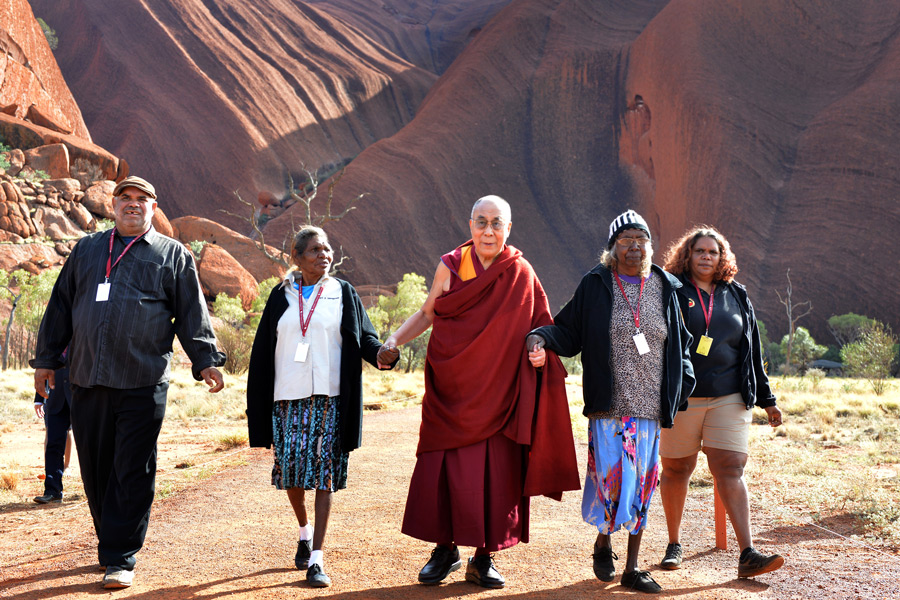
“This gentleman travels the world and saw our place from the air. He wanted to see it for himself, and that’s why he’s come here now.”
Another of the Traditional Owners added:
“We’ve been waiting for this visit with anticipation and we’d like to welcome you and the other visitors who’ve come with you.”
“For many years I’ve had an interest in the indigenous people of different continents, the indigenous Australians and this famous sacred rock. Now, today, I’ve had the opportunity to see it close up for myself and even to touch it. And I’ve heard the stories you tell about it, all of which makes me very happy.
“I’ve met many indigenous peoples in different places, all of them trying to preserve the language and traditions. To succeed, I think you have to be realistic. Some of them like those in South America prefer to maintain their isolation. Others like the Sami of Lapland, your neighbours the Maoris in New Zealand and people of Canada’s First Nation, try to combine their efforts to preserve their heritage with modern knowledge. I think that education is important and that it is necessary to accept some modern facilities and to learn English.”
He wondered if there might be benefit in planting more trees and experimenting with raising crops. If farming were successful, they might later introduce some small scale industry too. He thanked them for receiving him so warmly.
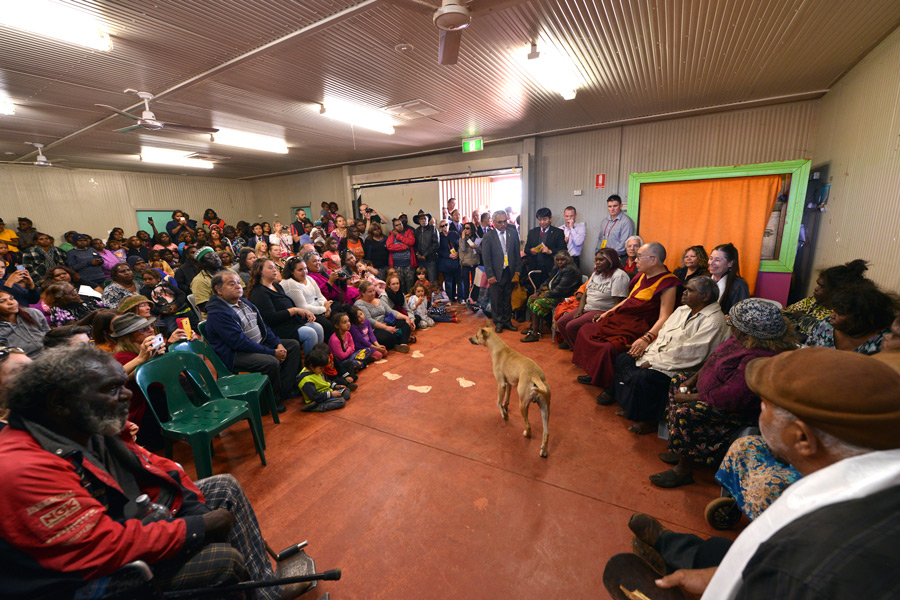
Interviewed by Karla Grant, presenter of Living Black for SBS after lunch, His Holiness told her how happy he was to have come to visit the place and meet the local people. He reported to her what he had told them about the importance of preserving traditions. He mentioned how soon after arriving in India in 1960 Tibetans had set about setting up schools where children could receive a modern education while still being taught their own traditions and values. He said:
“A lot of problems we face in the world today are our own creation. They are not due to a lack of money or education, but to a lack of values. Because modern education is inadequate on this score, I believe we need to find ways of incorporating what I call secular ethics, an approach to values that is respectful of religious and indigenous traditions.”
When she asked him his views about potential changes in government policy that may affect indigenous people, he told her it was a matter for experts and he wasn’t sufficiently informed to comment. A question about Tibet prompted him to refer to recent research based on Chinese documents that confirms the historical existence of Chinese, Tibetan and Mongolian empires more than one thousand years ago. Nevertheless, he said that since Tibet is a landlocked country and is materially backward it may be in Tibetans’ interest to remain within the People’s Republic of China. However, that should not limit their right to preserve their culture, language and rich traditions of Buddhism.
Ms Grant wanted to know how he responded to the protests that have been taking place in connection with his visit. He told her:
“Now this is becoming routine, wherever I go they turn up. In Norway recently about 1000 Norwegians came to welcome me to Oslo and I thanked them, while also expressing my appreciation that these other people could exercise their freedom of speech. However, when it comes to understanding the history of this controversial, nearly four centuries’ old, spirit, I think I know more about it than they do. I propitiated it too until the ‘70s, but when I discovered how critical the 5th and 13th Dalai Lamas had been about it, the 5th referring to it as harmful, evil spirit, I gave it up. It’s my duty to advise people about it.”

Beginning his talk, His Holiness said again how happy he was to have come to visit this sacred place and meet the local people. However, he confessed how uncomfortable he’d felt in the morning when he was offered two witchetty grubs or moth larvae. He explained that while he’s unaffected by insects like scorpions that scare other people, since childhood, wriggling creatures like caterpillars and these grubs have made him very uneasy. The already chuckling crowd laughed out loud when he exclaimed that Sammy, his guide, just ate one raw.
He commented on indigenous peoples’ right to preserve their culture and traditions.
“Indigenous people also tend to be very close to nature, which is something modern people can learn from. They seem to think they can control nature, but nature is our mother and deserves our protection. After all, this planet is our only home.
Several times during this talk, His Holiness appealed to his listeners to pay more attention to inner values, humane values, like warm-heartedness. Indeed, when he was asked what gift he would like for his imminent 80th birthday, he replied:
“Nothing. Although if you think about and find something useful in what I have been saying, that would be the greatest gift to me. Thank you.”
Following his exceptional stay in Uluru, His Holiness will tomorrow travel early on to Perth where he has several engagements that will conclude this year’s Ocean of Wisdom visit to Australia.