His Holiness the Dalai Lama Visits Boston, Day 1Thursday, 30 April 2009, 9:59 a.m.
 |
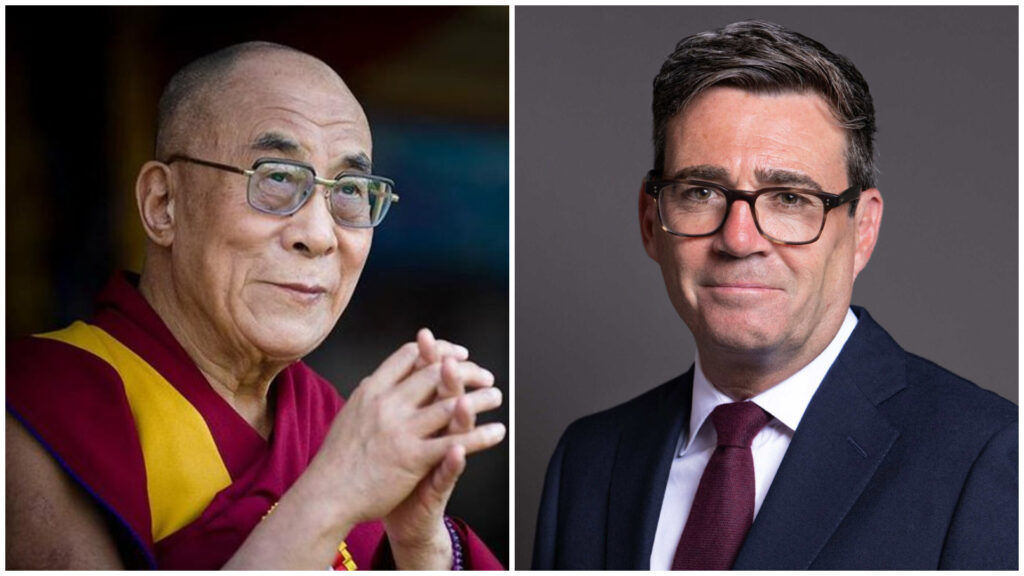
| His Holiness the Dalai Lama at the Charles Hotel in Cambridge on 29 April 2009/Photo: Pat Greenhouse of the Bosotn Globe |
Boston: His Holiness the Dalai Lama arrived in Boston a little before noon on the third leg of his tour.Following lunch, His Holiness’ program began with a press conference that lasted for nearly 45 minutes.In
his opening remarks, His Holiness talked about his first trip to
Harvard in 1979. He then explained his two commitments, promotion of
human values and promotion of religious harmony.Talking about
their relevance His Holiness asked the media to investigate into the
attitude of people during this current global economic crisis. He felt
that those individuals who thought only about money, even in their
dreams, they may be more disturbed in the current situation. On the
other hand those who paid attention to other values, in addition to
money, values like harmony, human family and community, may be less
disturbed. He said machines cannot produce happiness and that people
should look deeper way into our mind or consciousness. He said in the
past 20 years he had many discussions with scientists on such issues of
compassion and the co-relation between compassion and human health. He
thus explained the reason for his emphasis on the promotion of human
values.Referring to his second commitment of promotion of
religious harmony, His Holiness said that as a religious person and a
Buddhist, he felt that promotion of religious harmony was essential.
He said in the 21st century, there was material development, but that
sadly even today conflict was taking place in the name of religion. He
therefore felt that harmony among religions was important.His
Holiness said that he had always believed that the Western societies,
which are basically Judeo-Christian and some Muslim, people should keep
to their own traditional faith. He referred to some of his friends who
were wanting to construct Buddhist monastery in Europe or America and
said that he had reservations about this. He felt building a
monastery in Asia was okay given the Buddhist background there.
 |
| His Holiness the Dalai Lama answers questions from the Boston news media at the Charles Hotel in Cambridge on 29 April 200/OHHDL |
Talking
about his reason for coming to the United States this time, His
Holiness said that except for trips to Washington, D.C. or Brussels in
Europe where he had a political agenda, all his other visits are
non-political in nature. This time, he said it was basically
educational in nature.His Holiness then answered some questions.A
reporter said that Secretary Hillary Clinton and President Obama seem
to be downplaying human rights and wondered what His Holiness felt
about their position on Tibet. His Holiness said that all US
administrations, irrespective of which political parties they belonged,
were positive on Tibet. He said he had met Obama when he was a member
of the Senate Foreign Relations Committee and subsequently they have
had exchanges of communications. His Holiness said he found President
Obama to be straightforward and wanting to reach out to others.His
Holiness said that in an interview to Fox TV some days earlier, he had
spoken about the People’s Republic of China being an important nation
and that it must be brought into the international community. He said
it was for this reason he had supported the provision of the Most
Favored Nation (MFN) status to China. He said that US and China should
have good relations. At the same time there were certain principles
like human rights, political freedom, democracy freedom of speech and
freedom of press, that also needed to be paid attention. He asked the
media to play a role in highlighting these principles because paying
attention solely to the economy was shortsighted.His Holiness said that he did not think the Obama Administration was neglecting Tibet.Another
questioner asked whether the battle for Tibetan autonomy was lost. His
Holiness answered that from a local perspective it could be felt that
the situation was hopeless, but that from a broader perspective he
believes there is hope. He said the Tibetan spirit was very strong.
He said that the People’s Republic of China itself was changing.
Today, even the Chinese Communist Party is a party without communist
ideology and that it had become a capitalist authoritarian regime. He
said this was a big change.His Holiness talked about the
difference in the Chinese outlook; during the time of Mao Zedong, Deng
Xiaoping, Jiang Zemin and Hu Jintao. During Mao’s era importance was
given to ideology. During Deng’s time economy was given importance
while during Hu Jintao’s time importance is laid on bringing about a
harmonious society. His Holiness said that these changes meant that
the Chinese communist leadership has the ability to act according to
new reality.However, His Holiness said that for harmony trust
is very essential. He referred to the Chinese authorities’ attitude of
resorting to suppression to resolve issues and said that this cannot
sustain in the long run. He said China today had manpower and economic
power. But what it lacked was moral authority. He said China needed
the trust and respect from the rest of the world. He referred to the
over 400 articles written by Chinese, including some from the mainland,
on Tibet since March 10 last year and said that these showed their
maturity.
 |
| Media contingent at His Holiness the Dalai Lama’s press conference |
To
a question about President Obama’s conciliatory attitude, His Holiness
said that he fully appreciates the President’s attitude of reaching out
to others. When asked about the difference between President Obama and
President Bush, His Holiness said he loved President Bush for his
straightforward attitude, unlike some politicians who keep a
distance. His Holiness talked about his not agreeing with some of his
policies, though. He said President Bush had sincere motivation when
introducing democracy in Afghanistan and Iraq, but that the method of
using force was counterproductive.On another question whether
he would be meeting President Obama, His Holiness replied that this
time there was no visit planned to Washington, D.C. but that most
probably he would be meeting President Obama next time.A
journalist from a Chinese language newspaper asked His Holiness what he
felt about those Chinese people who have a different view on Tibet. His
Holiness said that he always admired the Chinese people who had a 5000
year old civilization. He said on some occasions he had said that
although his trust in the Chinese government was growing thinner he
had full faith in the Chinese people.When asked whether he
would be visiting Taiwan, His Holiness referred to his two earlier
visits there in 1997 and 2001. He said he had two main reasons for
visiting Taiwan; to show to the Chinese people that we are not
anti-Chinese and since he cannot go to China, going to Taiwan was the
next option; and to study the Taiwanese Buddhist tradition,
particularly since the only surviving highest level of ordination of
nuns was in the Chinese Buddhist system. He said that the Buddha had
bestowed this equality to all but that the followers have not been able
to fulfill it. Since 2002 after the re-establishment of contacts with
Beijing, visit to Taiwan became not an easy thing. He said while
President Chen Shuibian was eager for his visit, President Ma Ying-jeou
found it inconvenient.His Holiness was asked about his views on
the situation in Colombia and whether he would visit the country. His
Holiness said that while he followed the general news about Columbia,
he was not an expert. In general, he said that violent method is always
a mistake and the only solution can be achieved through dialogue. He
referred to the situation in Tibet and said that since the powerful
country China was resorting to suppression, there was more resentment
among the people. He gave the case of a nine-year old Tibetan from Amdo
who showed resentment of the Chinese attitude as an example saying this
young boy may not have much idea but that resentment was there.When
asked whether he thought he would stand on the soil of Tibet, His
Holiness said Oh. Yes, I feel. Every Tibetan feels the same way. He
said the Tibetans in Tibet were also eager to see this happen. He
talked about his desire to visit Tibet expressed first in 1983 and that
he had wanted to send a delegation in 1984 to prepare for a possible
trip in 1985 (he said the fact-finding Tibetan delegations were
received with strong emotions by the Tibetan people and so proper
preparation was needed for a trip by him). However, he said things
became difficult with China and the trip did not take place.His
Holiness said that as a Buddhist, he followed a Tibetan saying that
wherever there is happiness, that is home and that whoever showed
kindness could be considered parents. He said in the past 50 years as
a refugee he was able to have much exposure to the outside world.Following
the press conference, His Holiness departed for the Massachussets
Institute of Technology (MIT) where he first planted a sapling before
blessing a sand mandala of Tara and answering some questions collected
from students at MIT. These questions dealt with the qualities for a
meaningful life (he said this was the topic he would be touching in a
public talk) to what he would like to invent if possible (he said he
was interested in the idea of a machine that desalinizes water and
heard of that once while on a trip to California. He said many
countries were located along the sea coast and had water supply
problems). He was asked for his thoughts on the conversation between
Science and religion and he referred to the positive outcomes of such
dialogues and why it was important to pay attention to the mind. He
emphasised on the importance of the continued learning process and
quoted Sakya Pandita who said even if you were to die tomorrow, you
should continue to learn today.His Holiness said that whether
the knowledge is used for construction or destruction depends on the
motivation. He talked about terrorists who had brilliant brains but
were guided by hatred. As a result the knowledge is used negatively. He
said that in the modern education system knowledge is paid much
attention but that moral ethics seems to be taken for granted.
Sometimes people felt that it was for the religious institutions to
impart education in moral ethics.Thereafter, His Holiness went
to a reception for supporters of the Dalai Lama Center for Ethics and
Transformative values. He asked the Center to conduct research now
that the idea of a Center has become a reality.The Chair of the
Faculty welcomed His Holiness and talked about his previous visit when
there was a discussion between His Holiness and MIT scientist. He said
the beginning of a two way dialogue has culminated in the establishment
of the Center.After the reception, His Holiness returned back to the hotel.–Report filed by Bhuchung K Tsering on 29 April 2009