

April 8th 2016
New Delhi, India, 8 April 2016 – Before leaving for the American Embassy School this morning, His Holiness the Dalai Lama gave an interview to Sanjoy Majumder of the BBC. Majumder began by asking how we can defeat violence in the name of religion. His Holiness told him that while there may be a need to take short term measures, we also have to think about how to stop this in the long run. One way is to increase contacts between people of different faiths to improve understanding between them, bearing in mind that all religions carry the same message of love and observe tolerance and forgiveness to protect it.
In reply to a question about his reincarnation His Holiness repeated that his decision that whether or not one is sought will rest with the Tibetan people.
“I am committed to democracy,” he said, “while many of our religious institutions, such as reincarnation, are remnants of feudalism. Today we need to act appropriately to the new reality in which we find ourselves. The future of Tibetan Buddhism doesn’t depend on the
institution of the Dalai Lama. It’s the 10,000 monks and nuns now studying in Tibetan centres of learning, mostly in South India, who will ensure the preservation of the Nalanda tradition.”
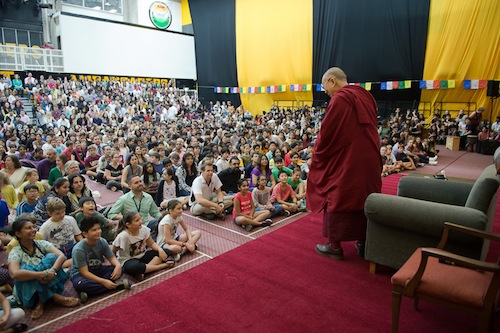
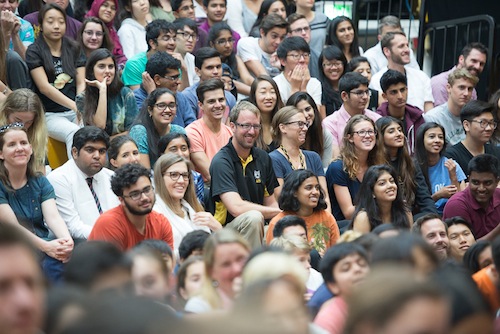
“Young brothers and sisters and older brothers and sisters, I am happy to be here again. Time moves on; nothing can stop it. The 20th century has gone and we’re more than 15 years into the 21st century. The past can’t be changed, but we do have the opportunity to shape the future and create a happier world. And who will do that? Those of you who are young today. In one or two decades from now, I’ll be gone. But even if I’ve ended up in hell, I’ll take a break to come back and see how you’re doing. If you’re working for peace and a more equitable world, when I get back there I’ll tell the wardens of hell that they can reduce its size. But if I find you are still engaged in violence and discrimination on the basis of race, nationality, faith or social status, I’ll report that hell should be expanded to accommodate everyone who’ll be destined to arrive there. Because of the changes you can make, you are the basis of our hope.
“The second reason I’m glad to be here is that I’m an old person and when I meet other people my age I wonder ‘Which of us will go first?’ Whereas when I meet young people like you, it makes me feel young and refreshed. For the last 30 years or more, I’ve been having regular discussions with scientists and they have told me of their findings that basic human nature is compassionate and positive. All 7 billion human beings alive today share the common experience that our mothers gave birth to us. That includes even those so-called terrorists. All of us have basked in our mother’s affection.
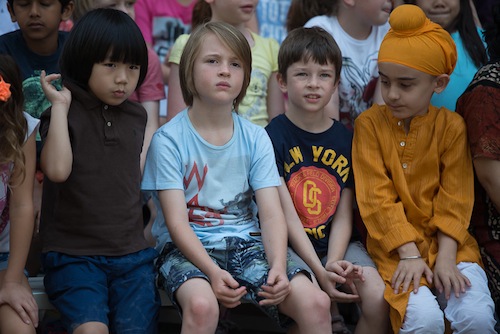
His Holiness explained that human beings are social animals, who cannot survive on their own without the support of a community. Therefore, he said, to think only of our own benefit is narrow minded, whereas taking care of others is like a farmer’s tilling the soil of his fields to ensure a good crop. He pointed out that where small communities in the past were largely self-sufficient, we are now very interdependent. We need each other. In the meantime, climate change affects us all wherever we are, and our global economy is interdependent. This is why we need a sense of concern for all the 7 billion human beings alive today.
Observing that as human beings we are all physically, mentally and emotionally the same, His Holiness pointed out that we not only share a desire to be happy and free from problems, but we have a right to live a happy life. As social animals we all need friends. Friendship depends on trust and trust grows when we live our lives honestly and sincerely, cultivating respect and concern for others. Wealth, power and reputation don’t attract genuine and reliable friends.
“Bringing about change in the world will depend on those of you who are young now making an effort on the basis of vision. I appeal to you to think about what I have said and how you can make it work.”
Another student wanted to know when he needed courage where he found it. His Holiness said he finds courage in trying to live honestly and truthfully, which is another reason why he prefers human warmth over empty formality. To a question about his favourite place he answered that he is happy everywhere, but that he’s fond of America and Italy where people are straightforward and warm. Asked whether he is still learning about kindness, he agreed that he is and recommended analytical meditation as one of the ways of increasing it.
He said he didn’t believe there is a conflict between science and religion, particularly if you take account of Pope Benedict’s recommending a need for both faith and reason. He agreed that a future Dalai Lama could be a woman. Finally, he asserted that change in the world begins with individuals transforming themselves.
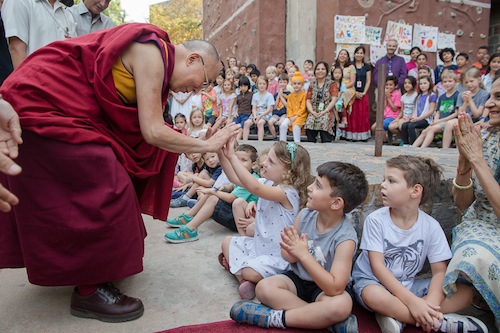
The occasion ended with the Director, Paul Chmelik expressing the school’s thanks to His Holiness for sparing the time to come and talk to them. There was an exchange of gifts and His Holiness returned to his hotel for lunch.