
His Holiness the Dalai Lama reaffirms hope on resolution of Tibet Issue[Friday, 21 May 2010, 12:09 p.m.]
 |
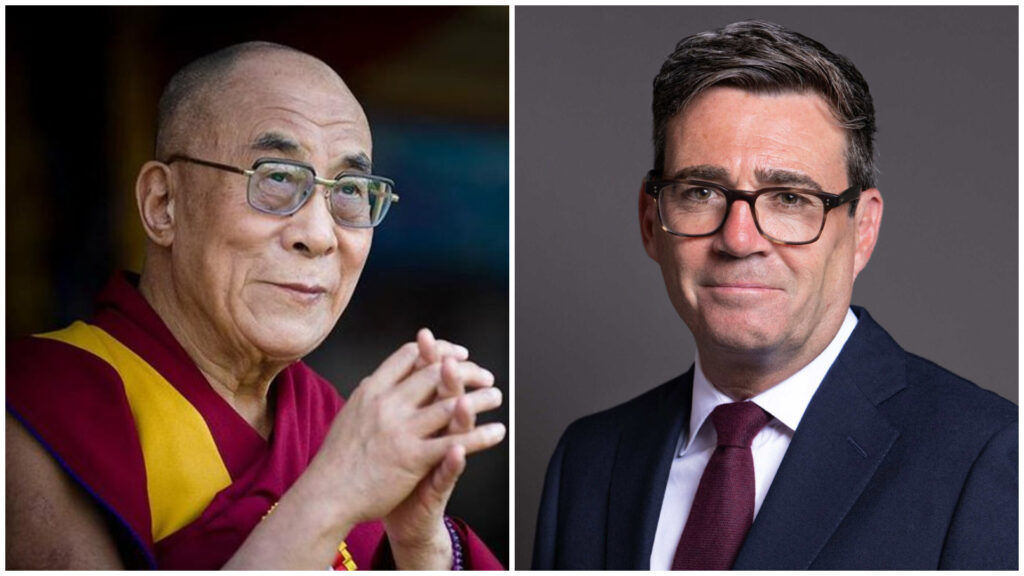
| His Holiness the Dalai Lama speaks during during a press conference after the first of his teaching sessions 20 May 2010 at Radio City Hall in New York/Getty Images |
New York: Sharing
his views on issues relating to Tibet and the world with over 100
journalists in New York on Thursday, His Holiness the Dalai Lama said
he remains optimistic about the resolution of the Tibetan issue.His
Holiness was first asked about his optimism despite the absence of any
positive attitude from the Chinese side. The journalist quoted a report
by the International Campaign for Tibet about Chinese police opening
fire on villagers in Amdo protesting a factory as a case in point. His
Holiness responded that while the dialogue process with the Chinese
leadership is yet to provide any positive results, he was optimistic
for two main reasons. First, he said the People’s Republic of China is
the most populated part of the world and had to go along the global
trend towards transparency, rule of law, democracy and independence of
the judiciary. His Holiness said that the authoritarian system in
China had the ability to adapt to changing times and referred to the
PRC’s history as composing of four eras. He said the first is the Mao
Zedong era during which ideology was the most important. Then came the
Deng Xiaoping era in which money replaced ideology and capitalism was
adopted. His Holiness said this brought positive developments to
millions of people in China. The third era was the Jiang Zemin era
during which the new reality was acknowledged by the Communist Party in
the form of the Three Represents. His Holiness said we are now in the
Hu Jintao era which has seen the drawbacks of the past policies and are
trying to rectify that through the development of a harmonious society.Secondly,
His Holiness said although his faith in the Chinese Government has been
thinning, his faith in the Chinese people had not reduced. He talked
about over 1000 articles in Chinese, with several hundreds written by
Chinese intellectuals in China, since the 2008 demonstrations in Tibet
and all of these articles were supportive of his approach towards the
resolution of the Tibetan problem. In answer to another
question why some of the ticket prices to his teachings were high, His
Holiness suggested that this issue should be taken up with the
organisers. He said it has always been his position to encourage the
organisers to provide tickets at the cheapest rate as possible. He
also clarified that he never accepted money for his teachings.His
Holiness said teaching organisers did donate money received for worthy
causes. He gave the example of the organisers in Indiana allocating
leftover money from his recent teaching there for a hunger project in
the state as well as for earthquake relief work in Tibet.His
Holiness recalled a development many years back when he accepted to
bestow the Kalachakra Initiation at the request of his brother, Taktser
Rinpoche, in Bloomington, Indiana. His Holiness said subsequently he
learnt that the money raised from the teaching went into the pockets of
a son of Rinpoche. His Holiness said he had then openly criticized this
as wrong and added that he still felt sad about this. His Holiness said
he told the son frankly that he had not come to raise money for them.Another
journalist asked him whether or not people should boycott the Tibetan
pavilion at the ongoing Shanghai Expo. His Holiness said it was up to
individuals. He said those who know something about Tibetan culture
could visit the pavilion and if they found something wrong or distorted
they could point them out. To a question on a report by the
International Campaign for Tibet about Tibetan intellectuals being
persecuted, His Holiness said unfortunately those narrow minded
Communist officials see the unique Tibetan cultural heritage as a
source or threat for separation. His Holiness spoke about a Chinese
official in the Tibet Autonomous Region, Chen Kuiyuan, telling a party
meeting more than 15 years back about the Tibetan Buddhist faith being
the ultimate source of threat for the Party. His Holiness also talked
about Chen Kuiyuan not allowing genuine study of Tibetan texts at Tibet
University. Those Tibetans who are intellectuals know the value of
Tibetan culture and when they express their feelings they become
target, His Holiness said.His Holiness said when he was in
China in 1954-55, the Communist Party of China was really wonderful,
and the Party members were really dedicated to the service of the
people. His Holiness said he was very much impressed and told Chinese
officials about his desire to join the Party. His Holiness said he
still is a Marxist (although some of his friends ask him not to mention
that) and he admired its objective of equal distribution (“this is
moral ethics”). His Holiness however talked about the clampdown after
the Hundred Flowers Campaign in China itself and said any authoritarian
system always subdue any force that has the potential to stand up to it.His
Holiness was asked about his optimism about the world, which he had
mentioned during the Today Show in the morning. His Holiness said he
was born in 1935 just before World War II. He said although Tibet was a
little bit isolated he would learn about developments in the world
through a Tibetan newspaper published in Kalimpong in India.
 |
| His Holiness the Dalai Lama speaks to the media after a news conference at Radio City Music Hall in New York 20 May 2010/Reuters |
He
then talked about his impression of the attitude of the German and
Japanese people towards the United States on account of the history of
suffering under American military power during World War II. He said
in general there is no sign of hatred or ill feeling. His Holiness said
he specifically asked his Japanese and German friends about any
negative feeling towards Americans and they said they had no such
feeling. Similarly when President Obama went to Berlin while he was a
presidential candidate over 100,000 Berliners came to welcome him,
which is an indication of the absence of negative feeling. His
Holiness said before the Iraq war began many people went on the streets
to oppose war. He said in the 1950s and 1960s people had the feeling
that war was ultimately unavoidable. At that time the Warsaw Pact and
NATO Pact countries had nuclear weapons ready to shoot at each other,
he said. That kind of situation had now completely gone, not by force
but through popular peaceful movement, His Holiness added. He said
these are developments within one century.On the ecological
front, too, in the early part of the 20th century nobody paid much
attention to it, while in the latter part, there was a growing
ecological movement, he said. His Holiness talked about the role of the
Green Party and jokingly suggested that Americans should start a Green
Party and he would join it. He recalled telling some Green Party
members in New Zealand if ever he wanted to join New Zealand politics
he would join the Green Party.On people’s attitude toward
science and religion, His Holiness said at the end of 19th century and
the beginning of the 20th century, people had the feeling that science
and spirituality were separate. He said now people are beginning to
appreciate a closer relationship between the two.He said when the Tsunami and the disasters in Haiti happened, the response was immense.His
Holiness referred to these developments as signs of human beings
becoming more mature. He felt these were signs of human beings
becoming more sensible and added that these are sources of his
optimism. He said if these sources are wrong, he would like to be
corrected.His Holiness then said whenever he met the media he
talked about the role of the media in the promotion of human values and
religious harmony. His Holiness said the media should be honest,
truthful and unbiased.When asked whether he felt the election
of President Obama was another indication of the positive change in the
world that His Holiness was talking about, he agreed. He recalled his
experience when he was with a group of Indians in a meeting in Pune
when President Obama’s election was announced. He recalled the positive
reaction of the people there and said that President Obama’s election
had impact not only in the United States but also throughout the world.–Report filed by Bhuchung K Tsering of ICT