
[dalailama.com]
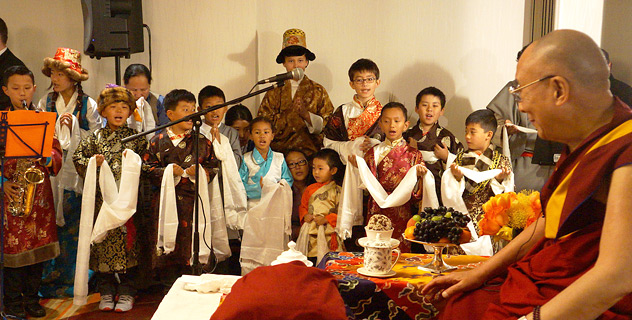
Los Angeles, CA, USA, 27 February 2014 – After young children dressed in their Tibetan best had sung for him and Tenzin Dorjee, President of Tibetan Association of Southern California had expressed words of welcome, His Holiness the Dalai Lama addressed the Tibetans assembled here in Los Angeles.
“In the 1970s, I began to speak openly about global responsibility and having a sense of a global community. Since then, scientists have come to recognise the importance of love and compassion for our well-being. In the 300 or more volumes of Buddhist literature included in the Kangyur and Tengyur are clear explanations of the awakening mind of bodhichitta and the wisdom understanding emptiness. These are the source of the custom of Tibetans, even those living in remote places, praying for the welfare of all sentient beings, not just Tibetans.
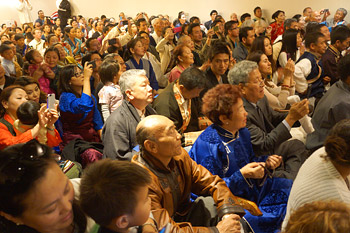
“There may be several hundred million Buddhists in the world, who, not to mention liberation and enlightenment, need guidance in training their minds. We Tibetans don’t need to look to Sanskrit, English or other languages because instructions about these things are available to us in our own language, Tibetan.
“When I recently visited Tibetan Muslims in Srinagar, I discovered their young children speak excellent Tibetan with a Lhasa accent. This is not the result of any instruction they receive at school, but of their parents’ and grandparents’ training. I’ve heard that here in the USA some Tibetan families only use English. It would be good if you could guide your children to take an interest in Tibetan, which is an ancient language. You should know that nowadays, modern scientists, especially those with an interest in the mind and brain, are intrigued by the depth and richness of ancient Indian psychology.”
Remarking that he has heard that the various Buddhist centres are doing well, His Holiness suggested that they should be used for more than just the offering of prayers and rituals. They should become centres of learning, places where people can study and exchange views. He mentioned the impending publication of a compendium of science and philosophy extracted from the Kangyur and Tengyur, first in Tibetan, but with translations into English, Chinese and Hindi to follow soon after. These books can be the basis for renewed study.
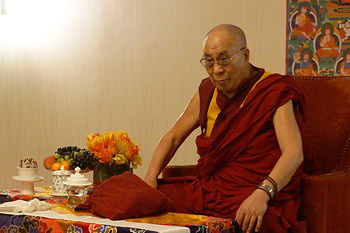
“After my retirement I met friends in America who told me it sent a powerful message to the Chinese. An elected system is no longer dependent on this or that individual. Twenty years ago I advised that the Central Tibetan Administration should function as if I were not there. And now that we’ve achieved that I have more time to dedicate to promoting human values and inter-religious harmony; my other commitments.”
His Holiness added that he did not have much to say about Sino-Tibetan relations.
“However, we Tibetans need to make the Chinese people our friends and we need to work to keep the support of the world community. Whatever progress you make in your lives, don’t forget the cause of Tibet or the importance of a Tibetan education. If some of you become the first Tibetan millionaires, well and good. There are already some Tibetans in the West who have funded schools in Tibet and clinics in monasteries. It’s very good to give such help; thank you.”