
His Holiness the Dalai Lama Meets the Press in Bloomington[Friday, 14 May 2010, 11:02 a.m.]
 |
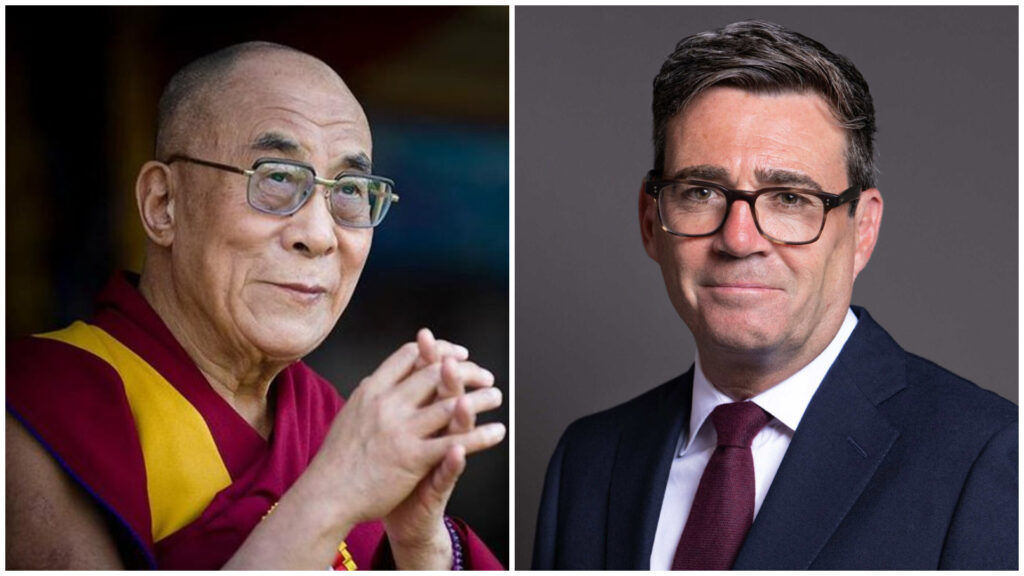
| His Holiness the Dalai Lama answers questions during a news conference Thursday at the Tibetan Mongolian Buddhist Cultural Center in Bloomington/AP Photo |
Bloomington, IN:
After concluding a two-day discourse on the Heart Sutra in Bloomington
on Thursday afternoon, His Holiness the Dalai Lama met the press at the
Tibetan and Mongolian Buddhist Culture Center. In his
introductory statement, His Holiness talked about his view on the role
of the media in society. Referring to his two commitments of promoting
human values and the promotion of religious harmony, His Holiness said
the media had the role of educating the public and the promotion of
such a society. His Holiness said both the commitments are related to
the promotion of compassion, which in turn was related to
non-violence. He said these were basic Indian values and thus he has
been saying that he was a messenger of Indian values.His
Holiness then answered some questions. When asked what he felt about
the absence of Taktser Rinpoche this time and about his reincarnation,
His Holiness said Taktser Rinpoche was a very dedicated and respected
person. He said Rinpoche passed away at an old age, “a normal way to
go.” His Holiness said he is pleased that the Center is carrying on the
vision outlined by Taktser Rinpoche. Regarding Taktser
Rinpoche’s reincarnation, His Holiness said the process of
investigation could begin next year as generally it was only after
three to four years after the passing away of a lama that the
investigation would start. His Holiness said at this stage it was
uncertain as to the place of his rebirth. His Holiness joked that the
investigation is “mysterious” and would involve meditation.His
Holiness responded to a question about his vision for the Center by
saying that he always felt that Buddhist centers should be more of a
learning center rather than merely being places of worship. He talked
about increasing number of scientists paying attention to Buddhist
thoughts and referred to the engagement between Buddhist and modern
scientists that was currently taking place. He said the
scientist-Buddhist dialogue initially began with a few scientists,
including Francesco Varela, and has subsequently expanded. Today, he
said the Universities of Wisconsin in Madison, Stanford and Emory had
special programs on researching into these issues.When asked
about the issue of the future of the Dalai Lama institution and his
successor, His Holiness responded that as early as 1969 he had made it
clear that it was for the Tibetans to decide whether the institution of
the Dalai Lama should continue or not. He said therefore he had no
concern. His Holiness said if in case he passed away in exile then it
was up to the concerned people, the Tibetans, Mongols and the Himalayan
Buddhists to decide whether the institution needs to continue or not.
He said then the issue of a successor will arise and said there were
options. He said it could either be done the traditional way or
differently through choosing an individual from among the spiritual
masters. His Holiness said there were several healthy educated younger
generation of Tibetan Buddhist masters from all the lineages. To
a question on what the United States could learn from Buddhism, His
Holiness said if the question is whether the West needed Buddhism he
said the answer was no. However, he recalled a discussion he had with
scientists at a meeting in Zurich during which they had talked about
the relevance of Buddhism to modern economy. One scientist had
mentioned that the Buddhist concept of altruism was very much
relevant. His Holiness said that generally he divided Buddhism into
three categories: Buddhist science, Buddhist philosophy and Buddhist
religion. In terms of religion, His Holiness said the West is a
Judeo-Christian society and it was best left as it is. But Buddhist
science and philosophy had universal relevance going beyond mere
religion and therefore useful to learn by both Buddhists and
non-Buddhists.When a young boy who had come with his journalist
mother, asked, “How long do you think before China pulls out of Tibet,
and what do you think it will take to achieve that?” His Holiness
merely responded, “Oh, ho, that’s a difficult question.” However,
after the press meet His Holiness explained the political situation to
the boy saying that with the changes now going on in China, some
progress for the Tibetan people could come in the boy’s lifetime.–Report filed by Bhuchung K Tsering of ICT