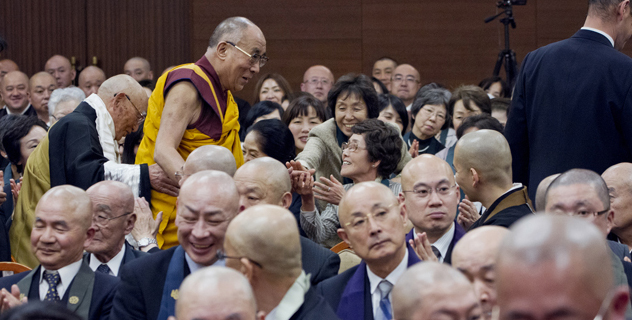
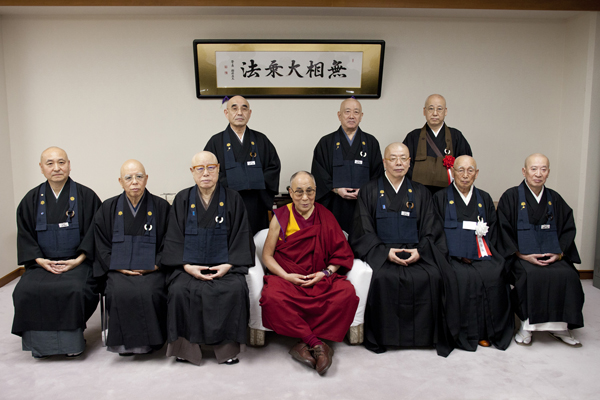
TOKYO, Japan: His Holiness the Dalai Lama today held an interactive discussion with a gathering of around 250 monks from Soto sect who preach criminals in various prisons develop their virtue and good human nature.
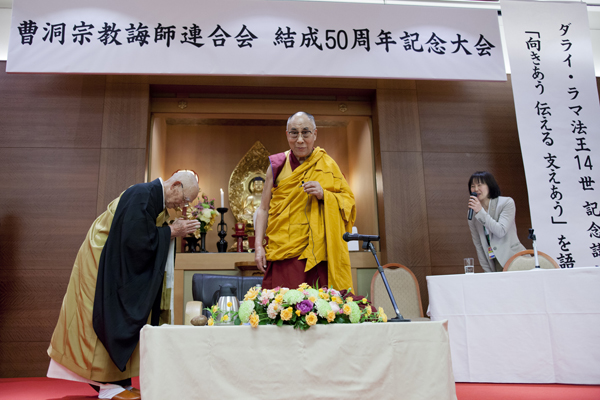
The programme, which marks the 50th anniversary of the service to guide the prisoners, began with a traditional service and recitation of Heart Sutra (Sherab Nyingpo) led by a senior priest of Soto sect.
The head priest then introduced to the audience the life history of His Holiness the Dalai Lama, shedding light on his birth, escape to exile in 1959, conferment of Nobel Peace prize for leading a non-violent Tibetan freedom struggle, and the devolution of his complete political authority to the democratically-elected leadership in 2011.
In his brief address, His Holiness the Dalai Lama said he is very happy to be able to meet Kyokaishi (a prison chaplain) on the 50th anniversary of their remarkable service of giving spiritual guidance to prisoners.
His Holiness the Dalai Lama said he travels around the world to promote positive values and religious harmony. “All the 7 billion human beings in this world aspires for happiness and do not want suffering. All of us have the same potential to lead a happy life and this can be achieved only developing positive human values like love, compassion, tolerance, forgiveness and contentment and inner peace. All religions in the world preach promotion of these human values. So, naturally there should respect and harmony among religious traditions.”
Every human being want happiness, he said, but many problems facing the humanity is our own creation. The real cause of our negative action is a result of influence of three negative afflictions, attachment, anger and ignorance. “Buddhism explains that ignorance is the root cause of anger and attachment and the law of cause and effect that every phenomena have no independent existence. The law of causality helps us to realize that virtuous deed will bear good fruit while negative deed will result in negative fruit.”
Responding to a question on why devastating natural disaster befell Japanese people in Sendai, His Holiness said the tragedy suffered by Japanese in the natural disaster is a result of fruition of collective negative actions committed in previous lives. However, he said, there is no use of feeling demoralised and depressed. Instead, you should develop self-confidence and look to the future with hope for a happy life. Moreover, Japanese people have a great sense of community service.”
He underlined that practice of forgiveness and compassion for someone who causes harm to you is key to develop a calm mind.
“In Tibet, Tibetans are suffering under China’s authoritarian regime. Though the Chinese government knows the reality, they still have deep suspicion and hatred. A Tibetan monk, who spent 18 years in a Chinese gulag after the invasion of Tibet, once told me after coming to India that he feared of grave danger while the serving the prison term. He said he feared of losing compassion if he developed anger against the prison guards. He lived up to 90s with very healthy and happy life. Interviews and studies have found that Tibetans who have suffered imprisonment have unusually calm mind with no trace of psychological trauma.”
Responding to question on meditation, His Holiness said meditation is common practice in every religion and advised that meditation on developing love and compassion is very effective to get rid of negative afflictions like anger and attachment.
His Holiness said he is one signatories of Amnesty International’s campaign to abolish death penalty.
A 14-year-old boy asked His Holiness if the Tibetan people have the tradition of parents advising their children not to do negative actions like they have in Japan. His Holiness said Tibetans have this tradition based on their belief in the law of cause and effect. He advised the young boy to follow the guidance of his parents.
His Holiness said one should not lose hope in their pursuit of service for other’s well-being, adding that human beings can undergo transformation in their life. He said people who lead a non-virtuous life becomes a good person in later part of their life. He called for the need to develop wisdom and self-confidence to train your mind.
On being asked on the prospects for peace and happiness in the 21st century, His Holiness the Dalai Lama said: I am very optimistic that the there will be big positive change in this century if we make concerted effort in this pursuit. Since the later part of the 20th century, there has been growing aspirations for peace and special attention on preservation of environment in different parts of the world. Japan taking lead in disarmament of nuclear weapons is a positive indicator.”
He said the Japanese people, with a rich Buddhist religious tradition, needs to make a new effort to study and practice its teachings.
His Holiness said he was very happy to have a very interactive discussion. Presenting two statues of Buddha to the organisation, he prayed that the elderly priests will live up to 100 years and told him to have the same determination.
The head priest said His Holiness the Dalai Lama is a living example of compassion and tolerance. “We will follow the example set by His Holiness the Dalai Lama and thank him for giving us precious teachings.”
Various books authored by His Holiness the Dalai Lama are on display at the entrance to the auditorium. Some of the books are “Dalai Lama’s Little Book of Wisdom: The Essential Teachings’ Beyond Religion: Ethics for a Whole World” ,Speeches of Happiness, Compassion and Love”, “How to practice: The Way for a Meaningful Life”, and 50 years in Exile.”
Tomorrow, His Holiness the Dalai Lama will give a day-long teaching on the “Heart Sutra”, Nagarjuna’s “In Praise of Dhammadhatu” and Gyalsey Thokme Sangpo’s “37 Practices of a Bodhisattva” in Tokyo.