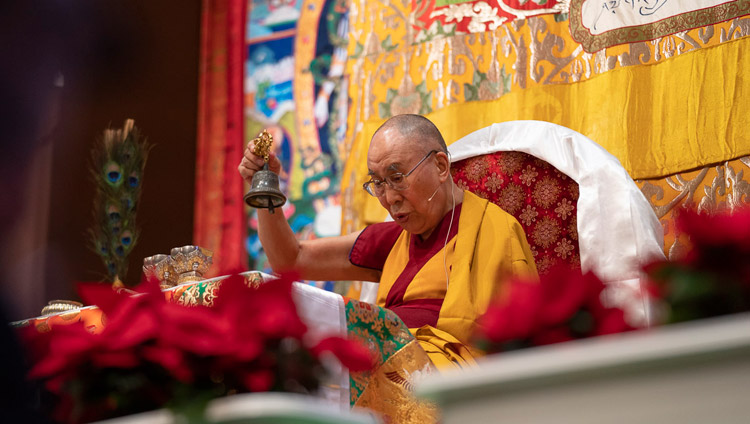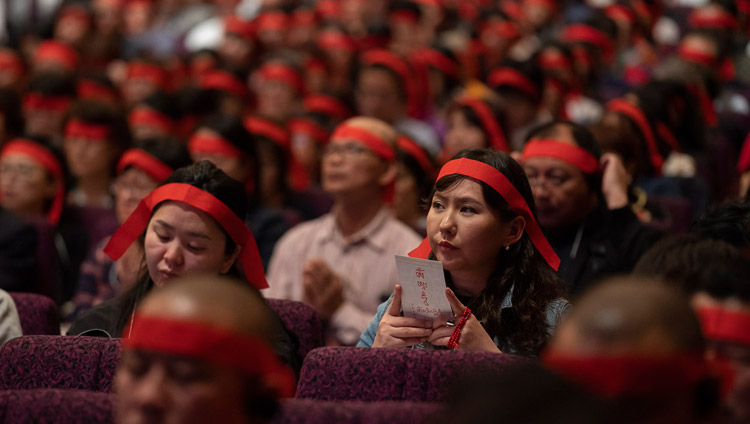

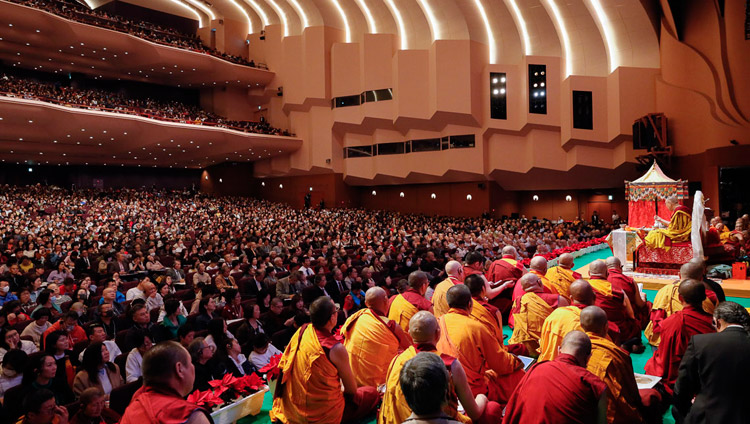
Dharamshala: His Holiness the Dalai Lama today concluded his two-day Buddhist teachings which were held from 14-15 November at the National Convention Hall of Yokohama.
His Holiness gave an explanatory transmission of Je Tsongkhapa’s ‘In Praise of the Buddha for Teaching Dependent Arising’ which was followed with the preparatory rituals for Avalokiteshvara initiation.
“Today’s tantric empowerment belongs to the category of specialized teachings. I regard the teachings of the Buddha as being of two categories: the general structure that includes the sutra teachings from the three turnings of the wheel of dharma and special teachings given to specific groups or individuals,” His Holiness said.
“In India there was no division into old and new tantras, a distinction introduced in Tibet at the time of Lotsawa Rinchen Sangpo. In the old tantra tradition there are teachings belonging to the distant ‘kama’ lineage, the near lineage of ‘termas’ or hidden treasures, and the close lineage from visionary sources. This empowerment is derived from the Secret Visions of the Fifth Dalai Lama. I received the empowerments from Tagdrag Rinpoché when I was very young and I have undertaken many of the associated retreats.
“When we first came into exile we didn’t have a copy of the text, but eventually a copy came to me and since then, following the custom of the 13th Dalai Lama, I perform an offering to Avalokiteshvara on the tenth day of every month in accordance with it. In Tibet there was a celebrated statue of Avalokiteshvara in the Potala, another in the Jokhang, while a third was the Wati Sangpo or Kyirong Jowo in the care of Dzongkar Chodé Monastery. When the Fifth Dalai Lama undertook an Avalokiteshvara retreat he brought the three together and experienced visions of deities emerging from the heart of the Wati Sangpo.
“That statue, the Kyirong Jowo, was brought to India by the monks of Dzongkar Chodé and is now staying with me in Dharamsala. The monks say that different expressions can be seen on its face and I’ve noticed that it seems to smile when I’m making prayers related to bodhichitta. I had a dream about it once in which I was talking to him face to face. I asked if he had realized emptiness. “Yes”, he replied. Some people regard the Dalai Lamas as emanations of Avalokiteshvara, but I consider myself to be just his messenger.”
His Holiness observed that there had been a custom in Tibet of venerating a set of Indian scholars known as the ‘Six Ornaments and Two Supremes’, but it occurred to him that several prominent scholars were missing. Adding their names he drew up a new list of the ‘Seventeen Masters of Nalanda’ and commissioned a painting of them all. He remarked that Khunu Lama Rinpoché, Tenzin Gyaltsen had told him that several Buddhist masters were outstanding among Indian scholars and that texts like Nagarjuna’s ‘Fundamental Wisdom of the Middle Way’ and Dharmakirti’s ‘Commentary on Dignaga’s ‘Compendium of Valid Cognition’ were Sanskrit works of the highest quality.
Returning to the question of visions and the Dalai Lamas, His Holiness mentioned that Gendun Drup, the First Dalai Lama studied with Je Tsongkhapa and was a dedicated practitioner who had visions of Tara. The Second Dalai Lama, Gendun Gyatso, had visions of deities from his childhood. Due to differences with Panchen Yeshe Tsemo he was unable to stay at Tashi Lhunpo Monastery that had been founded by his predecessor and went to Drepung. The Abbot there had a dream of the Tenma Chunyi (The Twelve Protector Goddesses of Tibet) carrying a monk towards the monastery. He told the monks that someone was coming and that they were to welcome him.
“Gendun Gyatso became Abbot of Drepung and later Abbot of Sera as well. He had a strong connection to Palden Lhamo. I once had a dream that I was on top of the Potala,” His Holiness explained, “and I could hear the poignant melody of Drepung’s offering prayer to Palden Lhamo. A voice told me that Gendun Gyatso composed it.
“The Second Dalai Lama is reputed for having founded Chö-khor Gyal Monastery and opened the Lhamo Latso Lake. He also established Ngari Dratsang and Dagpo Dratsang. The Third Dalai Lama, Sonam Gyatso’s deeds took him to Mongolia—it’s almost as if there was a plan for the Dalai Lamas to extend their influence. Eventually the Fifth became the temporal and spiritual leader of Tibet.”
Tomorrow, His Holiness will take part in a dialogue on modern science and Buddhist science with a group of scientists.
Report sourced from dalailama.com.