[Source: dalailama.com]
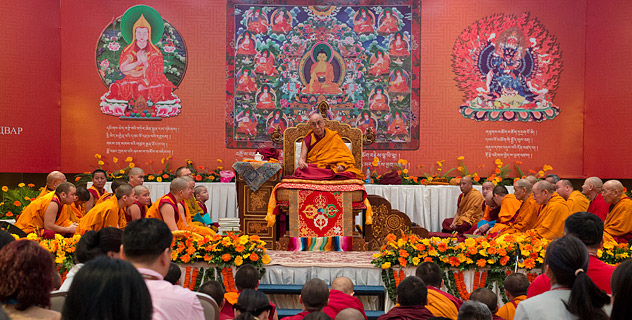
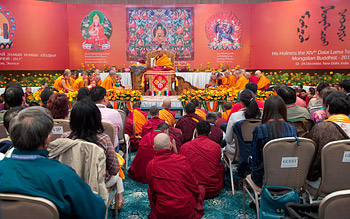
New Delhi, India, 2 December 2013 – A group of 818 Buddhists from Mongolia converged on the Kempinski Ambience Hotel in New Delhi, where they were joined by 60 Koreans and 15 Tibetans to listen to teachings by His Holiness the Dalai Lama. He was escorted from his car to a stage at one end of the hotel ballroom, which had been transformed by a large backdrop featuring a painting of the Buddha and the 17 Nalanda Masters and images of Je Tsongkhapa and Vajrabhairava. After he had taken his seat on the throne, monks led a recitation of the Heart Sutra in Mongolian.
“The verse we recite, says ‘I take refuge … May I attain enlightenment.’ We need to remember that although we speak of ‘I’, Buddhists assert selflessness, that there is no self apart from the body and mind. The three texts I’m going to teach are the ‘Blazing Teaching’, a praise spoken by the Buddha and the ‘Foundation of All Excellence’ and ‘Three Principal Aspects of the Path’ by Je Tsongkhapa.”
His Holiness observed that there have been many ups and downs in Mongolia, but now, in the 21st century, Mongolians are reviving their Buddhist traditions that earlier flourished for 1000 years. The question today, when the world is so materially advanced, is what the benefit of the Dharma is. Material development gives us sensory satisfaction, but when we become obsessed with sensory pleasure we lose our peace of mind. Instead we are subject to anxiety, attachment and anger. Since we all want to find peace of mind, the Dharma remains relevant today.
Buddhists believe instead in causality, that our experience of pain and pleasure arises through causes and conditions. The way causes and conditions give rise to results is an expression of karma. If you treat others well, good results; if you harm them, bad results. Altruism always brings benefit, which is why religions teach us to be compassionate.
“When you know how to free yourself from suffering and ignorance, you’ll know how to lead others away from them too. But to fulfil this role properly requires omniscience, which empowers you to judge what others need.”
His Holiness drew attention to a unique feature of Buddhism, the Buddha’s injunction to his followers not to take his teaching at face value, but to test it as a goldsmith tests gold. This ensures that Buddhist teaching continues to deal with reality. Masters like Nagarjuna, Dharmakirti and Dignaga did just that. They examined the Buddha’s teachings with reason and logic.
Emperor Trisong Detsen invited Shantarakshita from Nalanda to establish Buddhism in Tibet. The adept Padmasambhava joined him, so the king, preceptor and adept were responsible for preserving the Nalanda tradition. Later, there were said to be three emanations of Manjushri among the scholars in Tibet: Sakya Pandita, Longchen Rabjampa and Je Tsongkhapa.
Before lunch, His Holiness gave the transmission of a text known as ‘Blazing Teaching’, a praise of the Dharma composed by the Buddha. After lunch he began to teach the ‘Foundation of All Excellence’. It begins with outlines about the lama you rely on, the disciple who relies and how you rely on him. Je Tsongkhapa says ‘if you wish to discipline or tame others’ minds, you have to have first tamed your own mind. The essential qualities of a teacher were summed up as being learned and accomplished.
One of the ways of making our own lives meaningful is to contemplate death, its inevitability and the uncertainty of when it will occur. To prepare we need to tackle our disturbing emotions. The teachings in both Tsongkhapa’s texts derive from the Four Noble Truths. He said that because they encompass the entire teaching of the Buddha, they are very significant. The Four Noble Truths can be further elaborated in terms of the 12 links of dependent origination, which can be seen illustrated round the edge of the painting known as the wheel of life. The first link, the source o all suffering in the cycle of existence, is ignorance.
Before bringing the day’s teaching to a close, His Holiness mentioned that he intends to perform the ceremony for generating the awakening mind tomorrow. He also plans to begin the 13 Deity Vajrabhairava empowerment. He reminded the gathering that, as he has made clear previously, it would be better, if there is anyone present who persists in propitiating the perfidious spirit Dolgyal, that they do not attend tomorrow.