
Photo/American Himalayan Foundation
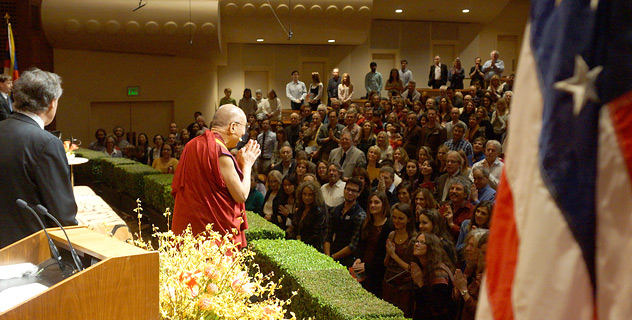
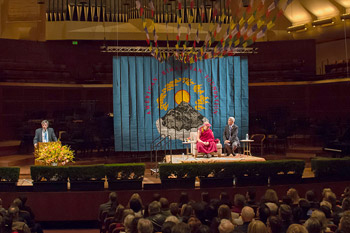
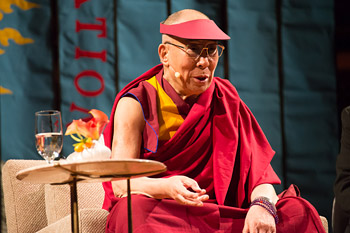
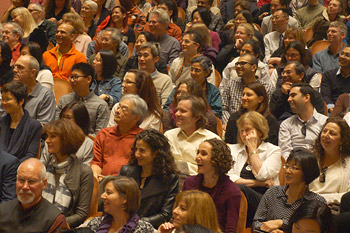
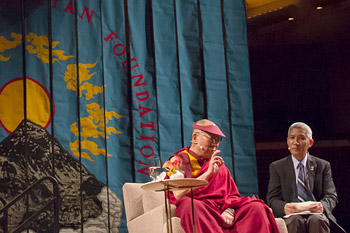
San Francisco, California, USA, 22 February 2014 – San Francisco was the first place His Holiness the Dalai Lama visited on his initial trip to the USA in 1978, when he accepted an invitation from Richard Blum and his wife Dianne Feinstein. Today, he was the guest of the American Himalayan Foundation, set up by Blum 30 years ago to help people of the Himalayan region, including Tibetans, with education and other support, and the Blum Center for Developing Economies, which aims to tackle poverty and inequality.
Photo/American Himalayan Foundation
His Holiness began in his customary way:
“Brothers and sisters I’m extremely happy to be with you. I’m here as one human being among the 7 billion alive today. We all want happiness and we each have the right to achieve it. A world without problems is impossible. In old age we have problems, but we also have a great deal of experience – that’s our beauty. Young people on the other hand are fresh with new ideas and aspiring vision – that’s their beauty. Faced with problems, how can we hope to lead a happy life? Many of our problems are related to our mental attitude. The more you adopt a broad and realistic view, the better able you are to deal with such problems. Maintaining a calm mind is the key to being happier and more peaceful. This is true for all 7 billion human beings, who are emotionally, mentally and physically the same.”
“Recently Pope Francis rebuked and suspended a German Bishop for living an extravagant lifestyle inconsistent with the teaching of the Catholic Church,” His Holiness reported. “He wanted to put a stop to such hypocrisy. Recently, in Eastern India when I was asked whether modern education gave sufficient guidance about ethics I pointed out that many smart, educated people are among the corrupt. Clearly more needs to be done to close the yawning gap between rich and poor. This involves ethics and won’t be achieved simply through prayer. It requires action based on truthfulness, honesty and transparency. These give rise to trust which leads to genuine friendship. And, because we are social animals, we not only need friends, but we are dependent on others for our very survival.
“Peace of mind and physical well-being are closely related. Some years ago, a scientist at Emory University told me that continuous anger, fear and suspicion tends to eat into our immune system. Besides, peace of mind and warm-heartedness bring confidence.”
His Holiness asked whether the world would be changed by governments or the United Nations and answered that change actually begins with the individual. He commended thinking of the 7 billion human beings as belonging to one great human family. And appealed to those who have children to show them affection and help them develop a broad perspective on the world.
Turning back once more to the topic of Shugden he declared that he had once worshipped the spirit himself. Gradually, however, he came to realise that there was something wrong with it, particularly in the context of the Buddhist tradition. He looked into its history and discovered that it had come about during the time of the 5th Dalai Lama, who had referred to it as a malevolent spirit arisen from distorted prayers that harms the Dharma and sentient beings. He suggested the protestors complain to the 5th Dalai Lama.
“Due to ignorance and distorted information, the followers of this practice are completely confused. In India, they have their own monasteries where they can do what they want. Kelsang Gyatso, one of their teachers once told a reporter in England that the 14th Dalai Lama had done nothing beneficial for the cause of Tibet. Isn’t this something of a lie?”
Returning to the Nature of the Mind, His Holiness quoted a friend who once told him that all religions seek to answer three questions: What is the self? Does it have a beginning? And does it have an end? For religions that believe in a creator god, he creates the self, so it has a beginning, but it is unclear whether it has an end. For traditions like Jainism, aspects of the Samkhyas and Buddhism, there is no creator other than self-creation. For Buddhists the body has a beginning and end, but consciousness does not. Only Buddhists assert that there is no self separate from the body and mind, which is not to say there is no self at all.
Liberation is related to consciousness and Buddhism provides a great deal of explanation of the mind. In ancient India, His Holiness went on, traditions that engaged in cultivating single-pointed concentration and insight included profound explanations of the nature of mind. They explain that ultimately negative or destructive emotions are based on ignorance, the antidote to which is knowledge and awareness. Ignorance is the cause of suffering, but by using our human intelligence to the full we can overcome it. Once you can control your mind, he said, you can exercise full control of your body.
”In the later part of the 20th century, scientists began to recognise something we call mind besides the brain. Then they discovered the plasticity of the brain. From the Buddhist point of view, nothing material will ever be the substantial cause of mind, nor will mind be the substantial cause of the body. Mind is said to have clarity, like water, and its nature is awareness.”
After briefly answering several questions from the audience, everyone stood respectfully for a unique performance of the Tibetan national anthem on piano and cello. After thanking the musicians and his hosts for inviting him, but before leaving the stage, His Holiness told the audience about the Tibetan flag that stood to one side. He explained that Mao Zedong had asked him in 1955 whether Tibet had a flag and on hearing that it did told him that it was important that it should be preserved and flown next to the Chinese one. His Holiness joked that while Chinese hardliners today complain of the Tibetan flag being a symbol of separatism, he feels Mao Zedong gave him permission to use it, which made everyone laugh.
Tomorrow, His Holiness will be speaking in Berkeley.