
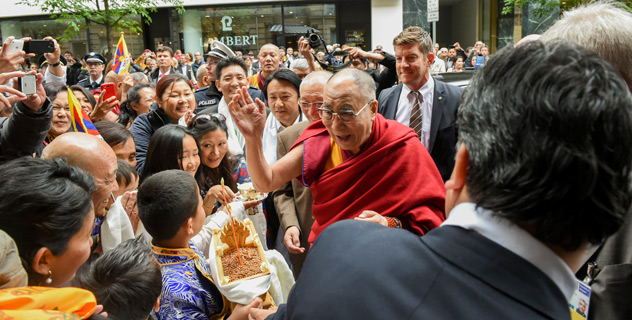
Frankfurt, Germany, 13 May 2014 – During the drive from Rotterdam to the airport at Amsterdam this morning the police escort proved valuable. An accident on the highway had blocked traffic, but the escorting police were able to lead His Holiness the Dalai Lama’s motorcade by other routes to reach the airport with the least delay.
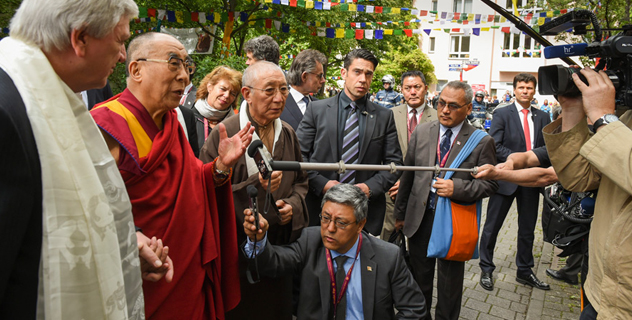
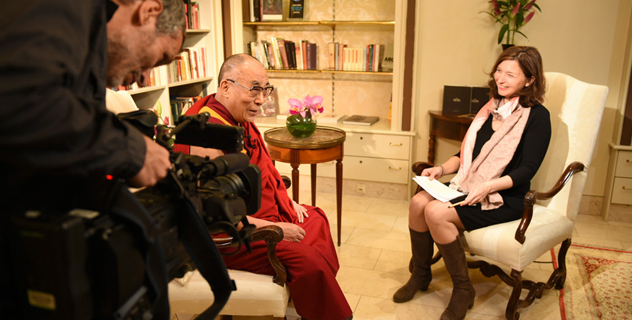
Ms. Schortmann asked why His Holiness keeps talking about inner peace and he replied that to create a peaceful world we first need inner peace. World peace cannot be built on the basis of anger and jealousy, nor on the basis that ‘we’ must win and ‘they’ must lose.
For dpa, Germany’s largest news agency, Jakob Blume posed a question about the pro-Shugden demonstrators who have been dogging His Holiness’s steps round Europe on this visit. He answered:
“I also used to propitiate this spirit, so I have experience of the ignorance they are labouring under. When I realized there was something wrong with it, I stopped doing it. More and more people came to know that and asked about it. It was necessary to tell the truth; it is my responsibility to tell the truth, to explain the reasons why I stopped that practice. Whether people listen or pay heed to what I say is up to them.”
Blume mentioned that last time he was here, His Holiness addressed the Parliament of the State of Hesse in Wiesbaden. He asked if he was disappointed not to do so this time. His Holiness said that similar questions had been raised in Oslo and clarified that his visit is entirely non-political and that his main concern is to talk to the public about human values and inter-religious harmony.
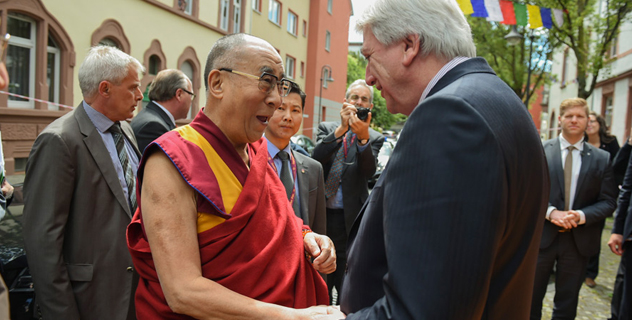
“Your Holiness, we are very happy to be meeting with you and to give you the opportunity to share your message with us. We have for decades admired you and your work for peace and freedom in Tibet. In Germany we have a clear respect for self-determination, human rights and peaceful co-existence.”
In his reply His Holiness said: “I very much appreciate your words. Tibet’s cause is a just cause; it also concerns our rich culture, the preservation of which is a priority for us. I appreciate your coming to meet me at this small Tibet House.
“Soon after arriving in India in 1959, we set up a Tibet House in New Delhi and later another one in New York. Dagyab Rinpoche here was the Director of Tibet House, New Delhi from 1964 to 1966, and then he came to Germany to work at Bonn University. When he proposed establishing a Tibet House here, I agreed with a view to its preserving Tibetan culture and Buddhist knowledge.”
He added that Tibetan culture is a Buddhist culture and that while the Buddhist part is largely of interest to Buddhists on a personal level, culture relates to the community. He pointed out that Tibet’s Muslims maintained their own faith purely, while at the same time absorbing much from Tibetan culture. He mentioned that a part of the Haj, the pilgrimage to Mecca involves animal sacrifice. He recalled an old Tibetan Muslim telling him about it, folding his hands and apologizing in clear reflection of the common Tibetan concern for the lives of animals. As a culture of peace and compassion, His Holiness said, Tibetan culture is worth preserving. He added that he is also very concerned about the state of the delicate natural environment of the Land of Snow that has been referred to for its significance to climate change as the Third Pole.
“Politicians too should know more about the mind and human psychology.”
He explained that the Buddhist literature contained in the Kangyur and Tengyur collections can also be categorised as dealing with Buddhist science and philosophy on the one hand and Buddhist religious practice on the other. Seeing that the science and philosophy sections can be of interest from an independent academic point of view work is going on to extract material about Buddhist science and Buddhist philosophy with the intention of making it available in separate books. The first, a volume dealing with science from Buddhist sources, is complete and a translation into English has already begun.
Among questions His Holiness was asked was an enquiry about what has happened to dialogue between Tibetans and Chinese. He explained that when Deng Xiaoping indicated in 1979 that he was open to talk, Tibetans were prepared, having decided as early as 1974 that they would eventually have to talk to the Chinese and that they would not seek independence.
“We were hopeful of positive developments under Hu Yaobang in the 1980s, but then the Tiananmen incident occurred and hardliners took control. Contacts resumed during Jiang Zemin’s leadership in 1993 and were resumed again in 2002. Kelsang Gyaltsen here was one of the delegates to the meetings. However, there was no result. The Chinese continue to accuse us of separatism. The last meeting took place in 2010.”

Asked what Germans can do to help the Tibetan people, His Holiness suggested they visit Tibet, see the situation for themselves and let people know what they find. The Minister-President made a gift of a watch to His Holiness on behalf of himself and his colleagues. Professor Dr Klaus Jork, Honorary President of Tibet House expressed appreciation for His Holiness’s visit.
His Holiness ended the meeting saying:
“I appreciate your warm feelings and expressions of support. I look forward to Tibet House’s flourishing as a centre of learning, contributing to the study of the mind.”
Tomorrow, His Holiness will give a public talk in the Fraport Arena on ‘Self-awareness and Compassion’.