dalailama.com
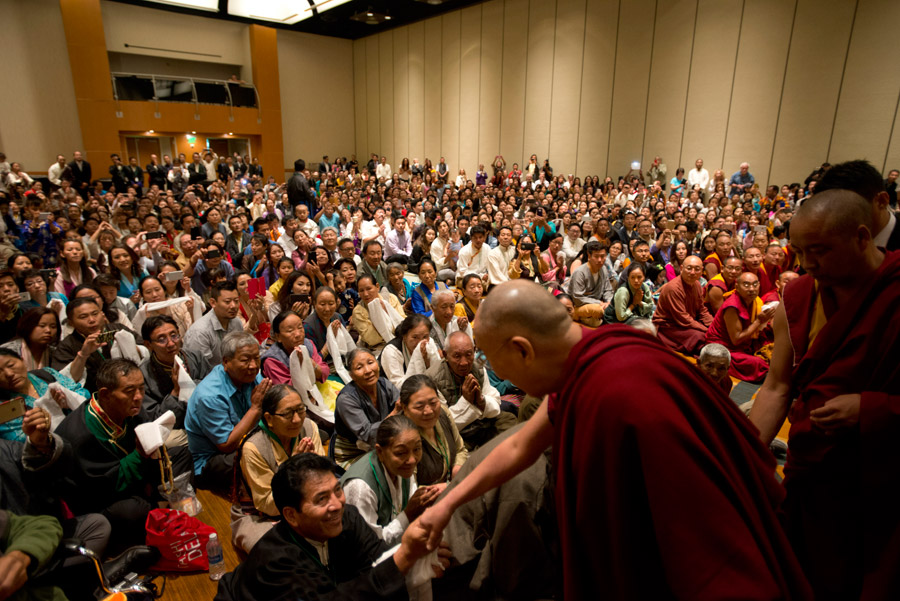
Westminster, CA, USA, 19 June 2016 – On a second day of weather forecast warnings about hot weather, His Holiness the Dalai Lama started the day by meeting 400 members of the Tibetan Association of Southern California in the cool of his hotel. He said:
“Trisong Detsen had a Chinese mother, so he could have brought Buddhism to Tibet from China. Instead he chose to go to the original source and invited Shantarakshita to come from India to Tibet. Despite his age, with the help of Guru Padmasambhava, who overcame inner and outer obstacles, he established Samye. The Chinese Hoshangs suggested that there was no need to study, but Kamalashila made clear the importance of study, reflection and meditation, an approach we’ve adopted for the last 1000 years.
“In Dharamsala and Ladakh there are now Dharma study groups among lay-people. Earlier this year after my medical treatment in Rochester, I visited Deer Park in Madison. I recommended that it becomes a more broadly based centre of learning, where the knowledge of the workings of the mind and emotions that we have in our tradition can be combined with the work on emotions of people like Paul Ekman and his daughter to the wider benefit.”
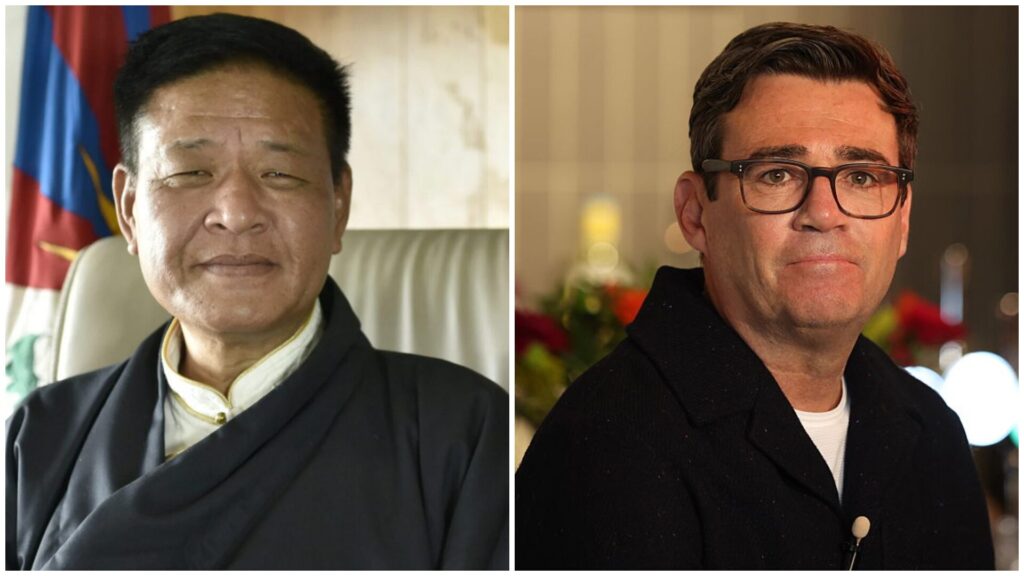
His Holiness ended by suggesting that change in China is inevitable. He introduced the former speaker of the Assembly of Tibetan People’s Deputies, Penpa Tsering, as his next representative in North America. He encouraged his listeners to be happy.
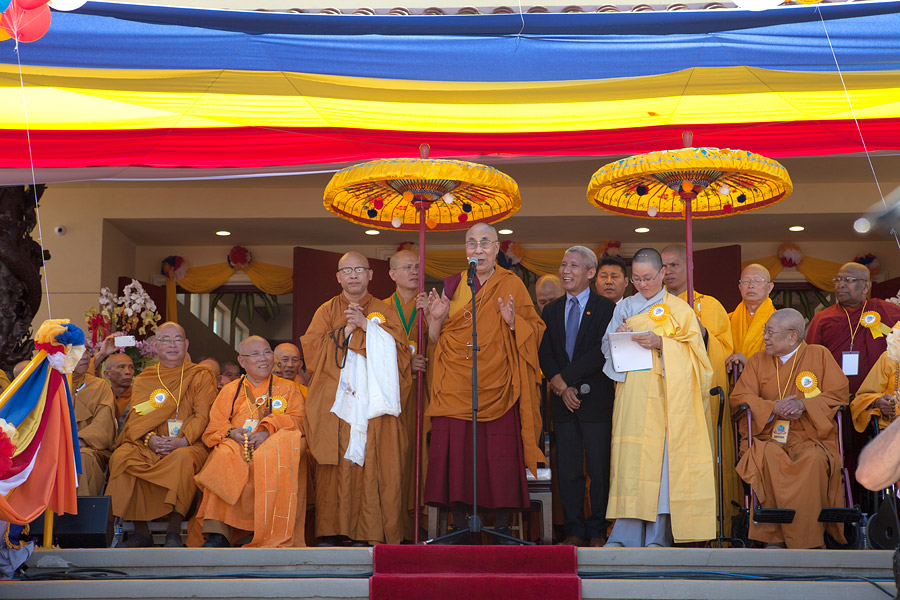
His Holiness was invited to give the keynote address:
“Respected fellow monks and nuns, brothers and sisters, once more we are gathered together under the hot sun. I am just a student of Buddha Shakyamuni’s teachings, particularly those of the Nalanda tradition. I am happy that you have been able to construct this temple. Some of you are refugees like me. I admire the way you Vietnamese keep up your culture and traditions. I’ve seen this in other parts of the world too and I appreciate it. The US is the leading nation of the free world and you’ve come here in search of a better life. The US government and local people have extended their hands to help you.
“However, the only way to preserve the scripture and realization of the Buddhadharma is through study and practice. We need to read and study the scriptures and apply the Three Trainings in practice. There is no other way. We have to pay attention to what the Buddha has already taught. I am nearly 81 years old, but I still consider myself a student. The ancient Indian traditions that cultivated the practices of shamatha and vipashyana developed a profound understanding of the workings of the mind and emotions. How to tackle the destructive emotions and cultivate those that are positive is something we can share with the world today. Therefore, I suggest you consider making this temple a centre where anyone can learn about the mind and emotions and where members of other spiritual traditions can meet and get to know one another.”
His Holiness began a short talk with a verse of homage to Buddha Shakyamuni. He mentioned how pleased he was to see so many brothers and sisters from other Buddhist traditions present. Holding up a Tibetan bell in the Vietnamese chant-master’s possession, His Holiness remarked that it should be accompanied by a vajra that symbolizes compassion, while the bell represents wisdom. He pointed out that the sound of the bell is made neither by the clapper nor the rim alone. The bell only rings when they come together.
“We recited the Heart Sutra,” he said, “which is a concise rendering of the Perfection of Wisdom teachings that explain emptiness. The Sutra says that the five aggregates are also empty of inherent existence, a declaration of the selflessness of phenomena in addition to the selflessness of persons. The essence of the Heart Sutra is that ‘all the Buddhas who perfectly reside in the three times, relying upon the perfection of wisdom, become manifest and complete Buddhas in the state of unsurpassed, perfect and complete enlightenment.’ Realization of emptiness directly complemented by the awakening mind of bodhichitta is the basis of the perfection of wisdom.
“What is emptiness? ‘Form is empty; emptiness is form.’ If we investigate and analyze form, we won’t find anything inherently existent. It exists in dependence on other factors. Appearance and emptiness complement each other. During the first Turning of the Wheel of Dharma the selflessness of persons was taught, but during the second Turning the selflessness of phenomena, the five psycho-physical aggregates that are the basis of the person, was also revealed.”
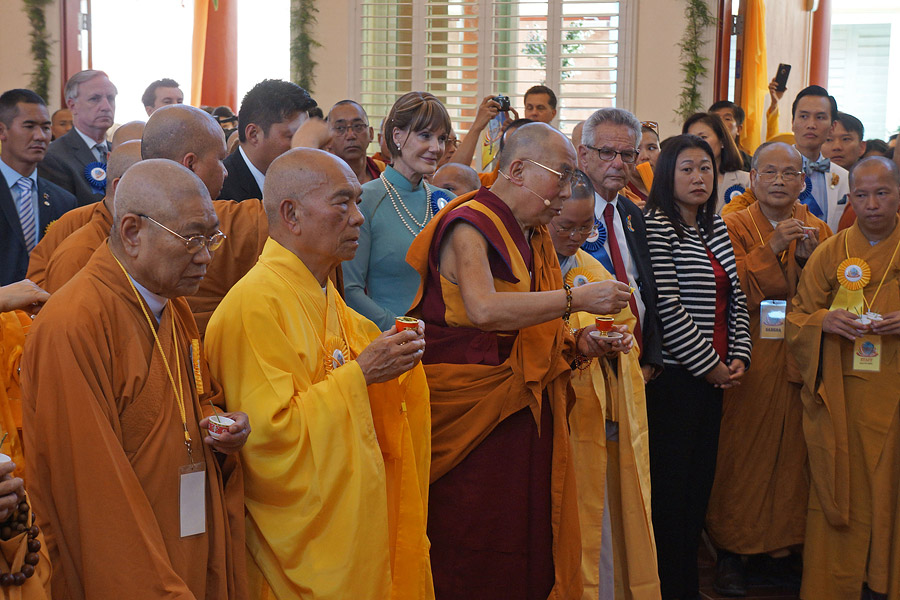
“We are all the same as human beings. I am nothing special. I am a student of Buddhist philosophy and for people who know nothing I can be a teacher, but among top scholars I am a student. The purpose of the Perfection of Wisdom teachings is to put an end to destructive emotions such as anger. It’s effective to seek the basis of anger and investigate whether anger has any benefit. Destructive emotions are rooted in ignorance that is a distortion of reality and only understanding of emptiness can counter it.”
Asked what youth can do to stand against violence in the world, His Holiness spoke of the young people from countries torn by conflict who he had recently met in Dharamsala and how their determination to take action had impressed him. A young man who admitted he’d been to jail for trespass told His Holiness how much he had learned from his teachings and how pleased he was to meet him. His Holiness told a young woman who asked if he would be the last Dalai Lama and wouldn’t that leave a spiritual gap to fill that the Buddha’s teachings have flourished for 2600 years without a reincarnation of the Buddha.
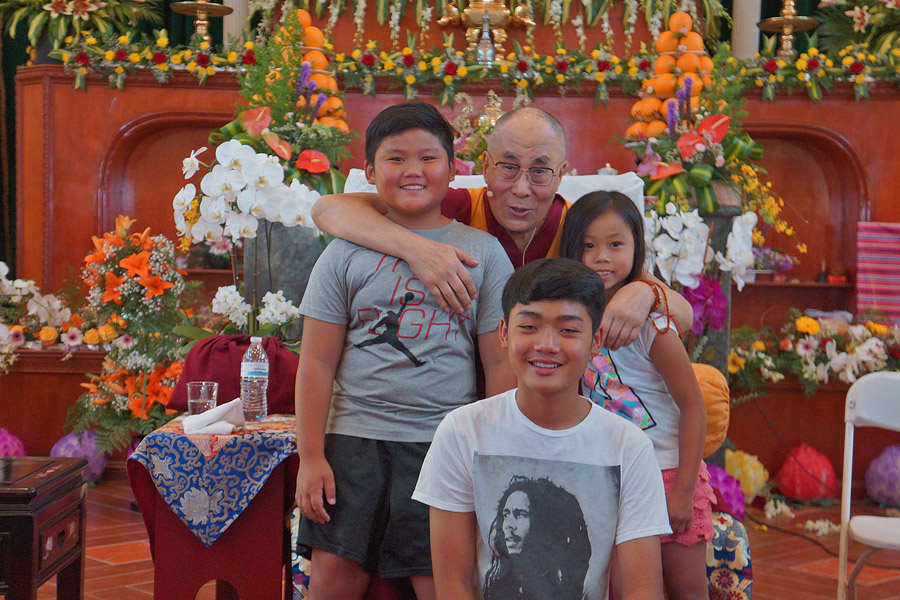
Finally, a small boy asked what His Holiness had wanted to be when he grew up and his little sister wanted to know how he’d become famous. His Holiness replied that he’d been chosen as the Dalai Lama when he was four years old and he’d had no choice. But later he’d found that having the name Dalai Lama could be useful in trying to help other people, so that’s what he tries to do.
At the Geden Shoeling Center nearby, His Holiness said he’d known the founder, Khensur Rinpoche, Lobsang Jamyang for many years and was happy to come to his center. He said that Buddhism remains relevant today and that the Nalanda Tradition in particular encourages the use of reason and intelligence. He recommended that the center become somewhere that people who are not necessarily Buddhist could come to learn. He suggested that another project that the center could take on would be the translation of key volumes of the Kangyur and Tengyur into Vietnamese.