
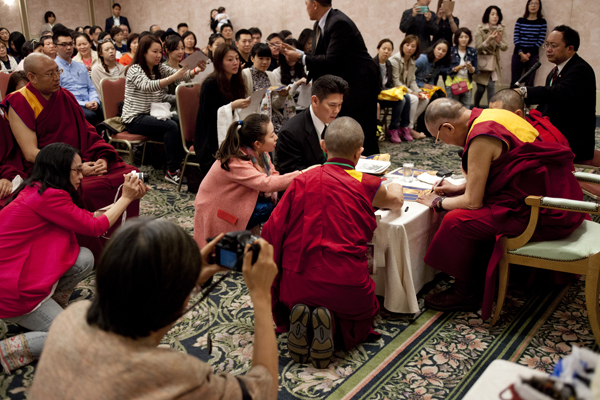
TOKYO, Japan: On the final day of visit to Japan on 18 April, His Holiness the Dalai Lama yesterday met over 100 Chinese followers, including many from mainland China, in Tokyo.
“Wherever I go I try to meet with Chinese friends. Tibetans and Chinese have had relations with each other since the time of Songtsen Gampo. Sometimes we’ve fought, but for more than one thousand years we’ve shared an interest in Buddhism. This began when Songtsen Gampo took a Chinese and a Nepalese wife. So I often tell Chinese Buddhists that I respect you as the senior students. Similarly, when I’m talking to Indians I tell them that as far as we are concerned Indians are our gurus and we are the disciples. And I mention that in times of trouble we look to the gurus and senior students for help. I have been to Taiwan several times and many Chinese have come to Dharamsala so our people to people relations have improved.”
He pointed out that when we don’t know what the real situation is it gives rise to suspicion, which is unhelpful and unnecessary. If we are able to meet and learn what’s really going on it makes for happier relations. He said that he had been recommending that Tibetans reach out to China even before the Tiananmen incident took place, but until that point people from mainland China avoided contact with Tibetans. After it happened they came round and connections became stronger. He added that even today it seems a lot Chinese are out of touch with reality; therefore he suggested that people from Taiwan and Hong Kong, who have a better idea about what’s going on, should do what they can to help the people of China become better informed.
“Although it might seem inappropriate to say so, those people in Tibet who have the courage to commit self-immolation are clearly capable of harming others, but have determined not to do so. Despite the difficulties they face they still follow the Buddha’s teaching about non-violence. This may not be clearly understood,” His Holiness said.
He reiterated that the Tibetan side is not seeking separation from China. “Since 1973 we decided not to take that line. Direct contact with China began in 1979 and we had already decided our stand. What we are asking for is the implementation of provisions already recognised in the Chinese constitution. Hardliners use the phrase ‘Greater Tibet’, but there is already recognition of Tibetan regions, prefectures and counties that share a common culture and language. We want these provisions fulfilled on an equal basis,” he said.
“Because the Tibetan language is a focus of our identity its use is discouraged. But as you know, the Tibetan language today is the best medium for explaining Buddhist philosophy and science. Sanskrit is no longer a living language and although there is substantial Buddhist literature available in Chinese, Tibetan translations are more accurate. So this issue is not just the concern of the Tibetan people, it’s about the expression of Buddhism in the world, the most comprehensive teaching of which is preserved in Tibetan.
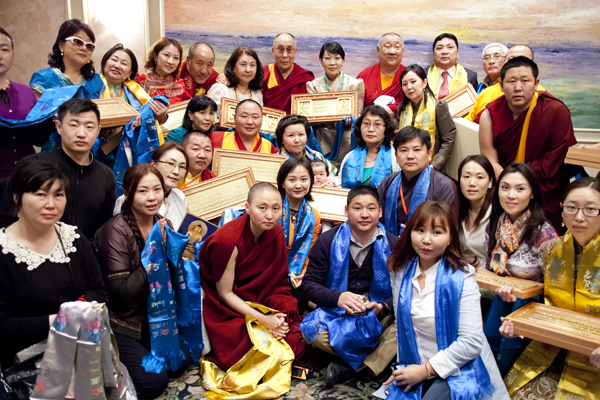
“The existence of different languages is not a threat. Look at India, many people there speak and write in different languages without it being a threat to the country. When they enjoy equal rights under the rule of law people can live together in freedom and equality. Tibetans having their own language is not in itself a threat.”
He said Hu Jintao’s idea of promoting a harmonious society was admirable, but it couldn’t be fulfilled by use of force. Friendship and harmony need to be based on trust not fear. Meanwhile the internal security budget in China exceeds the defence budget. His Holiness suspected that of the 200 countries in the world, this is only true of China. He concluded by saying that if harmony and respect prevailed between Tibetans and Chinese they could live together.
His Holiness then met a group of about 50 Mongolians. He praised the friendship and cultural ties Tibetans and Mongolians have long shared.
“In the 20th century you faced great tragedy and Buddhism in Mongolia went into decline. Tibetans are facing similar problems now. But relations between Tibetans and Mongolians go back hundreds of years to when we roamed the land as nomads. Now that you have regained your freedom, you must use the opportunity well. There are too many examples in Africa of what can go wrong when freedom and democracy are misused. With democracy comes responsibility. Today, Mongolians place great faith in the Dharma, but faith based on reason is even firmer and more stable, so study is important. In the past there were many great scholars who came from Mongolia. However, understanding of Buddhism needs to be combined with basic modern education. Tibet was backward in terms of modern education and technological development and we lost our country.”
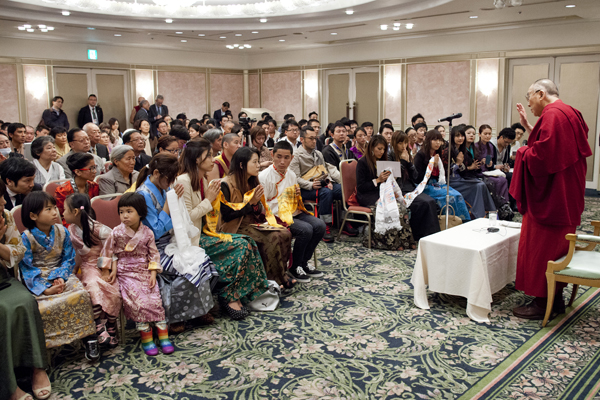
His Holiness advised Mongolians to emulate the determination exemplified by their people at the time of Genghis Khan. But today they need that kind of courage combined with intelligence. He said that he has also counselled Indians to focus development efforts in villages, not only in cities. Schools, hospitals and other facilities need to be provided to people in the rural areas where they live.
He recalled that there are now 300 Mongolian monks studying in the main Tibetan monasteries in South India who will be able to contribute to the flourishing of the Dharma in the future.
His Holiness also spoke to Tibetans based in Japan. “Tibetans are passing through a very difficult time in their history. We should also be proud of having thousands of year old distinct language, culture and religion. Tibetan is the only language capable of explaining Buddhism, one of the major world religions, particularly ancient India’s Nalanda tradition. During our interaction with modern scientists for the last two decades, the latter has highly appreciated the efficiency of the Tibetan language in studying the mind and emotions.”
He said Tibetans inside Tibet have kept alive their spirit and remained committed to non-violence in dealing with the urgent situation in Tibet. Those Tibetans who have self-immolated have not hurt others, he said, adding that Chinese visitors to Tibet report that Tibetans are a kind and compassionate people.
He suggested that as the office of Tibet has shifted to Washington, DC, there should be a branch office at New York to maintain contact with a considerable number of Tibetans living there. He also advised the Tibetan community to keep close contact with the office of Tibet.
His Holiness then drove directly to Narita airport to board his flight to India. Representative Lhakpa Tshoko, who will shortly be transferred to Australia, Lungtok, who is to be his successor as Representative in Japan and East Asia and Tsering Dorje from the Representative’s office, were all there to see him off at the end of a successful two weeks in Japan.
[Inputs from dalailama.com]