
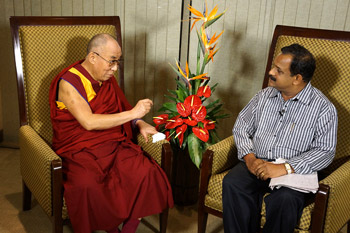
Varkala, Kerala, India, 24 November 2012 – His Holiness the Dalai Lama began the day with an interview at his hotel with Mr PP James for Doordarshan. Asked what he thought of Indian spirituality, he replied,
Challenged to agree with Sree Narayana Guru, founder of the Sivagiri Mutt, who spoke of one caste, one religion and one god, His Holiness said that whatever other differences we may have, we all belong to the caste of human beings. As for religion, the essence of them all is compassion, love, tolerance and respect for others. Their different philosophical views reflect different approaches to the same end. He advised that we should be faithful with regard to our own religion without becoming attached to it, for attachment blinds our ability to be unbiased and appreciative of other traditions.
About the series of self-immolations that have taken place in Tibetan areas, His Holiness made clear he sees them as a symptom of problems that Tibetans did not create. He repeated his appeal that the Chinese authorities investigate why they are taking place, saying,
Questioned about the Chinese assertion that they will control the search for his reincarnation, His Holiness conceded that Chinese authorities might have taken an interest in the matter in the past, because at that time they were Buddhists, received Buddhist teachings and believed in rebirth; there was a certain logic to it. Therefore, if the communist Chinese want to be involved, they should show that they accept rebirth and recognise the reincarnations for Mao and Deng.
Finally, as regards capital punishment, His Holiness clearly stated that he is a signatory of Amnesty International’s petition against the death penalty. He rejoices when another country abandons this measure. He feels that convicts should be imprisoned and have the opportunity to develop and express remorse, but concluded that it all depends on the country’s legal system.
Next was the day’s main event, the Inauguration of the 80th Sivagiri Annual Pilgrimage. In his welcome address, Bh. Shree Rithambharananda Swamikal paid tribute to Sree Narayana Guru as a revolutionary and leading social reformer. In 1928, he gave his approval for the first Sivagiri Pilgrimage, advising that pilgrims engage in 10 days of austerity or self-purification observing the Buddha’s principles of the five purities of body, food, mind, word and deed. He also recommended that pilgrims wear yellow clothes, emulating the Buddha’s saffron robes and keep 8 goals of the pilgrimage: education, cleanliness, devotion, organization, agriculture, trade, handicrafts and technical training.
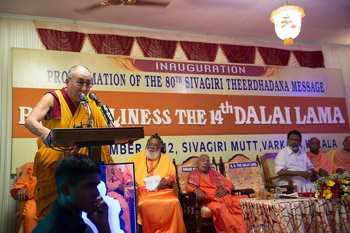
“It’s a great honour for me to participate in this 80th annual pilgrimage, recalling Sree Narayana Guru, who led such a meaningful life. Historically, in the 7th and 8th centuries, the great philosopher and logician Shantarakshita brought Buddhism to Tibet and we became chelas of India. As such I feel it a great honour to come here and participate in this meeting.”
“Once we develop empathy, compassion and concern for others, openness, trust, transparency and respect for others arise spontaneously. Once we develop concern for others, mistrust and suspicion vanish of their own accord.”
“I always try to share with others the idea that in order to become compassionate it is not necessary to become religious. Your Guru-ji spoke of one religion; I too say that compassion is the universal religion.”
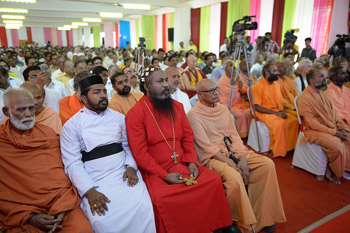
He suggested that compassion is also the basis of ahimsa, for too great a stress on our own interests at the expense of others is the basis of bullying, cheating and corruption, which is rife in many places, including India, and which is a form of violence. India has a wonderful tradition of ahimsa based on concern for others’ well-being. Moreover, he said, India is a world leader in the field of religious harmony, setting an example for others to follow.
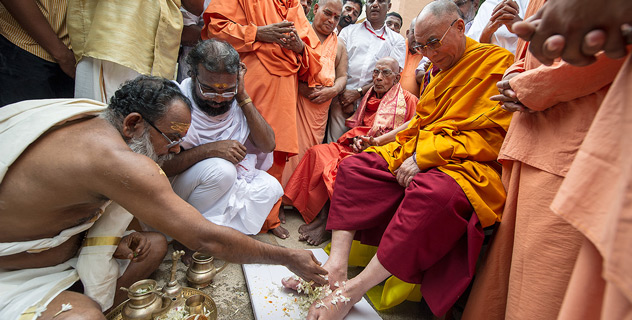
His Holiness was requested to release logos related to the pilgrimage and was presented with mementos of the occasion, before joining the Swamis and other guests for lunch. After bidding his hosts a respectful farewell, he began the long drive up the coastal road to Kochi. When he broke his journey at Alappuzha he was met by a contingent of police who presented arms to the sound of a bugle. Arriving in Kochi, he found his hotel decorated with Tibetan prayer flags with young Tibetans on hand offering an enthusiastic and traditional welcome.