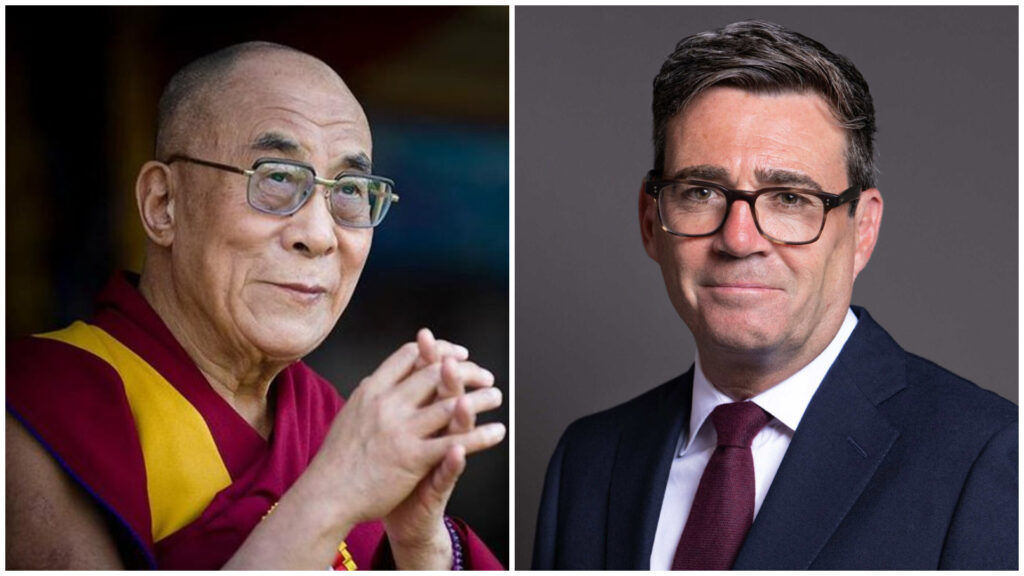
First-ever public meeting of Mind and Life Dialogue opens in India[Tuesday, 23 November 2010, 9:36 a.m.]
 |
|
Indian Habitat Center in New Delhi, India, venue for
the Mind and Life Conference from 21-23 Nov 2010. Photo/Tenzin Choejopr/OHHDL |
New Delhi:
The Mind and Life Dialogues that began in 1987 as a joint quest between
scientists, philosophers and contemplative practitioners to understand
the human mind and the benefits of contemplative practices is holding
its first public meeting in Asia. Previous Mind and Life
dialogues have predominantly explored the benefits of Buddhist-based
contemplative practices. This 22nd edition of dialogue now being held
at India Habitat Center in New Delhi from 20 – 23 November is the
outcome of His Holiness the Dalai Lama’s wish to hold Mind and Life
Dialogue in Asia particularly India where a rich array of philosophical
and contemplative traditions have originated and developed since
ancient times. The dialogue in New Delhi seeks to broaden the
contemplative science research by examining practices from the Indian
philosophical and cultural heritage including Vendanta, Jain and Yoga. Dr
Vijaylakshmi Ravindranath, chairman of the Center for Neuroscience of
the Indian Institute of Sciences (Bangalore) and founder-director of
the National Brain Research Center, said holding such dialogues for the
first time India, a land rich in contemplative science tradition would
help neuroscientists find answers to critical questions in
understanding the brain. Addressing His Holiness, she said Indian
scientists are already showing enormous interests in the dialogue
asking for workshops.In his presentation during the first
session of the Mind and Life dialogue, His Holiness the Dalai Lama
dismissed the notion that science is a killer of religion adding Indian
philosophical traditions including the Nalanda tradition of Buddhism
emphasise the importance of investigation and reasoning in
understanding the nature of reality. Such an approach like modern
science requires one to be skeptical and adopt investigation to gain
awareness or understanding of what benefits human beings in the
long-term perspectives. “There’s no concept of right or wrong,” he
said, “Investigate the reality and there’s no danger to religion.”The
purpose of Mind and Life Dialogue, according to His Holiness, is to
simply expand knowledge not only on external matters but also internal
matters such as mind. The knowledge gained through this approach will
be used not only for individual benefit but for the well-being of the
whole humanity. Sometimes remarkable scientific and technological
knowledge, His Holiness said, are used for destructive purposes like
nuclear weapons; when used for constructive purposes, it could promote
a sense of individual well-being as well as concern for others.
Religious methods alone cannot bring a compassionate and peaceful world.In
the first session, Swami Atmapriyananda, the vice-chancellor of
Ramakrishna Mission Vivekananda University who is also a physicist and
a contemplative practitioner of Advaita Vendata tradition and Thupten
Jinpa, the principal English translator to His Holiness and a Tibetan
Buddhist scholar provided an overview of the philosophical perspectives
from Hinduism and Buddhism. In their presentations, Swamiji and Mr
Jinpa discussed the ways their traditions articulated the wider
understanding of reality that is the context for contemplative
practices. They emphasised similarities and differences in addressing
such questions as the nature of the mind and body, and techniques to
achieve personal transformation. Mr Jinpa said the primary sources of
Tibetan Buddhism are the texts authored by Nalanda masters like
Nagarjuna, Dhignath, Dharmakirti, Asanga, Vasobandhu, Shantideva, etc.Dr
Richard Davidson, Director of Center for Investigating Healthy Minds at
University of Wisconsin-Madison, in his presentation of scientific
findings on the nature of contemplative practices reported benefits of
compassion on brain for long-term practitioners including increase in
mindfulness and attention. He said anxiety at anticipation of pain or
suffering intensified in novice practitioners compared to expert
practitioners. In his study of Attentional Blink Task, dramatic changes
were cited among subjects who underwent three months training in
meditation practices.
 |
| His Holiness the Dalai Lama speaking at the opening of the Mind and Life conference in New Delhi on 21 November 2010. Photo/Tenzin Choejor/OHHDL |
The
third session on 22 November focussed on the understanding Vedanta
practice and its intersection with science with Swami Atmapriyananda
making his presentation on the nature of the Advaita Vedanta
practitioner. He discussed the number of stages of purification process
that leads dehypnotising the mind from false realities leading to
ananda or pure bliss. Commenting on Swamiji’s presentation on
the ‘small self’ or ego merging into the ‘greater self’ as if
understood in Vedanta tradition, His Holiness said the act of merging
itself in a way indicates the deconstruction of the self. He drew the
same analogy with the Christian practice of total submission of oneself
to the creator or God. Another more secular way, he said, is to reduce
self-centered arrogance. He said the methods are different in different
traditions but the effect is same.His Holiness then discussed
some cases of Tibetan practitioners who were clinically declared dead
but their body remained fresh for 2-3 weeks indicating the existence of
a subtler form of consciousness long after heart beating and blood
circulation had stopped functioning. Three such cases were reported
recently in south India where large Tibetan monasteries are located. Dr Singer said science have yet to find answers for such phenomena although they do occur.His
Holiness said until now science has focussed more attention on
understanding the external things or outer realities in contrast to
eastern traditions which have been around for centuries studying and
investigating internal things. He said there needs to be a closer
co-ordination among scientists and contemplative practitioners so
science will become more complete by carrying out more research work on
internal phenomena.Dr Matthieu Ricard, Buddhist practitioner
and the French interpreter to His Holiness the Dalai Lama, said the
dehypnotising process explained by Swamiji was similar to Buddhist
practice of undiluting a mind filled with distorted perceptions; the
act of deconstructing misconceptional reality leading to pure
awareness. In session four of the Mind and Life Dialogue,
His Holiness discussed the central practices in yoga and Jain
traditions with Muni Mahendra Kumar, a multi-linguist versatile Jain
scholar in physics, Mathematics, bioscience, philosophy, psychology,
parapsychology, ancient history, and meditation and Dr Shirley Telles,
director of research at Patanjali Yogpeeth in Haridwarand head of
Indian Council of Medical Research Center for Advanced Research in Yoga
and Neurophysiology at Bangalore.In addition to explaining the
contemplative practices in Jainism, Muni Mahendra Kumar presented some
empirical evidences of the overall benefits of emotional, mental and
physical developments through Preksha (science of living) meditation
carried out in over 10,000 schools in India. He called for a global
education system where education is not only focussed on providing
livelihood and career but also on how to live a life, a social life, as
a human being. He said reversal of coronary heart diseases among 20,000
patients were also reported. There were cases where immunity to cancer,
AIDS, and drug addiction increased. Studies are also being carried out
in areas such as juvenile delinquency. There are also efforts to bring
non-violent socio-economic changes in Naxalite-hit areas of Jharkhand
where efforts are on to bring non-violence training to poor people.
Muni Mahendra Kumar emphasised the need for a systematic research
design to help Indian scientists in implementing contemplative
practices in everyday life.
 |
| His Holiness the DalaiLama and Swami Atmapriyananda exchange views during the Mind and Life conference in New Delhi on 21 November. Photo/Tenzin Choejor/OHHDL |
Dr
Telles speaking on the physiology of meditation presented some findings
from a series of studies carried out in the last 17 years to examine
the application of yoga in clinical contexts for mental and physical
health. Using five meditation traditions – four from yoga and one from
Vipassana – the study found all five reduced signs of arousals in body
such as blood pressure, reduced heart rate and metabolism. She also
discussed the effects of meditation on attention and memory using the
Dhyana and Dharana meditative states as practiced in the Patanjali Yoga
Sutra. Studies were also carried out among schizophrenic patients using
the Dharana meditation in understanding distorted perceptions. In
his presentation on expansion and contraction approaches in Vedanta
contemplative practice, clinical scientist HR Nagendra explained the
Samadhi, that level of consciousness when the meditator, the meditated,
and the process of meditation merge together and become one. His
Holiness commenting on Dr Nagendra’s presentation referred to
descriptions of the nine stages of mental development in Samadhi
process in Buddhist meditation manuals. Dr Rajesh
Kasturirangan, associate professor at National Institute of Advanced
Studies (Bangalore) who completed his doctorate in cognitive science at
MIT in his comments suggested the integration of both philosophical and
theoretical knowledge base of eastern and western traditions to explore
grounds for unity. He said there could be avenues for the emergence of
a new discipline of what he called “science of human nature” or study
of well-being. Dr Kasturirangan said benefits of well-being can be
applied to many pressing contemporary issues such as education and
climate change. This could be achieved by culling together best of
theoretical ideas with latest advanced scientific developments. Citing
Bertrand Russell’s quote on the incompatibility of Plato and
Mathematics, he said it is possible for Nagarjuna and Neuroscience to
be compatible.