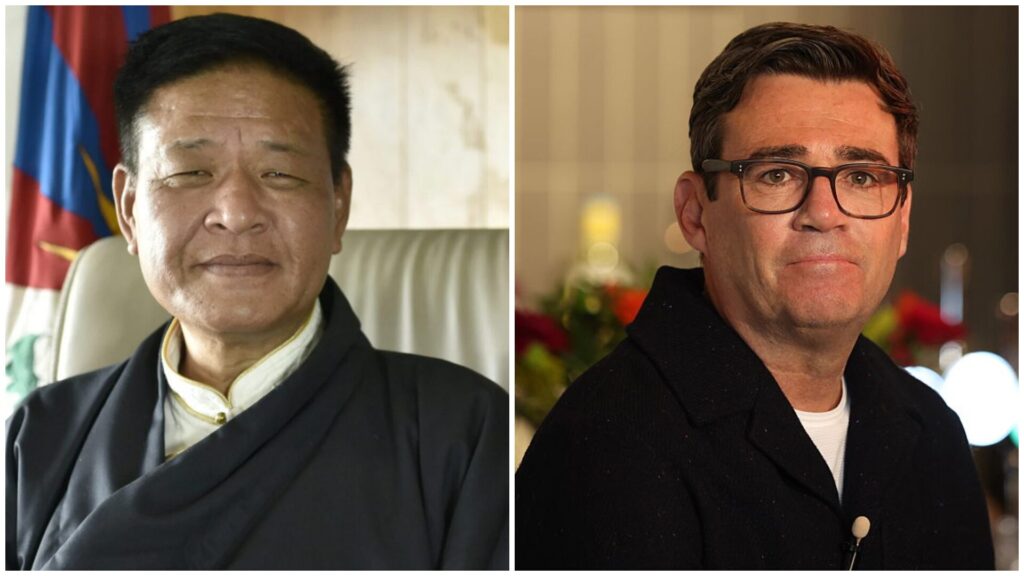
DHARAMSHALA: Tibetan political leader Dr. Lobsang Sangay inaugurated a day-long conference on Simla Convention After a Hundreds in Delhi on 3 July. The conference was organised by India International Centre in co-ordination with Tibet Policy Institute of the Central Tibetan Administration.
In his address, Sikyong Dr. Lobsang Sangay said: “I would like to make two clarifications. The first clarification concerns the legality of the McMohan Line. I would like to clarify that the demarcation of border between Tibet and India was done between two sovereign political entities. A sovereign Tibet legally ceded a part of its territory to British India.:
“The second point I would like to make concerns the Simla agreement and the 17-Point Agreement which Tibet was forced to sign with the People’s Republic of China in 1951. The weakness of both these agreements was that it divided one people sharing a common language, culture and religion and way of life into two. This is an important cause of the armed resistance that sparked in eastern and north-eastern Tibet which engulfed the whole of Tibet and culminated in the Lhasa uprising in 1959. This forced His Holiness the Dalai Lama and thousands of Tibetans to seek refuge mainly in India,” Sikyong said.
“It is my conviction that there is a viable and effective solution to the issue of Tibet. This is the Middle-Way Approach formulated by His Holiness the Dalai Lama, endorsed by the Tibetan Parliament in Exile and supported by majority of Tibetans in and outside Tibet. The Middle- Way Approach is based on the principles of non-violence and mutual respect. It does not seek independence for Tibet nor accept the present humiliating treatment of the Tibet people by China,” he added.
Around hundred people, including students, former diplomats, former ambassadors and scholars, took part in the conference.
Dr. Michael van Walt Praag, lawyer and author spoke on “International Perspective on the Simla Agreement”; Mr R N Ravi, former Special Director of India’s Intelligence Bureau, spoke on “Panchsheel Agreement 1954” and Dhondup Gyalpo, Senior Fellow of the Tibet Policy Institute, spoke on Tibet Perspective on Simla Agreement.
In the afternoon session, Prof Dibyesh Anand of University of Westminster, London, spoke on Indian Perspective on Simla convention”, Tenzin Norgay, Research Fellow of Tibet Policy Institute spoke on Tibet in the Great Game: View from London, and Mr Naresh Mathur, an advocate, on Reconciliation of perspectives and its outcome.