
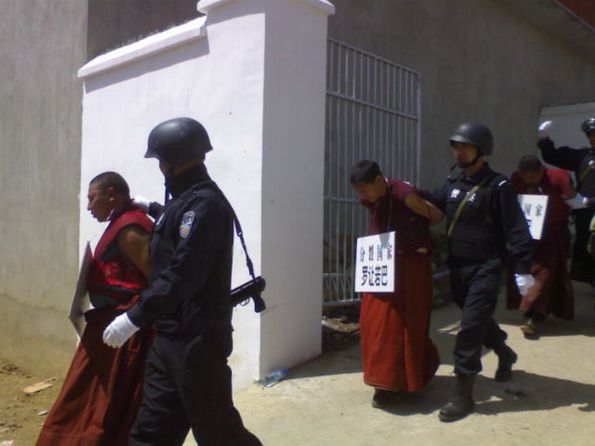
- Photo released by Boxun website in 2011 shows Tibetan monks with placards around their neck being forcibly taken away by Chinese police in a Tibetan area incorporated into China’s Sichuan Province
DHARAMSHALA: The Chinese government has planned measures to launch strike hard campaign to crackdown on Tibetans across Tibet, and those living in Nepal through collaboration with the Nepalese police, according to reports received by the Central Tibetan Administration.
The report said a meeting of Tibet Autonomous Region’s Public Security Bureau officials was held this April to launch the strike hard campaign to reinforce police crackdown on Tibetans in Lhasa, Tibet’s capital.
The strike hard campaign will give special powers only to a group of Chinese officials who are heading the Public Security Bureaus to implement the repressive measures like arbitrary detention, arrest, interrogation and beating of Tibetans.
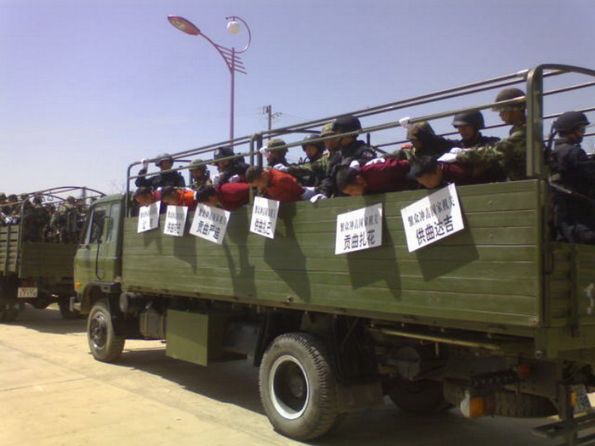
- 2011 file photo released by Boxun website shows Tibetan monks with placards around their neck being bundled away in Chinese military convoys in a Tibetan area incorporated into China’s Sichuan Province
It will also engage the Nepalese government and its police force to collaborate with the Chinese police to suppress Tibetans in Nepal, who the Chinese government alleged of carrying out separatist activities.
The strike hard campaign will be also imposed in Tibetan areas outside the so-called Tibet Autonomous Region, that is Kham and Amdo Province. Many of the self-immolation of Tibetans, to restore freedom in Tibet and for the return of His Holiness the Dalai Lama, took place in Amdo and Kham.
In capital Lhasa, numerous security committees have been set up under the supervision of specially-appointed Chinese officials having the rank of director of the Public Security Bureau, which include Lhasa’s deputy PSB director Luo Xiaobing. These officials will lead other security agencies like People’s Armed Police, Special Police and PAP border security forces to intensify crackdown in Lhasa.
The strike hard campaign will specifically target senior officials of the Tibetan monasteries and nunneries, Tibetan monks and nuns who have left monastic life, monks and nuns who were expelled from their monasteries and nunneries, and former political prisoners who have undergone indoctrination, suspected individuals and new arrivals.

- 2011 file photo released by Boxun website shows lay Tibetans being forcibly taken away by Chinese police in a Tibetan area incorporated into China’s Sichuan Province
The strike hard campaign in Tibet was first launched in 1996 to stifle Tibetan people’s voice against the Chinese government’s repression of religious freedom in Tibet. In monasteries, Chinese government “work teams” are being sent to forcibly “re-educate” monks and nuns in their political and religious beliefs.
The “strike hard” campaign between 1996 and 1998 alone saw 492 monks and nuns arrested and 9,997 expelled from their religious institutions.
Zhang Qingli’s arrival at the helm in the “Tibet Autonomous Region” in May 2006 led to the scope of the “patriotic re-education” campaign being expanded from the confines of the monasteries and nunneries to encompass the wider population in Tibet, including schools. The main thrust of this campaign is to re-orient the Tibetan people’s religious faith and belief by requiring to pledge their opposition to His Holiness the Dalai Lama.
These repressive policies have failed and only deepened the Tibetan people’s resentment against the Chinese government.