
GENEVA: UN Special Procedure Mandate holders, who play a significant role in the human rights mechanism, will present their reports during the Human Rights Council’s 22nd session. Their reports include specific country visits and communications of human rights violation concerns to respective governments.
On 5 March, the UN Working Group on Arbitrary Detention has presented its annual report to the plenary session. This was followed by interactive dialogue.
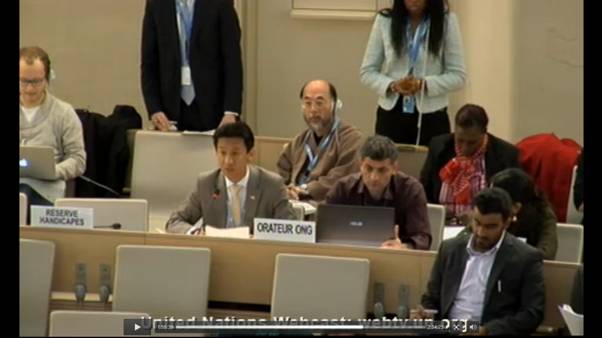
Mr Tenzin Samphel KAYTA, speaking on behalf of the Society for Threatened Peoples, said that since the 2008 uprising on the Tibetan plateau, hundreds and thousands of Tibetans faced arbitrary detentions leading to many cases of enforced disappearances, custodial deaths, unfair trails and harsh prison sentences.
He said that on 13 July 2012, five mandate holders wrote to the Chinese authorities about the “allegations of arbitrary deprivation of liberty and ill-treatment of a 17 year old girl following the peaceful exercise of her rights to freedom of opinion and expression and assembly.”
He further expressed deep concern over growing number of relatives and friends of Tibetans who self-immolated. In late June 2012, a week after Ngawang Norphel and Tenzin Khedup self-immolated, Ngawang Norphel’s wife, Drolma Dekyi and two other family members were detained for questioning.
On 5 March, the UN Working Group on Enforced or Involuntary Disappearance (WGEID) and the Special Rapporteur on Freedom on Religion or Belief presented their annual reports. Both had sent official communications to China asking clarification on allegations with regard to individual case and several thematic issues.
Speaking on behalf of Society for Threatened Peoples on 6 March, Mr KAYTA said that the practice of enforced disappearances continues to persist in many countries in Asia and particularly in China as stated in the WGEID continues to document.
He drew the plenary session’s attention to China’s failure to issue official clarifications on status of residence or well-being of 300 monks of the Kirti Monastery. Chinese paramilitary police took the monks away in ten military trucks to unknown destination in April 2011.
Speaking on religious freedom or belief, Mr KAYTA said though the Chinese constitution guarantee’s freedom of religion; China’s introduction of new management policies on monasteries and intensification of so-called “patriotic education” campaign has put pressure on religious institutions in Tibet Regions.
During such campaigns, the communist cadres force monks and nuns to pledge allegiance to the Communist Party and denounce their spiritual leader the Dalai Lama. The six million Tibetans who follow Tibetan Buddhism regard His Holiness the Dalai Lama as the manifestation of the Buddha of Compassion.
The Special Rapporteur on Freedom on Religion or Belief in his report expressed major concern about State interference in the direct proper functioning of religious institutions referring to China’s “Democratic Management Committee” that oversees the overall day-to-day affairs of monastic and religious activities in Tibet.
In his final oral intervention, Mr Tenzin Samphel KAYTA urged China –
1. To fully cooperate with UN mechanisms by fixing early date of the visit of Special Rapporteur on Freedom of Religion or belief including in Tibet regions where situation is reported to be grim and serious.
2. To respond to the WGEID’s allegation transmitted on 6 August 2010 0 (A/HRC/16/48, paras. 118-21) with regard to detention of hundreds of Uighur and disappearance of some of them on in the event of unrest in Urumqi, Xinjiang in July 2009.
3. To take legislative action that will abolish “reeducation through labor”
4. To clear path for the ratification of the International Covenant on Civil and Political Rights which was signed on 5 Oct 1998.