
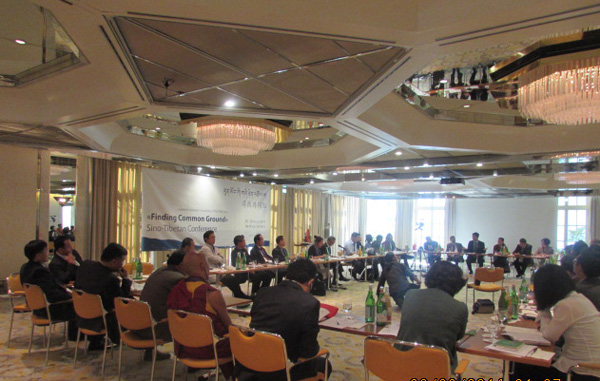
FINDING COMMON GROUND – Sino-Tibetan Conference
26-28 August 2014 – Hamburg, Germany
Welcome Address by Kalon Dicki Chhoyang
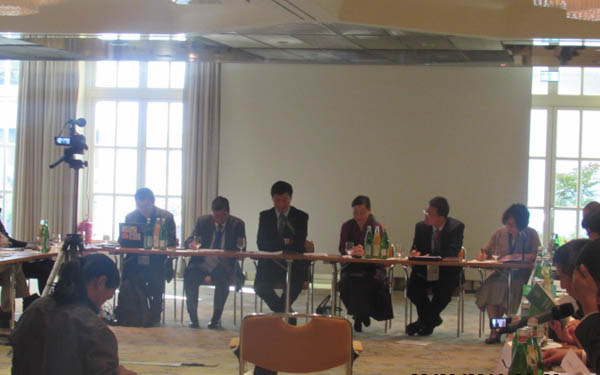
Good morning,
On behalf of the Central Tibetan Administration, I would like to welcome all of you to this gathering. Today’s meeting is the first Sino-Tibetan conference attended by members of the 14th Kashag which assumed office in August 2011. However, the importance we attach to Sino-Tibetan relations pre-dates our current role in the Tibetan Administration. Honorable Sikyong Dr. Sangay has worked for several years at Harvard University to promote Sino-Tibetan dialogue and I have worked and studied, for several years as well, in Tibet and China. We are both pleased to be able to join you for this gathering.
Over the last few years, we have seen a gradual increase in the number of Chinese tourists in Tibet. Chinese interest in Tibet from the mundane to the profound is growing with extravagant sums of money being spent on Tibetan dogs, use of caterpillar fungus, hope in Tibetan medical cures, entertainment with songs and dance, and yearning for spiritual guidance.
Sadly, with the intense Chinese government propaganda on Tibet, I am not sure the questions with regards to Tibet that need to be pondered are asked by those thousands of Chinese tourists. Why have 130 Tibetans set themselves on fire? What is the importance of preserving Tibetan culture? Is Tibet’s pristine environment adequately protected? Why is there still unrest in Tibetan areas after all these years?
When speaking about Tibet, it is common for the Chinese government to cite the large sums of money poured into Tibetan areas for infrastructure development and so on. This is partly why the Tibetan political movement for freedom often leaves Chinese individuals incredulous and wondering — Why are they so ungrateful, still unhappy? What more do they want?
Fundamentally, the Tibetan issue is about a basic human instinct which does not have a price, a people’s yearning to exist, to survive with its distinct culture, the bedrock of its identity. It is perhaps difficult for Chinese people to relate to the deep emotions triggered by such staunch will to survive culturally. With its large population and well-established diaspora throughout all continents, the Chinese people will never be faced with the burden of such challenge.
The Tibetan struggle for cultural preservation is about inclusion, not exclusion — ensuring the inclusion of Tibetan culture, while not excluding other cultures. Tibetans acknowledge the importance of knowing Mandarin both in Tibet and in exile where it is now even part of the curriculum in some schools. With decades of life in exile, the Tibetan people have learned to embrace cultural diversity and appreciate the richness it brings, but not at the expense of one’s own cultural heritage disappearing.
With developments witnessed in Tibet over the last few decades, it is difficult to say what the future holds. No one anticipated the wave of self-immolations which began in 2009 or last week’s incident when the police opened fire on peaceful Tibetan demonstrators in Eastern Tibet (Chinese: Ganze prefecture, Sichuan) leading to at least five individuals dying in police custody. The standoff is ongoing as we speak. What is certain is that the issue of Tibet will not go away as long as Tibetans in Tibet are forced to live under repressive policies and lack freedom to preserve their culture. Tibetans in exile are responding to their call for support.
There is no romantic notion about why Chinese people should care about Tibet. Any motivation to resolve a situation is interest based. Tibetans do not expect Chinese goodwill out of pity, generosity or, kindness, but a realization that peacefully resolving the situation in Tibet is in China’s interest for several reasons including an opportunity to establish a new model of conflict resolution and safeguard a culture which can play an instrumental role in strengthening Chinese collective sense of secular ethics.
With the number of domestic and international conflicts involving China, the Middle Way Approach presents an opportunity to implement a new model for conflict resolution based on non-violence, dialogue and reconciliation. The situation in Tibet offers a unique testing ground for such an idea.
Whether one believes in Buddhism or not, Tibetan Buddhist principles offer, as the West is discovering, a solid foundation for reflection on the development of secular ethics which can help a society, with weak rule of law, avoid further fraying of its collective moral fiber. This is what comes first to mind, upon hearing of tragedies such as the substandard constructions which collapsed during the 2008 Sichuan earthquake and caused the deaths of over 5,000 schoolchildren, or the tainted baby milk incident which caused over 300,000 victims, with at least six infants dying and an estimated 54,000 babies being hospitalized.
One of the biggest challenges facing the issue of Tibet today is the Chinese people’s limited access to accurate information on Tibet. Chinese official misinformation campaign depicting the Tibetan political movement as a separatist movement, and a Sino-Tibetan inter-ethnic conflict, seek to fuel Chinese nationalistic sentiments to justify the Chinese government’s intransigence and hardline Tibet policy.
The most realistic and promising avenue for harmony and stability in Tibet remains through the Middle Way Approach. I encourage those of you who are not familiar with this policy to read the Memorandum on Genuine Autonomy and its Note. Both documents were presented to the Chinese government, by Envoys of His Holiness the Dalai Lama, in 2008 and 2010 respectively. We have also created a web site and video to promote a better understanding of the policy. I wish to highlight three aspects of the Memorandum which may not be known to some of you: genuine autonomy as sought by Tibetans is based on China’s current Constitution, there are 11 basic areas for which local decision-making power is sought and lastly, as a clear demonstration that the Tibetan movement is about Tibetans in Tibet and not the Tibetan community in exile or Central Tibetan Administration, there is a clause stating that should a political solution be found, the latter will self-dissolve.
Lastly, I hope the discussions taking place over the next few days will give rise to ideas for concrete actions as to how we can promote a better understanding of the Middle Way Approach amongst the Chinese people. Thank you.