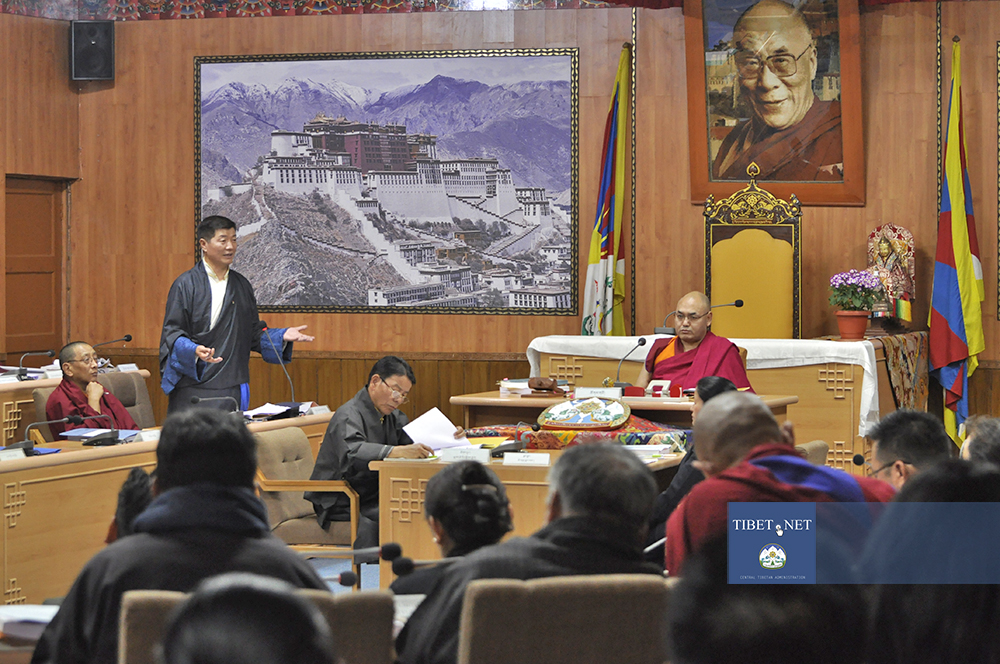
Dharamsala: At the ongoing fifth session of the 16th Tibetan Parliament-in-Exile, various queries were raised by parliamentarians in relation to the issue of Tibet and its future prospects, China’s status in the global arena and how the international community views the Tibet’s cause is shaping amid shifting trends in global politics.
Responding to the queries, the President of Central Tibetan Administration Dr Lobsang Sangay narrated how past international events had a direct bearing on Tibet. Citing the Korean War and Cold War, Dr Sangay iterated how these two events influenced the United States’ support towards Tibet.
Speaking of the awareness and support from the international community towards the issue of Tibet in 1990’s, Dr Sangay credited the recognition of the Tibet cause to the prevalent world ideology of liberalism and internationalism. “And because Tibet cause is deeply rooted in the principle of freedom and democracy, it was in sync with the prevalent ideology of that time,” he added.
However, he added that since the last 10 years liberalism and internationalism is being challenged by nationalism and extremism. “In this clash of ideologies in the present world, which course should Tibet take?” Such questions, he added, needs to be pondered upon. Dr Sangay also stressed that extremism is not an option for Tibet and its freedom struggle that has so religiously treaded a peaceful, non-violent trajectory.
Given the rise of China and its relentless pursuit of “socialism with Chinese characteristics” and economic strategies such as the Belt and Road initiative, Dr Sangay iterated that there has been a growing discourse on China. Citing recent events such as the President Trump’s decision to impose heavy tariffs on imports of steel and aluminium, US and EU’s denial of Market Economy Status to China last year and discourses on China’s influence in Australia, Dr Sagay spoke of how the rise of China is being cautiously gauged by global powers.
At the same time Dr Sangay highlighted the growing speculation over shift in power from the west to the east, and speculation of a possible war in Asia in the coming 5 or 10 years in which China will be the key player. This speculation, he added was based on the fact that many countries in Asia are on the path to seeing an economic boom accompanied by proliferation in arms purchase in Asia.
Dr Sangay also spoke about China’s Tibet policy and how it is seeking to exponentially increase the influx of Chinese population in and around Lhasa in the coming 50 years. “A recent report on China stated that China’s expenditure on domestic security surpasses its defence with spending on security per person highest in Tibet in 2017,” exclaimed Dr Sangay.
Highlighting the recent reform in the Chinese constitution removing the presidential term limit, Dr Sangay added that though at the outset it heralds the consolidation of power in the hands of President Xi Jinpng, but such authoritarian rule could lead to power struggle, which history tells us have led to the fall or disintegration of a nation.
Dr Sangay further added that amid such a scenario the ‘Five-Fifty Vision’ of CTA seeks to assess the current global trends, the current international wave and strategise ways for Tibetans to ride that wave. To that end, Dr Sangay urged every Tibetan to be intellectually engaged in gauging the trends in global political diplomacy and assert the Tibetan voice in the global narrative and make Tibet relevant in every political development impacint global political discourse.
“This coming three to four years is an important window for us,” said Dr Sangay.
Report filed by Tenzin Lhakmon, Communications Officer, Sikyong Office.