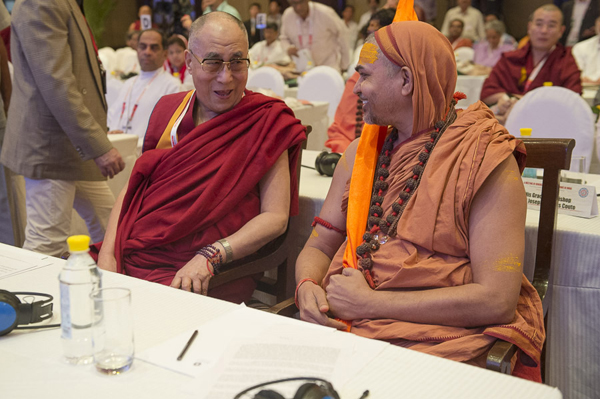

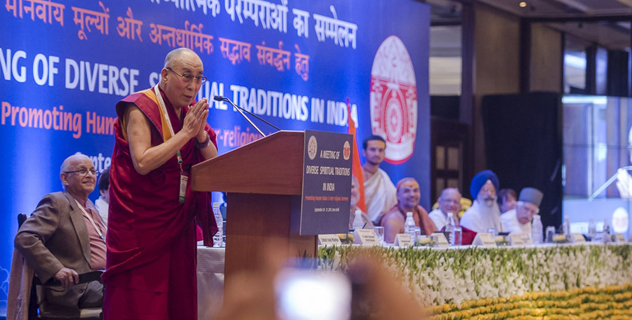
New Delhi, India, 20 September 2014 – This morning, well before the announced starting time for the ‘Meeting of Diverse Spiritual Traditions in India’, of which he was host, His Holiness the Dalai Lama was at the door of the hall to greet each of the delegates as they arrived.
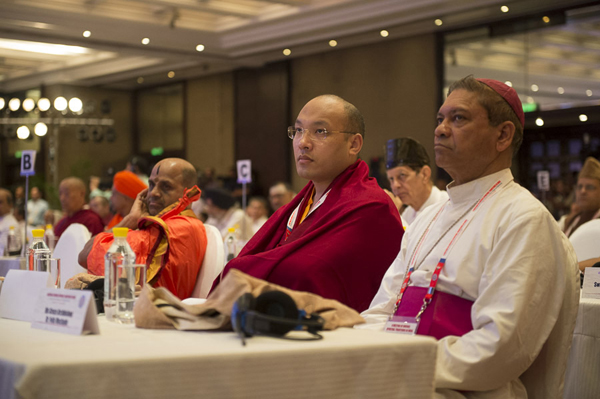
Once representatives of nine spiritual traditions had taken their seats on the platform, former diplomat Lalit Mansingh opened proceedings. He warmly welcomed His Holiness, the Chief Guest, Lieutenant Governor of Delhi, Najeeb Jung, and all the delegates. He cited several topics that such an illustrious gathering of spiritual leaders and representatives might discuss, such as violence in the name of religion; climate change and the continued existence of many thousand nuclear weapons in the world. He invited His Holiness to inaugurate the occasion by lighting the lamp, and he called on his companions on the stage to join him in this.

‘May the supreme and precious bodhichitta
Take birth where it has not yet done so;
Where it has been born may it not decrease;
Where it has not decreased may it abundantly grow.’
”I am just one human being among many. We human beings are social animals; we each depend for our existence on other people. Even the Buddha depended on begging for alms. Wherever I go, as I say, I just think of myself as another human being. I don’t think of myself as a Tibetan, a Buddhist or as somebody special like His Holiness the Dalai Lama. All of us human beings are the same physically, mentally and emotionally. We all want to live a happy life and we have a right to do so. And yet many of the problems we face are our own creations. Why? Because we think only of ourselves and neglect others.
“If we were to think of others as our human brothers and sisters there’d be no room for quarrelling or killing each other. We’d remember that even the person we call our enemy is another human being. This means that our intelligence needs to be guided by warm-heartedness.”

All the world’s major spiritual traditions convey a message of love and compassion, which is why we can view those who belong to them as spiritual brothers and sisters. However, His Holiness said, these days we hear repeatedly about conflict in the name of religion. This is very sad. The idea that people are killing others in the name of religion is unthinkable.
“India is the only country where all the major religious traditions live together side by side and have done for more than 1000 years. This is an example from which the rest of the world can learn. And that is one of the reasons why I convened this conference.”
When the Chief Guest, Najeeb Jung, was called upon to speak after His Holiness he said he felt the challenge was comparable to that faced by Swami Vivekananda when he addressed the World Parliament of Religions in Chicago in 1893. He quoted what the Swami said:
“Do I wish that the Christian would become Hindu? God forbid. Do I wish that the Hindu or Buddhist would become Christian? God forbid. The seed is put in the ground, and earth and air and water are placed around it. Does the seed become the earth, or the air, or the water? No. It becomes a plant. It develops after the law of its own growth, assimilates the air, the earth, and the water, converts them into plant substance, and grows into a plant.
Similar is the case with religion. The Christian is not to become a Hindu or a Buddhist, nor a Hindu or a Buddhist to become a Christian. But each must assimilate the spirit of the others and yet preserve his individuality and grow according to his own law of growth.”
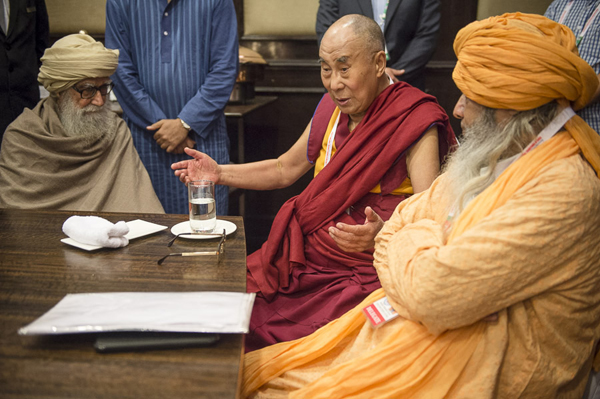
Paul Dhinakaran spoke of how India is the only country he’s come across that observes respect for all spiritual traditions and cherishes inclusiveness. He told a story of the rich girl who offered to help Mother Teresa. The Mother asked her to comfort and bandage a newly arrived leper. The girl could not do it, so Mother Teresa did so saying that she visualized that she was dressing the wounds of Christ. Karmyogi Peethadheesh Swasti Shri Ravindra Keerti Swami repeated that by following different paths we can reach the same conclusion, but that to do so requires a sense of brotherhood and not thinking of your own religion as the best.
Sheikhul Masheikh Dewan Syed Zainul Abedin Ali Khan pointed out that if you have a group of children awaiting hospital treatment in need of blood, you do not ask for Sikh, Hindu or Muslim blood; the only stipulation is the necessary blood group. He advised that we cannot take what we cannot give; since we cannot give life, we should not take it either. When he finished speaking, Swami Avimuktetshwaranand Saraswati rose from his seat and came up to the stage to offer the Maulana a flower as a mark of his appreciation.