By ISSAKU HARADA, Nikkei Asian Review, 7 June 2016
BEIJING — Leading diplomats and economic officials from the U.S. and China are locking horns over security in the South China Sea and the global commodities glut at an annual dialogue here, crystallizing tensions that have deepened over the past year.
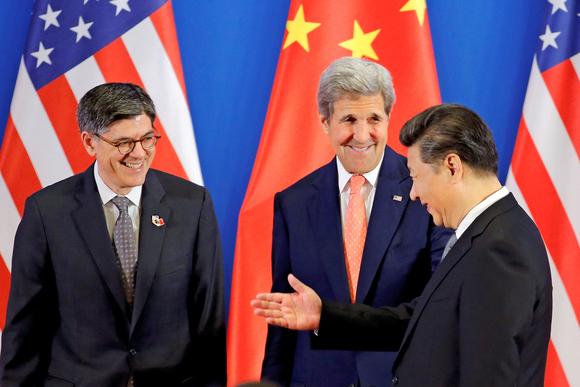
Territorial conflicts in the South China Sea must not be resolved “by unilateral action,” U.S. Secretary of State John Kerry said Monday in his opening remarks for this year’s U.S.-China Strategic and Economic Dialogue, which runs through Tuesday. “Let’s resolve this through rule of law, through diplomacy, through negotiation.”
This did little to calm Chinese worries of U.S. intervention. Beijing aims to resolve disputes through dialogue between the parties involved, said Yang Jiechi, China’s top diplomat and a member of the State Council.
Kerry also sought cooperation with Beijing to rein in North Korean military provocations, saying China and the U.S. must “stand firmly and strongly together” against nuclear proliferation.
War of words
Excessive Chinese industrial production dominated the economic talks. The U.S. “supports efforts to reduce excess capacity and leverage in the economy” and let market forces allocate resources, Treasury Secretary Jack Lew said in his opening remarks. “Excess capacity has a distorting and damaging effect on global markets, and implementing policies to substantially reduce production in a range of sectors suffering from overcapacity — including steel and aluminum — is critical to the function and stability of international markets.”
Lew reiterated this point at bilateral economic talks later in the day, calling on Beijing to detail how it will implement its new five-year plan, which includes measures to cut capacity. Successful implementation would be an effective reform step, he said.
Lou Jiwei, Lew’s Chinese counterpart, reacted harshly to the secretary’s criticisms. The world was very receptive to China’s heavy capital investment in the wake of the 2008 financial crisis, Lou said in a Monday afternoon news conference, calling that investment the root of current overcapacity and noting that “China accounted for 50% of global economic growth between 2009 and 2011.”
“The majority of that contribution was in the form of increased investment — it’s only natural that we produced steel, a raw material,” Lou said.
Promises to keep
Lew’s own frustration stems largely from the frequent lack of follow-through on Beijing’s plans for cutting production and capacity in such sectors as steel and coal. China produced 69.42 million tons of crude steel in April, nearing its highest-ever per-day level. Exports of steel materials climbed 6% on the year to 9.08 million tons, while the export price per ton dropped 20% to $487. China’s low-cost offensive in the global steel market remains as powerful as ever.
Measures to address global warming were a rare point of agreement on the contentious first day of talks. Both sides are ready to cooperate on putting into action the new climate change deal struck in Paris last year. The deal “would not have happened” without cooperation between the U.S. and China, Kerry said, grabbing hold of a matter where the two sides have few disagreements to set a positive tone.