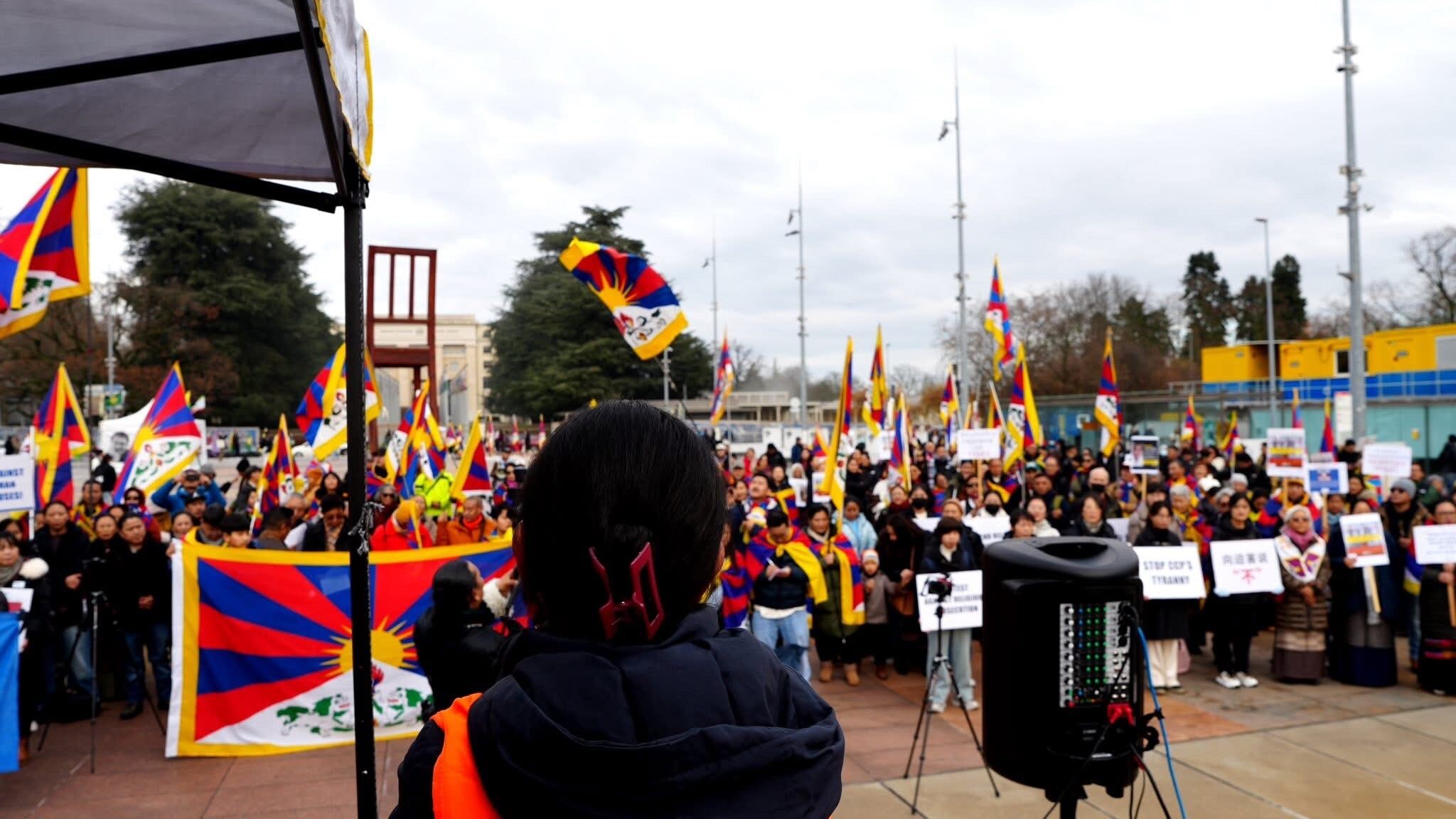
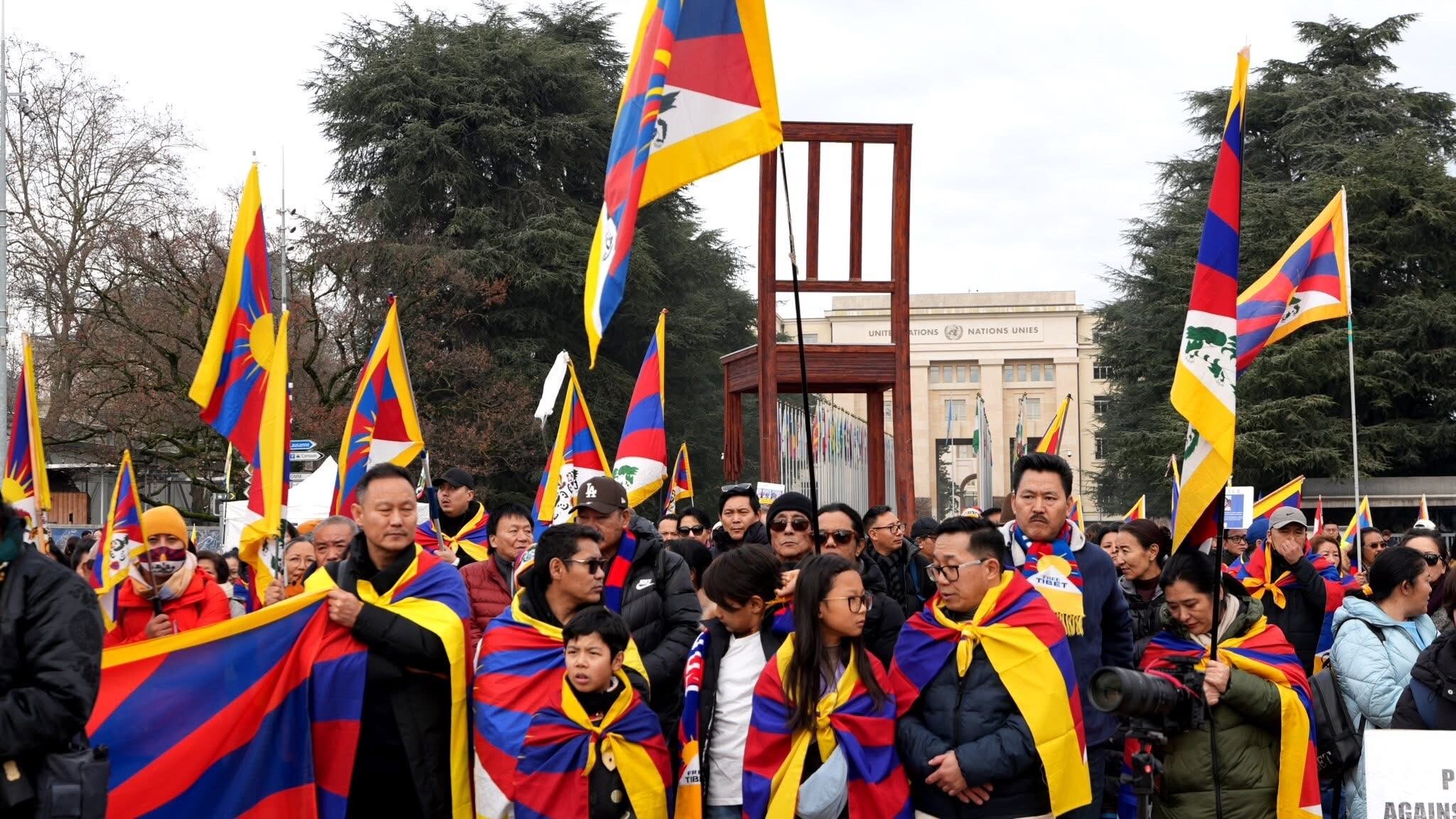
Geneva, 10 December 2025: The Tibetan Community of Switzerland and Liechtenstein (TCSL) organised a solemn and impactful peace march in Geneva to commemorate the 77th Human Rights Day. The event served as a reminder of the ongoing human rights crisis in Tibet and reaffirmed the universal principles of freedom, dignity, and equality for all people.
The march began at the Office of the High Commissioner for Human Rights (OHCHR) at Palais Wilson. Nearly 500 participants march peacefully for approximately two kilometres to the Palais des Nations, where the iconic Broken Chair—a symbol of resistance, perseverance, and hope—stands. The crowd included members of the Tibetan community, Tibetan supporters, and members of the Almighty God and Church of Almighty God Christian Chinese community, united in solidarity for human rights and justice.
The demonstration was further strengthened by the presence of several distinguished guests, including Rikon Khen Rinpoche, representatives from the Tibet Bureau Geneva, former Tibetan parliamentarians, the President of GSTF, members of Tibetan Youth in Europe, the Tibetan Women’s Association, and members of the French-speaking GSTF chapter. Their participation reflected the unity, resilience, and collective commitment of the Tibetan community.
At Palais des Nations, the gathering was addressed by Phuntsok Topgyal, UN Advocacy Officer at the Tibet Bureau Geneva. His speech highlighted the profound significance of 10 December for both Tibetans and the international community. He recalled that on this day in 1989, His Holiness the 14th Dalai Lama was awarded the Nobel Peace Prize—a global acknowledgment of his lifelong dedication to nonviolence, compassion, and peace. The date also marks the anniversary of the Universal Declaration of Human Rights in 1948, which enshrines the principle that all human beings are born free and equal in dignity and rights.
However, as Phuntsok Topgyal emphasised, these fundamental rights remain inaccessible in many parts of the world—most notably in Tibet. He cited recent cases illustrating the severity of the situation: the closure of Tulku Dorjee Ten’s school and his subsequent detention; the arrest and disappearance of Ven. Zega Gyatso for sending money abroad; and the tragic self-immolation of Ven. Shersang Gyatso under extreme political pressure during His Holiness’s 90th birthday period. He also noted the expulsion of monks under 18 from monasteries, a policy that denies young Tibetans the right to receive religious education in their own tradition. These examples, he said, reveal the deep suffering and ongoing injustice endured by Tibetans.
Despite these hardships, the speech also highlighted the positive impact of continuous Tibetan advocacy on the global stage. Through persistent actions—including public demonstrations, awareness campaigns, and international engagement—the Tibetan cause has achieved meaningful progress. In October 2025, UN Special Rapporteurs issued four separate communications on Tibet. In July 2025, the Human Rights Ambassadors of seven European countries—France, Germany, the Netherlands, the United Kingdom, Lithuania, Estonia, and Iceland—issued a joint statement regarding the reincarnation of His Holiness the 14th Dalai Lama. The United Kingdom also hosted a successful UN side event in collaboration with several co-sponsoring countries, and public pressure prompted a French museum to reverse its decision to replace the name “Xizang” with “Tibet.” These achievements, he stressed, demonstrate the power of peaceful action and the importance of every individual voice.
Phuntsok Topgyal also acknowledged the challenging international landscape. With many countries prioritizing geopolitical interests and the United Nations facing a serious budget crisis, global attention to Tibet may fluctuate. Nevertheless, he encouraged the community not to lose hope. Tibetans, he said, possess strong leadership, a stable administration, and a functioning democratic system—all of which serve as the foundation of the Tibetan struggle for justice.
He concluded with a stirring message: “Power is temporary—like fashion, it comes and goes. But our unity and determination will remain. As long as we stand together, the Tibetan cause will never die.”
The event concluded with a deep sense of renewed purpose. Participants pledged to continue raising awareness, promoting peaceful advocacy, and strengthening community efforts through social media and public engagement. The day’s message was unmistakably clear: the fight for human rights in Tibet continues, and unity will keep the movement alive.
– Report filed by Office of Tibet, Geneva