Geneva, 27 November 2025: The Unrepresented Nations and Peoples Organisation (UNPO) organised a side event in Geneva alongside the ongoing 18th United Nations Minority Forum, bringing together experts and advocates to address persistent human rights challenges faced by marginalised communities. Representative Thinlay Chukki of the Office of Tibet in Geneva participated in the event as a panellist.
In her opening remarks, Thinlay Chukki recalled that the Tibetan movement is a founding member of UNPO and expressed deep appreciation for the organisation’s continued commitment to amplifying the voices of unrepresented peoples. She emphasised the importance of UNPO’s role in hosting a timely and meaningful discussion in parallel with the Minority Forum.
Addressing the situation in Tibet, Thinlay Chukki highlighted that the United Nations General Assembly adopted three resolutions on Tibet—in 1959, 1961, and 1965—which consistently and unequivocally affirmed the rights of the Tibetan people. These resolutions defended fundamental human rights, including freedom of religion, assembly, and expression, as well as the protection of cultural rights, and affirmed the Tibetan people’s right to self-determination.
She further recalled that within the framework of the Human Rights Council—formerly the Commission on Human Rights—the Sub-Commission on the Prevention of Discrimination and Protection of Minorities adopted a resolution in 1991 that explicitly addressed atrocities committed by the Chinese government in Tibet.
Despite these UN General Assembly resolutions and subsequent UN Sub-Commission reports since 1959, Thinlay Chukki noted that the human rights situation inside Tibet remains grave, with violations occurring on a daily basis. She warned that Tibetan civilisation itself is now facing an existential threat.
Elaborating on the right to self-determination, she stressed that this principle must be reflected in tangible and meaningful rights for the Tibetan people. These include the right of Tibetan parents to send their children to schools that preserve and promote Tibetan language, identity, religion, and culture. She expressed serious concern that more than one million Tibetan children—some as young as four years old—are currently being placed in compulsory residential schools. Such practices, she noted, raise profound questions regarding the implementation of the right to self-determination, a core principle enshrined in the Universal Declaration of Human Rights.
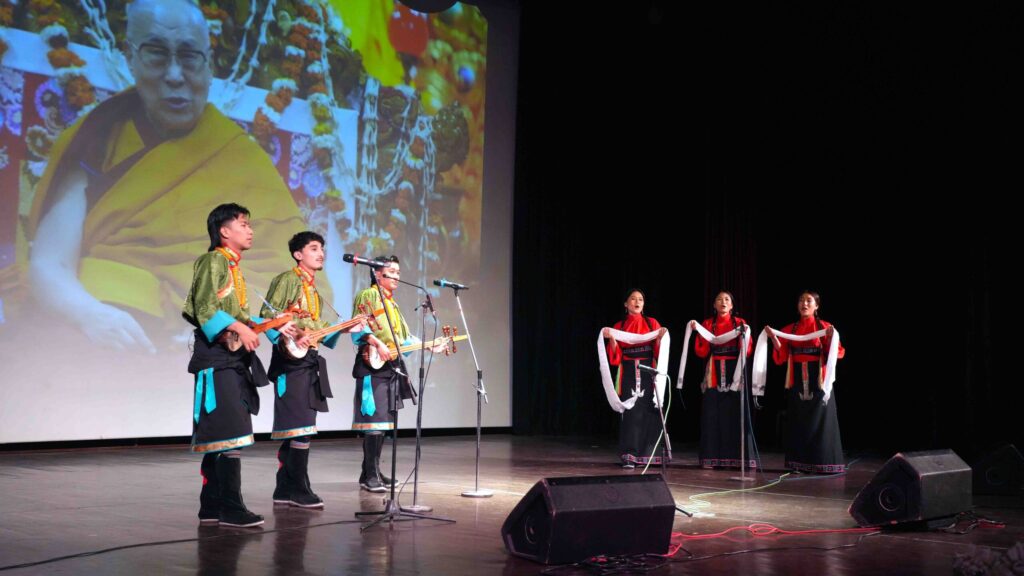
On the issue of cultural rights, Thinlay Chukki emphasised that Tibetans are being systematically denied the ability to participate freely in their cultural life and traditional way of living. She noted that these policies have resulted in the widespread sinicisation of Tibetan culture. As an example, she referred to Tibetan dances and cultural performances being presented internationally by Chinese authorities in forms that closely resemble Han Chinese culture. She stated that such portrayals advance the narrative that Tibet has historically been part of China, while Tibetans continue to be marginalised in their own homeland. This, she underscored, represents a clear denial of the Tibetan people’s right to self-determination.
Thinlay Chukki also addressed concerns surrounding the issue of the reincarnation of His Holiness the Dalai Lama, underscoring the central importance of religious freedom and the Tibetan people’s authority in matters of faith and tradition. In addition, she drew attention to the continued enforced disappearance of the Panchen Lama and his family. This year marks 30 years since the Panchen Lama’s disappearance, while the Chinese government has installed a state-appointed substitute who is widely rejected by Tibetans.
Other participants in the UNPO side event included Phuntsok Topgyal (UN Advocacy), Sangjey Kep (Chinese Liaison Officer), Tenzin Dorjee (Tibet Action Institute), and Tenzin Dolkar (Tibetan Legal Association, Dharamsala). The panel contributed to a broader discussion on minority rights, accountability, and the role of international advocacy in addressing systemic human rights violations.
-Report filed by Office of Tibet, Geneva