
UN discusses Special Rapporteur’s China report

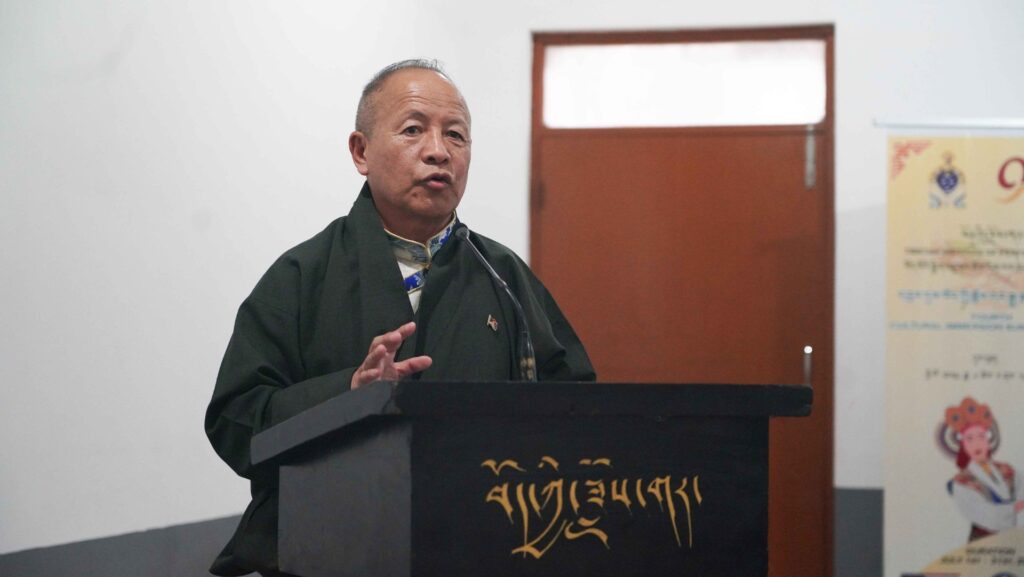
| Mr Tenzin Samphel Kayta reading an oral statement at the UN Human Rights Council session in Geneva. | |||
Olivier de Schutter, the Special Rapporteur on the right to food’s
China report today. The Special Rapporteur’s preliminary report issued
after visiting China from 15 to 23 December 2010 expressed concern
regarding the marginalisation of nomadic herders in Tibet.
The
report highlighted ‘Nomadic herders in the western provinces and
autonomous regions, especially in Tibet (Xizang) and Inner Mongolian
Autonomous Regions, also face increasing pressure on their access to
land.’The Special Rapporteur recommended the Chinese
authorities that herders should not, as a result of the measures
adopted under the tuimu huancao (removing animals to grow
grass) policy, be put in a situation where they have no other options
than to sell their herd and resettle.The International Covenant
on Economic, Social and Cultural Rights prohibits depriving any people
from its means of subsistence, and the Convention on Biological
Diversity (1992) acknowledges the importance of indigenous communities
as guarantors and protectors of biodiversity. China has ratified both
of these instruments. The Special Rapporteur encouraged the Chinese
authorities to engage in meaningful consultations with the herding
communities.The European Union expressed its support for the
Special Rapporteur’s recommendations to the Chinese authorities to
engage in meaningful consultations with herding communities, including
in order to assess the results of past and current policies, to examine
all available options in order to combine the knowledge of the nomadic
herders of their territories.The EU asked the Special
Rapporteur what measures could be taken to effectively promote adequate
forms of public participations in decision-making.Mr. Tenzin
Samphel Kayta speaking on behalf of the Society Threatened Peoples made
reference to the 2006 International Conference on Poverty Reduction and
the Important Role for International Cooperation in Sichuan Province,
China. International development agencies at the conference said that
Tibetan nomads had been coercively removed, excluded from their
rangelands and made to settle in rows of houses in rigid lines from the
watershed, with no livelihoods, little compensation and nothing to do
but watch television.He drew the attention of the Council and
the Special Rapporteur on the right to food that China’s Xinhua News
agency report dated 17 January 2011 quoting Mr. Padma Choling,
Chinese-appointed governor of Tibet saying that a total of about
300,000 families involving 1.43 million Tibetan nomads and farmers had
been moved into new or fixed settlement homes. He further said that
some 185,500 families were expected to move into new homes by 2013.’Since
the very survival of Tibetan nomad’s traditional way of life and
livelihood is at stake, we would like to urge Special Rapporteur to pay
close attention on this issue and urge the Special Rapporteur to
request a follow-up visit which include schedule to see those affected
Tibetan nomads. ‘We are, of course, disappointed that the
Special Rapporteur was not able to visit Tibetan areas of present-day
China,’ said Mr. Kayta during his oral statement to the Human Rights
Council.