
Sangay Gyatso, a leading protester in 2008 Tibet uprising, dies[Monday, 28 February 2011, 3:01 p.m.]
 |
|
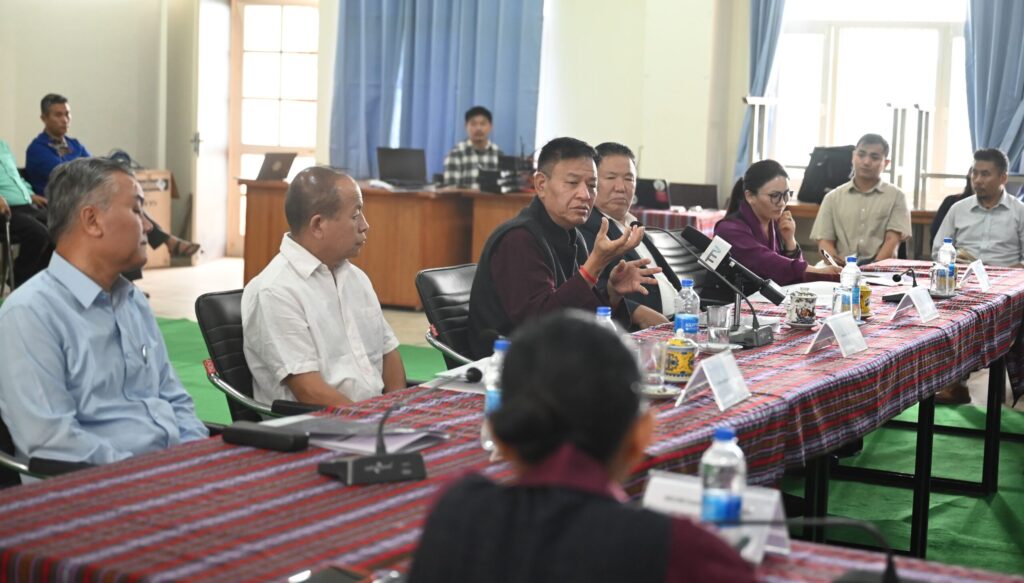
Sangay Gyatso (1st left) speaking to foreign journalists about repression of human rights by the Chinese government during a peaceful protest in Labrang in Amdo Province in northeastern Tibet on 9 April 2008
|
DHARAMSHALA:
Sangay Gyatso, who was among the leading peaceful protesters during the
widespread protests in Tibet in 2008, succumbed to his physical and
mental trauma suffered during a year-long escape in the hills to evade
government persecution, according to a report received by the Central
Tibetan Administration.Sangay took leading role in the peaceful
protests that occurred in Labrang in Tibet’s northeastern Amdo Province
in 2008. Defying intense restriction by the Chinese government on 4
April 2008, he and his colleagues from Labrang Monastery spoke to a
group of visiting foreign journalists about the “suppression of
fundamental human rights in Tibet by the Chinese government”.Fearing
arrest by the Chinese government he fled and spent more than a year in
hills facing insurmountable hardships. Lack of proper food compounded
by mental trauma left him debilitated and bedridden. Every possible
help to recover him through medication by his family and relatives
failed and his health condition grew bad to worse. He was eventually
admitted to a hospital in Siling and as there was not much improvement
in his health, he had to undergo a surgery in another hospital.
Ironically, the Chinese government did not arrest him after knowing
that there was no hope of his recovery. Even the hospital discharged
him for the same reason. Sangay spent his remaining days in
his home and passed away on 26 February 2011. He is survived by his old
parents, both of whom are above 70 years old. Sangay was born
in 1969 in a nomadic family in Labrang Tashikhyil. He was ordained at
the age of 16 and began his religious studies at Labrang Monastery. In
1991 he went to Drepung Loseling Monastery in India to pursue his
studies. Unfortunately, he had to return to Tibet to continue his
studies as his health could not adapt to the environment in India. Like
Sangay Gyatso, many Tibetans living in Tibet are forced to leave their
homes for hills to escape torture by the Chinese authorities. The death
of Sangay Gyatso has reinforced the danger to the lives of many
Tibetans who are losing their strength to live in insuperable harsh
circumstances. An
estimated 227 Tibetans have died under China’s crackdown since March
2008, out of which 153 could be identified. The deaths were caused by
to indiscriminate firing by the PRC forces during the demonstrations;
severe beatings and torture of detainees during arrest, interrogation
and detention; and a built-up of insurmountable repression and
suppression that drove some Tibetans to commit suicide. One death was
caused either by starvation or suicide in the initial phase of the
March 2008 protests when the major monasteries were sealed off and
closed for days. (Read 2008 uprising in Tibet: Chronology and Analysis]Over 6,810 Tibetans have been arrested and detained and at least 510 Tibetans sentenced since 10 March 2008. The judicial process was devoid of fair trial and independent legal representation.A
total of seven Tibetans have been sentenced to death since then – two
with immediate death sentence who were subsequently executed and five
are currently facing suspended death sentence or death sentence with a
two-year reprieve. All defendants are young Tibetans below the age of
30. Lobsang Gyaltsen and Loyak, both 25-year-old, were executed on 20
October 2009. The other five facing suspended death sentences are
Tenzin Phuntsok, 27; Kangtsuk, 22; Penkyi, 21; Pema Yeshi, 28; and
23-year-old Sonam Tsering.