
‘Tibetans in Tibet yearn for His Holiness the Dalai Lama’s return’[Saturday, 18 December 2010, 12:50 p.m.]
 |
|
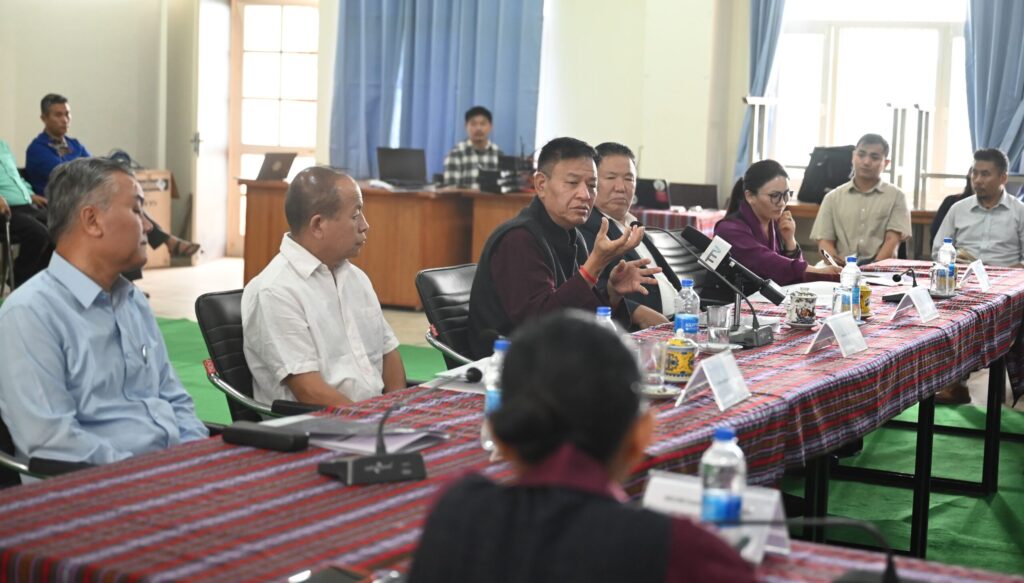
From right: Khedup Gyatso, Lobsang Norbu and Kunga Rinchen during the press conference organised by the Tibetan Centre for Human Rights and Democracy in Dharamsala, India, on 18 December 2010/TibetNet Photo
|
DHARAMSHALA:
Three Tibetan monks belonging to Gonsar Monastery in Derge in eastern
Tibet who led a peaceful protest against the Chinese government’s wrong
policies on Tibet in 2009 testified that “Tibetans living inside Tibet
yearn to see His Holiness the Dalai Lama like cuckoo birds wait for
rains to quench their thirst.”“Tibetans living inside Tibet have deep yearning to see His Holiness the Dalai Lama back in their homeland,” they said.The
monks – Lobsang Norbu, aged 30, Khedup Gyatso, 24 and Kunga Rinchen, 26
– passed through a year-long ordeal as they had to hide in isolated
nomadic areas, forest and hills to evade police arrest for their role
in the protest at Derge county’s Za-Khok township and Gonsar monastery
on 10 September 2009.“The Chinese government denied the monks
at Gonsar Monastery to pray to our spiritual leader His Holiness the
Dalai Lama,” Lobsang Norbu, one of the monks, told reporters today in
their first press conference after reaching Dharamsala, India, on 15
November 2010. “We made Tibetan national flags and posters and
pasted around the monastery’s premises and around Za-Khok township to
express our deep grievances against the blatant violation of Tibetan
people’s fundamental rights such as freedom of expression and religion
by the Chinese government,” Norbu said, adding that the monastery has
over 200 monks.The posters carried slogans that said “Tibet was an independent country”. He
said “three of them wrote their own names on the posters so that other
monks and the public would not come under trouble from the
authorities”. But two monks of the monastery – Lobsang Dhonyoe and
Taygya – were later arrested and sentenced to six and two years
imprisonment respectively for their role in writing the posters, he
said.“After we fled, around 300 Chinese police laid siege to
the area and rounded up residents for interrogation during which my
father died due to torture and beating,” Lobsang Norbu said. “The
police forced the residents to do hard labour and fetch water to cook
food for them. They tried to arrest nine people under the pretext of
questioning them regarding our whereabouts. As the women shouted to
avert arrest, the police shot at them wounding two of the women with
serious eye injuries. Eventually, the police took the nine people into
their custody and as they failed to extract any information about us
they were released after paying a fine 10,000 Yuan each,” he added.Responding
to a question about the condition of Tibetan nomads in Tibet, Lobsang
Norbu said “it is hard for animal herds to survive and many perish as
the government has closed grasslands using barbed wire fencing.” “The
local Chinese police have announced a reward of 20,000 Yuan to whoever
gives information of our whereabouts, but later when they were not able
to get any information the reward was increased to 50,000 Yuan. The
police are also searching for us around the region,” the monks revealed
in their testimony to the human rights watchdog Tibetan Centre of Human
Rights and Democracy.“The fear of arrest has forced us to leave
our country on 7 October 2010. Walking for 23 days from Lhasa through
Nepal-Tibet border, we reached Kathmandu on 30 October 2010. We arrived
in Dharamsala, India, on 15 November 2010,” the monks said.