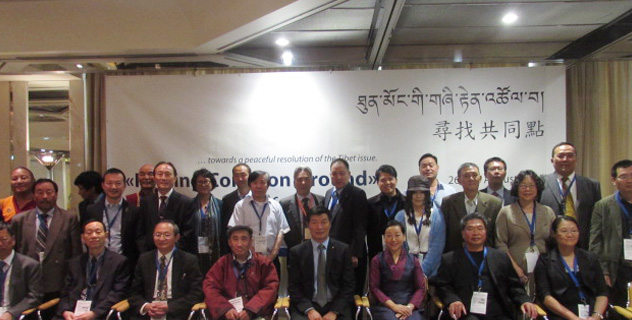
(Below is a written statement of Sikyong Dr. Lobsang Sangay)
The Middle Way Approach – The Path Forward
The Middle Way Approach for Genuine Autonomy for the Tibetan People (Tibetan: Umaylam) is a policy conceived by His Holiness the Dalai Lama in 1974, in an effort to engage the Chinese government in dialogue and find a peaceful way to protect the unique Tibetan culture and identity. It is a policy adopted democratically through a series of discussions held over many decades by the Central Tibetan Administration (CTA) and the Tibetan people. It is a win-win proposition, which straddles the middle path between the status quo and independence – one that categorically rejects the present repressive policies of the Chinese government towards the Tibetan people while not seeking separation from the People’s Republic of China.
To this day, His Holiness the Dalai Lama remains steadfast in his endorsement of this approach as a realistic and pragmatic solution to the grave and now-urgent problems faced inside Tibet. The policy’s first accomplishment came with the establishment of direct contact between Dharamshala and Beijing when Deng Xiaoping said in 1979 that, “apart from independence, all issues can be discussed.”
Meanwhile, since 1987, His Holiness the Dalai Lama had presented the Middle Way Approach in a range of forums around the world – including the U.S. Congress and the European Parliament – hoping to once again draw the Chinese leadership into discussions. Dialogue resumed in earnest in 2002, and led to a total of nine rounds of talks. During the 7th round of talks in 2008 – the year in which unprecedented and widespread protests broke out across Tibet – the Chinese government asked the Tibetan leadership to put in writing the nature of the autonomy it sought. The Memorandum on Genuine Autonomy for the Tibetan People was presented during the 8th round of talks in 2008.
The Chinese government expressed a number of concerns and objections to the Memorandum. To address these, during the 9th and last round of talks in January 2010 the Tibetan leadership presented the Note on the Memorandum on Genuine Autonomy for the Tibetan People. The Memorandum and the Note elaborate how genuine autonomy for the Tibetan people would operate within the framework of the People’s Republic of China: its constitution, sovereignty and territorial integrity, its ‘three adherences’ and the hierarchy and authority of the Chinese Central Government (CCG).
A Tibetan regional administration would govern the protection and promotion of the 11 Basic Needs of Tibetans, which encompass the following:
language, culture, religion, education, environmental protection, utilisation of natural resources, economic development and trade, public health, public security, regulation on population migration and cultural, educational and religious exchanges with other countries.
This is consistent with both the National Regional Autonomy Law and the Constitution of the People’s Republic of China.
The Chinese authorities claim that it is the Tibetan leadership’s intention to expel “all Chinese” from Tibetan areas. In fact, the Memorandum on Genuine Autonomy for the Tibetan People clearly articulates that this is not the case: “Our intention is not to expel non-Tibetans. Our concern is the induced mass movement of primarily Han, but also some other nationalities, into many Tibetan areas, which in turn marginalizes the native Tibetan population.”
There has been no dialogue with the Chinese since 2010. Despite this, the Tibetan leadership remains steadfast in its commitment to the Middle Way Approach for Genuine Autonomy for the Tibetan People and to finding a lasting solution through dialogue between the envoys of His Holiness the Dalai Lama and the representatives of the Chinese leadership.
Widespread support for the Middle-Way Approach
The Middle-Way Approach gains more support every year from the Chinese community. Some of the most respected Chinese intellectuals and artists endorse dialogue. These include Liu Xiaobo, the imprisoned Nobel Laureate who was one of the co-authors of an open letter in 2008 that expressed support for His Holiness the Dalai Lama’s peace initiatives. Since then, more than 1,000 articles and opinion pieces have been written by Chinese scholars and writers supporting dialogue to resolve the issue of Tibet. These include a report by the Beijing-based legal NGO, the Gongmeng Constitutional Initiative, describing the grievances of the Tibetan people and calling for policy review. In 2012, 82 Chinese NGOs based in 15 countries sent a petition to the United Nations, the E.U., various parliaments and governments, exhorting them to “urge the Chinese government to start negotiations as soon as possible.”
Other Chinese intellectuals who support dialogue include Wang Lixiong, a well-known writer, Zhang Boshu of the Chinese Academy of Social Sciences and a constitutional expert, Ran Yunfei of Sichuan Literary Periodical, Yu Haocheng, a senior member of the Communist Party and legal expert based in Beijing, Su Shaozhi, former economist at the Chinese Academy of Social Sciences and Yan Jiaqi, a close aide of former CCP Party Secretary, Zhao Ziyang.
To put the Middle-Way Approach into effect, global leaders who have called for dialogue include U.S. President Barack Obama, former U.S. President, George Bush, High Commissioner for UN Human Rights, Navi Pillay, High Representative for E.U. on Foreign Affairs/Security Policy and Vice-President of European Commission, Lady Catherine Ashton, former British Prime Minister Gordon Brown, former French President, Nicolas Sarkozy, German Chancellor, Angela Merkel, Canadian Prime Minister, Stephen Harper, Australian Prime Minister, Tony Abbot, former Australian Prime Minister, Kevin Rudd and Taiwanese President, Ma Ying-jeou.
The late Baba Phuntsok Wangyal, a senior Tibetan official of the Chinese Communist Party, stated that “the Dalai Lama’s Middle Way Approach of seeking only a meaningful autonomy for Tibet rather than independence, in the present historical context, is an expression of the great responsibility he takes in giving serious thoughts over the fundamental interests, future and fate of Tibet and the Tibetans as a whole.
After President Barack Obama’s meeting with His Holiness the Dalai Lama on 16 July 2011 and again on 21 February 2014, the White House applauded “the Dalai Lama’s commitment to non-violence and dialogue with China and his pursuit of the Middle-Way Approach,” and encouraged “direct dialogue to resolve long-standing differences”, saying “that a dialogue that produces results would be positive for China and Tibetans.”
Tibetan leaders such as Dorje Tseten, a senior Tibetan Communist leader and former director of the Tibetology Research Centre in Beijing, Sangye Yeshi (Tian Bao), a veteran Tibetan Communist leader, Tashi Tsering, a professor of English at Tibet University in Lhasa, and Yangling Dorjee, a senior Tibetan Communist leader, support the unification of all the Tibetan people under a single administration.
Are Tibetans seeking a “Greater Tibet” and a “High Degree of Autonomy” as alleged by the Chinese government?
The Central Tibetan Administration is committed to the Middle Way Approach, which neither seeks “Greater Tibet” nor a “high degree of autonomy”, but genuine autonomy for all Tibetan people under a single administration. This is consistent with both the National Regional Autonomy Law and the Constitution of the People’s Republic of China.
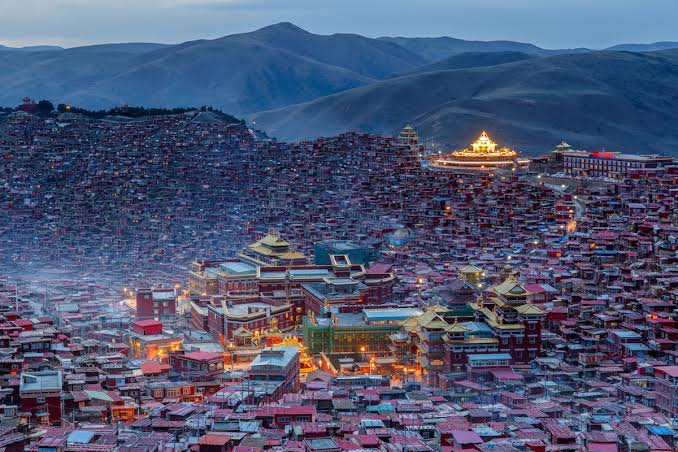
The People’s Republic of China has intentionally formulated the word “Greater Tibet” to mislead the international community into believing that Tibetans are seeking separation or demarcation of Tibetan areas. The CTA does not use the term “Greater Tibet”. The three traditional provinces of U-Tsang, Kham and Amdo have always been essential parts of traditional Tibet which cover the entire Tibetan plateau. They share not just the same geography and topography but also culture, language and religion. Division of Tibet into several provinces of China is a clear violation of Chinese laws and of Article 4 of the Constitution which recognizes the right of minority nationalities to practice regional autonomy “in the areas where they live in concentrated communities” and “to set up organ of self-government for the exercise of power of autonomy.” 99% of Uyghurs in China live in Xinjiang Uyghur Autonomous Region and 95% of Zhuangs live in Guangxi Zhuang Autonomous Region. Tibetans living in one concentrated community are divided into different provinces with less than 50% in the Tibet Autonomous Region ( TAR) while the majority is incorporated into neighbouring Chinese provinces as autonomous prefectures and counties.
Tibet constituting one-fourth of China is not a recent political creation but a natural outcome of Tibetans inhabiting the Tibetan plateau for thousands of years. The fact that Tibet constitutes one-fourth of China should not be a concern for the Chinese government because one sixth of China is already established as Xinjiang Uyghur Autonomous Region and one-eighth as Inner Mongolia Autonomous Region. Moreover, genuine autonomy for all Tibetans does not only conform to Tibet’s geographical reality, but conforms to its administrative needs, all of which aims for the actual implementation of Chinese laws in these areas to empower Tibetans to become masters of their own affairs.
Having all Tibetans, who share the same culture, same level and mode of economic development and even the same environment of the Tibetan Plateau, live within a single administrative unit will be an efficient and effective form of governance rather than dividing them into TAR and four Chinese provinces of Qinghai, Sichuan, Gansu and Yunnan with Chinese majority.
Similarly, the Chinese government has unleashed a massive propaganda to project that Tibetans are seeking “high degree of autonomy.” In reality our aspiration is for the Chinese government to implement the provisions of national regional autonomy as enshrined in the PRC constitution. Apart from this we have never talk about high or low degree of autonomy.
The Way Forward
The Tibetan administration is seeking the support of the Chinese community and the wider international community to encourage the Chinese government to resume dialogue in a spirit of reconciliation, and mindful of the many benefits to both sides that would stem from genuine autonomy. The Tibetan leadership believes the Central Chinese Government can no longer defend its position that Tibetans in Tibet are satisfied with the current Chinese policies. Therefore the Tibetan people must be granted a genuine say in their own affairs in order for them to live in harmony. Through the Middle-Way Approach, the People’s Republic of China can ensure regional peace and stability by having a legitimate presence. Internationally, it also stands to gain by improving its image in the minds and hearts of people around the world, while at the same time protect its territorial integrity and sovereignty.