Festival pays tribute to the 14th Dalai Lama’s leadership and contributions
BANGALORE, 7 July: Hundreds of visitors thronged the two-day-long Tibet Festival – 2014 held in the city and celebrated the distinct and wide-ranging facets of Tibetan culture and religion that were on display at the cultural extravaganza. The event was launched on 6 July, on the auspicious 79th birthday of His Holiness the Dalai Lama, and paid tribute to his leadership of the Tibetan people as well as his immense contributions to Tibet and the world.
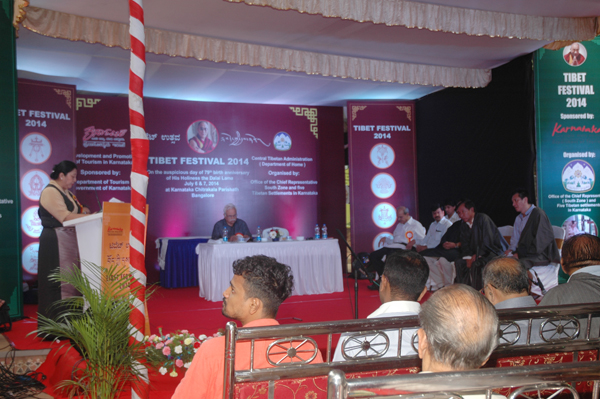
Under the aegis of the Department of Home, Central Tibetan Administration (CTA) and the generous sponsorship of the Department of Tourism, Government of Karnataka, the Office of the Chief Representative, CTA, South Zone and the five Karnataka-based Tibetan settlements organized the Tibet Festival at the Karnataka Chitrakala Parisath on 6 and 7 July.
The festival, which was open to the public, celebrated the Tibetan way of life through its wonderful collection of exhibitions, religious and cultural performances, talks, film screenings, and Tibetan food. Through the festival, the organizers hoped to bring Tibet closer to the people of Karnataka by familiarizing them with Tibet’s distinct traditions.
The 14th Kashag (Cabinet) has dedicated 2014 as the year of the great 14th Dalai Lama. As such, this year, the Tibet Festival was dedicated in recognition of the Dalai Lama’s tireless efforts for the benefit of the Tibetan people and the world in general. The festival paid tribute to his leadership of the Tibetan people during the most turbulent years in Tibetan history.
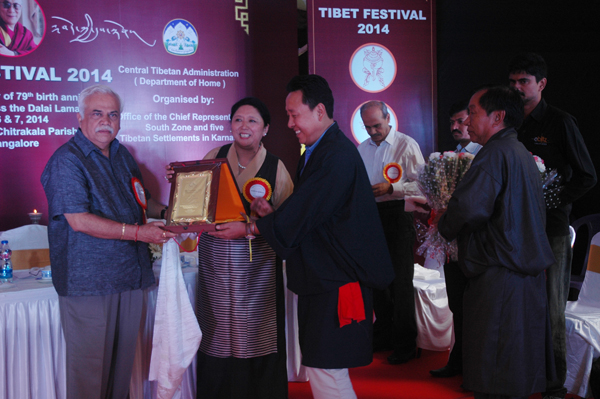
The event was inaugurated by Chief Guest, Shri. R.V. Deshpande, Honorable Minister for Higher Education and Tourism, Government of Karnataka, who praised the achievements of the Tibetan refugees during their stay in India. Deshpande vowed to consider potential partnership opportunities with the Central Tibetan Administration to promote and develop tourism within the state.
Guest of Honor, Mrs Dolma Gyari, Honorable Kalon (Minister) of Home Department, CTA, expressed gratitude at Deshpande’s consideration of the CTA’s request to be viewed as a partner in tourism-related ventures of the state, given the significant presence of the Tibetan Buddhist monastic institutions that attract a large number of international and domestic tourists. Gyari, in her address, also highlighted the importance of the Karnataka state as a Buddhist heritage site, noting that archaeological excavations in the state had clearly vouched for the existence of Buddhism starting from the 2nd century B.C.
WITH GRATITUDE
On behalf of the Tibetan people, Gyari thanked the Karnataka government and its people for its generosity and hospitality over the past five decades. Gyari also provided the gathering a detailed account of how the Tibetan settlements of south India had emerged as popular tourist destinations over the years.
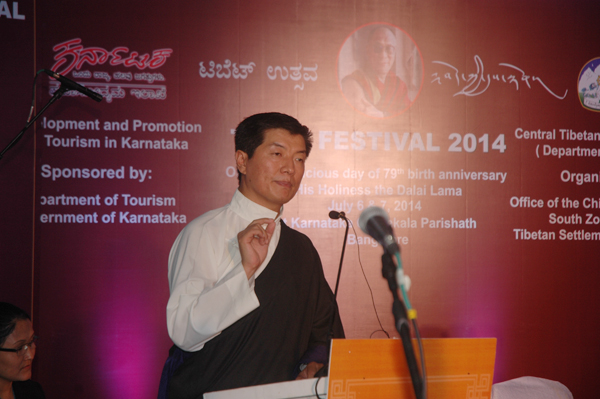
Honorable Sikyong Dr. Lobsang Sangay, the Political Head of the democratically-elected Central Tibetan Administration, was the Chief Guest during the closing ceremony on 7 July. Dr. Sangay too recognized the kindness and support extended by the Karnataka government and its people to the Tibetan refugees over the past five decades. After thanking the state government and the people of Karnataka, Dr. Sangay called for greater awareness about Tibet’s geopolitical, geographical and environmental significance to India and the world in general.
Speaking at the length on the environmental concerns plaguing Tibet, Dr. Sangay highlighted the environmental significance of the country, given that the Tibetan plateau holds the third-largest store of water-ice in the world, serving as a source of many rivers in Asia, particularly the great rivers of India. In addition, the exploitation of Tibet’s pristine ecosystem owing to rampant mining, deforestation and damming, among others, are causing irreparable damages to the environment, subsequently impacting global conditions, Dr. Sangay added.
Dr. Sangay called on the gathering to raise their voices against these injustices, and expressed hope that the Festival had allowed the visitors to experience the unique Tibetan way of life. He thanked the organizers for a successful event and noted the importance of this event as it is dedicated in honor of His Holiness the Dalai Lama.
This year marks 25 years since the 14th Dalai Lama was conferred the Nobel Peace Prize on 10 December 1989, said Dr. Sangay. The CTA would honor this auspicious occasion in Dharamsala later this year by inviting several Nobel laureates for the anniversary celebrations, he added.
CULTURAL EXTRAVAGANZA
“We are very happy with the response we have received. If you notice, almost all the stalls have been jam-packed since the morning of the first day of the event, with many items already having sold out. Therefore, I’m sure the festival has been successful in creating awareness about Tibet’s rich cultural and religious heritage, which despite having survived in exile, faces the risk of extinction in Tibet,” Mr. Chophel Thupten, Chairman of the Organizing Committee, Tibet Festival 2014 said.
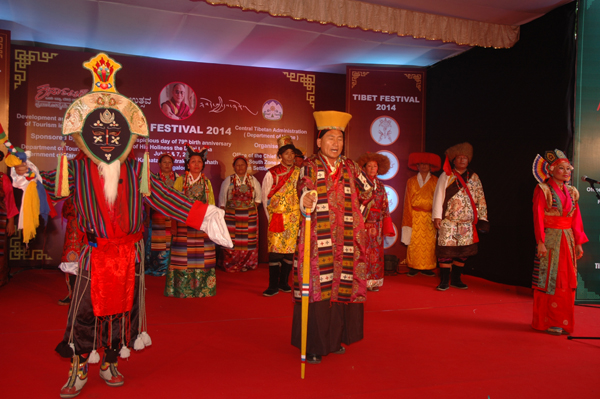
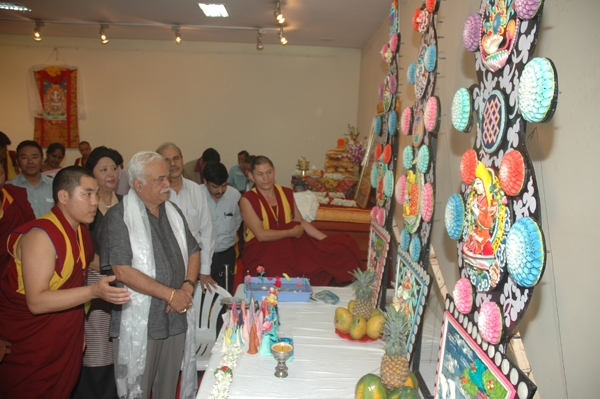
The festival included a photo exhibition titled ‘Tibet’s Journey in Exile’, which portrayed the evolution of the Tibetan refugee settlements over the past five decades. In addition, monks from the monasteries in south India showcased different elements of Tibetan Buddhism, including mandalas, ritual dances, chantings, and butter sculptures or offerings. Monks also performed a snow lion dance that was well-loved by the audience.
Also on display were Tibetan handicrafts, such as Tibetan carpets, wood carvings, and scroll paintings, as well as Tibetan medicinal and herbal products, with visitors having the option to avail of free consultation services by an acclaimed Tibetan doctor. The festival also included cultural performances, such as Tibetan music, dance and opera, as well as talks and film screenings. Visitors could also taste the distinct flavors of the Tibetan cuisine at the Food Court.
“Karnataka has been home to thousands of Tibetan refugees for more than five decades and has helped ensure the community’s socio-economic development, while simultaneously allowing us to keep our cultural and religious traditions alive even in exile.” Mr. Thupten said. “Therefore, we are extremely grateful to the government and people of Karnataka, and we view this festival as an opportune moment to express our gratitude.”