Tibet is an occupied country, says a senior Russian scholar [Thursday, 6 May 2010, 4:04 p.m.]
 |
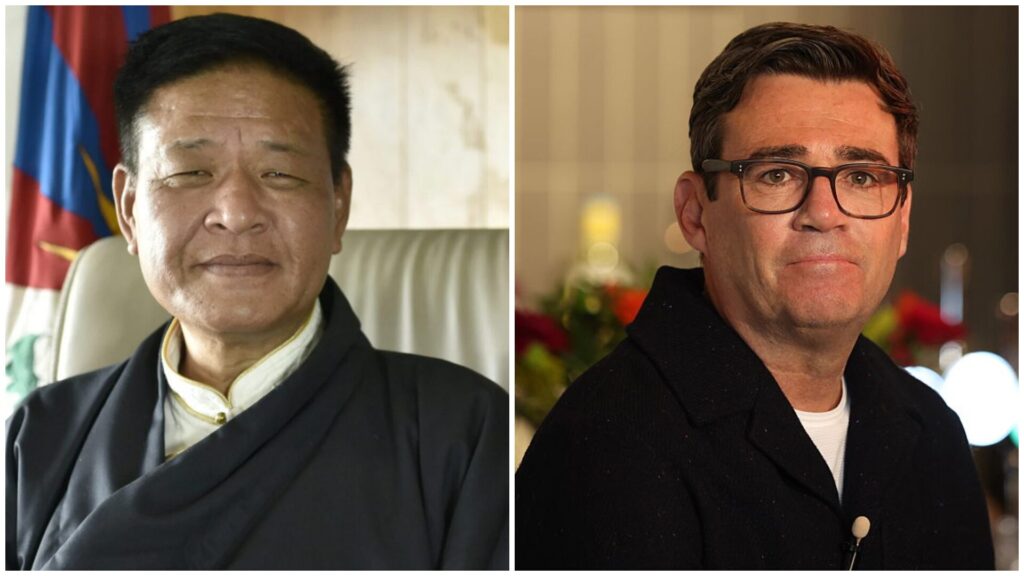
| Kalon Tripa Prof. Samdhong Rinpoche releases a boook ‘Hidden Tibet : History of Independence and Occupation’ with Speaker Penpa Tsering, Geshe Lhakdor la, and the writer of the book Dr. Sergius L. Kuzmin. Photos / Tibet.Net. |
Dharamshala:
“Tibet is an occupied country,” said Dr. Sergius L. Kuzmin, a senior
Russian Scholar from the Russian Academy of Sciences, Moscow, on
Tuesday at a press meet organized jointly by the Moscow based Save
Tibet Foundation and Library of Tibetan Works and Archives (LTWA) in
Dharamsala. The meet the press was held just after his book
‘Hidden Tibet : History of Independence and Occupation’ was officially
released at Library of Tibetan Works and Archives by Prof Samdhong
Rinpoche, Kalon Tripa. Kalon Tripa thanked Dr. Kuzmin for writing an
unbiased true history of Tibet based on facts.
 |
| Dr. Sergius L. Kuzmin speaking on the book released. |
According
to Dr. Kuzmin, “Tibet has never been part of any other state. When
China was an inseparable part of Mongolian Yuan Empire and Manchu Qing
Empire, Tibet was a separate country – not a part of these empires. It
was not a part of Chinese Tang and Ming empires. Statement that Tibet
was a part of neighbouring empires is related to ancient Chinese
conception of the emperor’s global power. Its principles are being
wrongfully transferred onto a nation state model in post-revolution
China. Inclusion of Tibet into the People’s Republic of China was not
legitimate. Tibet is an occupied country.” “In my book I
tried to trace the history of Tibet since ancient times to our days
which is first part of the book. The second part is analysis of
statehood, Chinese dynasties, China and its neighbouring countries,
Chinese claims and the basis for such claims,” said the writer.
Dr. Kuzmin further said, “Therefore the conclusion of my book is that
Tibet is an occupied country and that movement for independence of
Tibet is not separatism because it is not claiming for creation of new
state or new autonomy. It is a movement for recovery of a state which
existed before and the Kashag is the legitimate Tibetan government. It
is the legacy of independent government of Tibet.” Dr.
Sergius Kuzmin, born in the year when Tibet lost independence in 1959,
is based in Moscow. He is a member of World Conservation Union and a
senior scientist has more than 200 publications to his credit as well.
He had visited Tibet in February 2008 before the massive protests by
Tibetans across Tibet. Currently the book (with 12
chapters, 542 pages and 180 photographs) is available in Russian
language only and can be accessed at www.savetibet.ru The
Moscow-based Tibet Culture and Information Centre will translate it
into English and attempts will be made to translate it into Chinese as
well.