
CTA’s Response-VBeijing Wanting to Choose Tibet’s Spiritual Leaders is a Political Tool[posted on Wednesday, 16 December 2009]
IntroductionFrom
the onset of China’s occupation of Tibet, the Chinese Communist Party’s
outlook towards Tibetan Buddhism has been of extreme suspicion and
fear. Tibetan people’s way of life and their outlook towards the world
is inextricably linked with fundamental precepts of Buddhism. This
common philosophical thread and a shared culture bind Tibetans into a
unified entity giving them a sense of national identity. For Tibetan
people this basic identity is inseparable from their belief in Buddhist
principles, which “encompasses the entirety of their culture and
civilization and constitutes the very essence of their lives. Of all
the bonds which defined Tibetans as a people and as a nation, religion
was undoubtedly the strongest.”1 On the other hand,
such unifying power and spirit become definitive threats to Beijing’s
authority and survival. As a result the Chinese rulers have been at
pains to hammer down and eradicate Tibetan faith and identity from
within their hearts.In recent years China has increasingly
involved itself in controlling and manipulating Tibetan Buddhism. In
July 2007, the State Religious Affair Bureau issued a so-called Order
No. Five ─ which is a set of “management measures for the reincarnation
of Living Buddhas in Tibetan Buddhism.” This is an ultimate
interference in the centuries-old Tibetan spiritual practice and a
gross violation of the freedom of religion as enshrined in the
Universal Declaration of Human Rights and also mentioned in the
constitution of the People’s Republic of China.History of ReincarnationTibetans
believe in rebirth, which brings about universal love for living
beings. Highly realized spiritual masters use the vehicle of rebirth to
come back in another human form with “the innate wish to help others.” 2
The root of the reincarnation goes back to the theory of ‘three buddha
bodies’ in Buddhism ─ the body of reality, the body of perfect rapture,
and the emanational body.”3 The emanational or reincarnated body has many different terms in Tibetan such as lama, tulku, yangsi, kyetul, latul etc. The Chinese term ‘Living Buddha’ does not exists in Tibetan Buddhist parlance.Tibetans
have adapted reincarnation into a unique system of successive rebirths
of spiritual masters. Thus when a lama passes away, his reincarnation
is recognized through centuries-old traditional methods. This
uninterrupted lineage is essential for the spiritual practice to
transmit the accumulated wisdom of the lama to the new reincarnation,
who in turn will teach them to the faithful.The first
reincarnation in Tibetan Buddhism dates back to the 12th century.
Karmapa Dusum Khyenpa (1110-1193) was a great scholar and an
accomplished meditation master. Before he passed away at the age of
eighty-three, he presented Drogon Rechen, with a prediction letter,
detailing Düsum Khyenpa’s future incarnation. Karma Pakshi (1204-1283),
who was born in Eastern Tibet, “was recognized as the reincarnation of
Dusum Khyenpa by Pomdragpa Sonam Dorje. Karma Pakshi received the
entire cycle of the Kagyü teachings and became a famous siddha with
extraordinary powers and accomplishments.”4Since the
reincarnation of the first Karmapa, more than seven hundred years have
passed and the current Karmapa Ugyen Trinley Dorjee is the 17th
reincarnation. The selection, recognition and enthronement of the
successive Karmapa reincarnations have been a spiritual affairs
performed by experienced practitioners of the Kagyu school of Tibetan
Buddhism.Panchen Lama lineage started when Sonam Choklang was
recognized as the reincarnation of Khedup Gelek Palzang (1385-1483),
the foremost student of Je Tsongkhapa, who founded the Gelukpa school
of Tibetan Buddhism. “Sonam Choklang was the second Panchen Lama and
the first reincarnation in the Gelukpa school.”5 The
institution of the Panchen Lama, based in Shigatse, was created by the
5th Dalai Lama in recognition of his esteemed teacher, Lobsang Choekyi
Gyaltsen, who became the first in line to assume the Panchen Lama title.The
Dalai Lama institution began when Gendeun Drup’s reincarnation was
found after an intense search and a series of rigorous tests. Gendun
Gyatso was the second Dalai Lama, who established the Gaden Phodrang.
Altan Khan of the Tumat Mongols offered the title Dalai Lama to Sonam
Gyatso, who was the third in line. The relationship with China under
Qing and the Dalai Lamas as Tibetan spiritual and temporal leaders
began with the 5th Dalai Lama’s Beijing visit of 1653.”The 5th Dalai Lama established a standard manual of titles and ranks for reincarnate lamas and tulkus. The Dalai Lama based this guideline on the traditional ranks and positions of each lama and tulku in their respective monasteries and set a standard benchmark. This effectively managed recognition of tulkus and avoided selecting them out of preferential treatment.”6 No Chinese emperor had authority in Tibetan religious matters.The
special bond between the Panchen and Dalai Lamas has been that of
teacher and student with each performing the critical role in the
recognition of the reincarnation of the other. The elder of the two
plays a crucial role in the education of the other, passing on special
initiations, transmissions and other spiritual heritage. There were no
Chinese interventions in the selection process; and whenever there was
interference Tibetans had thwarted it.One of the major Chinese propagandas is that the selection of reincarnation of lama and tulku
is done by using golden urn lottery system. In 1792 “after the Gurkha
war, the Chi’en-lung Emperor tried to institute a new system by which
the reincarnations of high lamas, such as Dalai Lama and Panchen Lama,
would be determined by lottery.”7 However, about a decade later in 1805
“although there were two candidates for the ninth incarnation of the
Dalai Lama, the golden urn system was ignored and the selection made by
the Tibetan officials themselves.”8 Moreover, the Manchu
army General Fu K’ang-an told the 8th Dalai Lama that this was a mere
“suggestion” and that Tibetans should “decide for themselves as to what
is in their favour and what is not.”9After the 9th
Dalai Lama passed at the tender age of ten, Chinese Ambans demanded
that golden urn be used to select the reincarnation. Once again, “the
regent, members of the Kashag, and representatives of the three big
monasteries confirmed him [a child from Lithang] to be the tenth Dalai
Lama.”10 The 10th Dalai Lama too passed away at young age of
27 and when his reincarnation was found the 7th Panchen Lama recognized
and gave the name Khedrup Gyatso. Khedrup was the 11th Dalai Lama.It
is historically clear that Tibetans carried out their spiritual
practice independently without being ordered or forced by outside
powers. A point made clear by the 9th Panchen Choekyi Nyima: if an
“advice ran counter in any respect to their [Tibetan] national
prejudice, the Chinese Emperor himself would be powerless to influence
them.”11In 1995, through a carefully manufactured
performance using the golden urn lottery system Beijing chose
six-year-old, Gyaltsen Norbu, as ‘their’ reincarnation of the 10th
Panchen Lama. As soon as the selection was done the boy was “ushered
into the room in golden robes and a yellow silk hat. Norbu was hailed
by the monks and by a man dressed incongruously in a Western-style
suit: Luo Gan, a senior Chinese official dispatched to oversee the
ceremony. Luo later bent forward, shook the boy’s hand and said, “Love
the country and study hard.”12 Systematic SuppressionThe
“17-Point Agreement” signed by the Tibetan under duress in 1951
explicitly stated that “the policy of freedom of religious belief laid
down in the Common Programme of the Chinese People’s Political
Consultative Conference will be protected. The Central Authorities will
not effect any change in the income of the monasteries.”13
Three years later during his final meeting with His Holiness Dalai Lama
in 1954, Mao Zedong edged closer to His Holiness and whispered: “…
but of course religion is poison. It has two great defects: it
undermines the race, and secondly it retards the progress of the
country. Tibet and Mongolia have been both poisoned by it.”14
This was an undeniable precursor to subsequent violation of the
provision of the ‘agreement’ and eventual destruction of religion and
religious institutions in Tibet.Early on Chinese leaders
realized that religion was the biggest hurdle to their control over
Tibet. Hence Beijing had launched a series of systematic policies,
directives and campaigns to undermine religion and its inherent
influence on the Tibetan people.In 1950s and 60s under
so-called ‘democratic reforms’ land and other assets were seized from
the monasteries. “Attacks on religion became more violent. Lamas were
assaulted and humiliated; some were put to death. The ordinary people
who refused Chinese orders to give up the practice of religion were
beaten and had their good confiscated.”15 By 1959 the
Chinese occupying forces have killed a large number of monks and
civilians and numerous religious structures were demolished, prompting
International Commission of Jurist to comment that “they [Chinese] have
systematically set out to eradicate this religious belief in Tibet,”
and that “in pursuit of this design they [Chinese] have killed
religious figures because their religious belief and practice was an
encouragement and example to others.”16 In 1959
“there were more than a total of 6,259 monasteries with about 592, 558
resident monks and nuns. These religious centres also housed tens and
thousands of statues, [and] religious artifacts.”17 When
Mao’s convoluted Cultural Revolution was over in 1976, “Chinese
government was responsible for the destruction of more than 6000
monasteries in Tibet. The contents of these monasteries – religious
images and statues – were destroyed or looted, and millions of ancient
and priceless manuscripts burnt.”18 The entire Tibetan way of life was fractured. The
destruction of religion, however, did not stop with end of the Cultural
Revolution. It got more subtle and insidious. The various policies on
religion are overseen and authorized by China’s highest body the
Central Committee and Politburo and the State Council. The Party sits
at the top of a tightly controlled system that implements policies and
directives in Tibet.Through this chain of unbroken command the
Democratic Management Committee (DMC) that China set up in each of the
monasteries throughout Tibet implements the policies. It is the lowest
operating unit. “The Committee receives guidance and support from
relevant government departments in charge of religious affairs, and
keeps them informed of any problems in implementing state policies…”19 Through it the government “provide maximum economic and political control over monasteries”20 and one of its important roles is “to inform the PSB of the identities of counter-revolutionaries.”21The
local DMC also functions in collusion with ‘work team’ whose prime
responsibility is to conduct political education and investigation. The
‘work teams’ routinely move into monasteries and nunneries sometimes
for months “to carry out investigations, hold meetings, conduct
surveillance and identify candidates for arrest.”22 Thus
traditional role of abbot is undermined and the entire religious
establishment is turned into a political battlefield to bend monks’ and
nuns’ loyalty towards the Party.Article-36 of the Constitution
of PRC, which was adopted in 1982, claims that “citizens of the PRC
enjoy freedom of religious belief. No state organ, public organization
or individual may compel citizens to believe in, or not to believe in,
any religion; nor may they discriminate against citizens who believe
in, or do not believe in, any religion.”23 Yet the same year Document 1924
was released. This was the “most authoritative and comprehensive
statement ever issued by the central government on the permissible
scope of the religious freedom.”25 It “declared religious tolerance to be a necessary step in the path towards eradication of religion.”Beijing
had launched a wave of campaigns such as ‘Strike Hard’ and ‘Patriotic
Re-education’ through which the government heavily interferes in the
religious institutions and introduces “Marxist outlook to Buddhism or
reshaping of Buddhism to suit the needs of socialist China.”26China’s
systematic polices to stamp out Tibetan religion have led to
executions, destruction of religious institutions, political
indoctrination, expulsion of monks and nuns, imprisonment, banning
religious ceremonies, restricting on number of monks in monasteries and
enforcing loyalty to the Party. But no matter how hard the Chinese
suppression is or how severe the reprisals are when caught “Tibetans
stubbornly refuse to abandon their religion and culture. On a daily
basis they find ways to rebel, hiding banned images of the Dalai Lama
close to their hearts, lighting banned incense, whispering banned
prayers.”27Persecutions only drive the Tibetans
further from the Chinese. The rift has grown larger, thus denying
Beijing the approval, the respect and the allegiance of Tibetan people
that it needs to legitimately meddle in religious affairs.Political Tool“Religious tenets and practices which do not comply with socialist society should be changed”28 Beijing declared in A Golden Bridge Leading to a New Era,
a high-level official guideline on religious policies in Tibet
established during the Third National Forum on Work in Tibet 1994. This
has always been the central focus of China’s policy on Tibetan religion
─ forcing the monks and nuns ‘to love the Communist Party of China; to
love the motherland; to love socialism; and to love people.’The
most recent, and probably the most ludicrous policy on religion, is the
so-called Order No. Five issued by State Religious Affairs Bureau. This
guideline requires recognition of all reincarnate tulkus or
lamas be authorized by Beijing, which is a clear, direct and
undisguised interference the fundamental right of Tibetan people.China
is a socialist state that firmly believes and adheres to
Marxist-Leninist Mao Zedong Thoughts. For this trio of socialism’s
placard religion is a social toxin. “Religion is the sigh of the
oppressed creature, the heart of a heartless world, and the soul of
soulless conditions. It is the opium of the people,”29 wrote Marx. “Religion is a spiritual oppression … [a kind] of spiritual booze,”30
Lenin added. Mao was vehemently direct. “Religion is a poison,” he
said. If indeed religion is such a loathsome poisonous affair, then why
is Beijing so keen to involve itself in Tibetan Buddhism?The answer is simple ─ Political Tool.During
a brief policy relaxation in the early 1980s, Tibetans voluntarily
rebuilt a number of monasteries in occupied Tibet leading to resurgence
in Tibetan national identity, which in turn led to a series of
demonstration calling for Tibet’s freedom and the return of the Dalai
Lama. “The revival of Tibetan culture, religion, and nationalism was a
surprise to the Chinese, who had imagined that thirty years of
repression and propaganda would have eliminated Tibetan separatism.”31
Upon realizing that total suppression alone does not bring the desired
result, Beijing chose to employ religion as a tool not only “to
transform Tibetan national identity and loyalty to the Dalai Lama into
Chinese national identity and loyalty to China” but also as a kind of
legal measure which constitute means to put their people in positions
that control Tibetan people’s spiritual realm.”Religion must be of no concern to the state, and religious societies must have no connection with governmental authority,”32
wrote Lenin. But of course these words of wisdom from the socialist
founding father do not ring any bell in the minds of Chinese comrades.For
them safeguarding their power and suppressing any challenge to the
Party’s authority trump over rights of people. This is clear when in
1993 the Chinese President Jiang Zemin said that religion should be
“guided to adapt to socialism.” To fulfil such objective China has set
up heavy regulations on religion at all levels.The result is
that “everything to do with religion in Tibet, including building
restoration, entering orders, monk quotas in monasteries, festival
celebrations, and pilgrimages, has to be authorized by the Commission
of Nationalities and Religious Affairs.”33 Beijing
sees danger in Buddhism as an increasing number of Chinese come to
receive teachings from Tibetan lamas, including the Dalai Lama. Over a
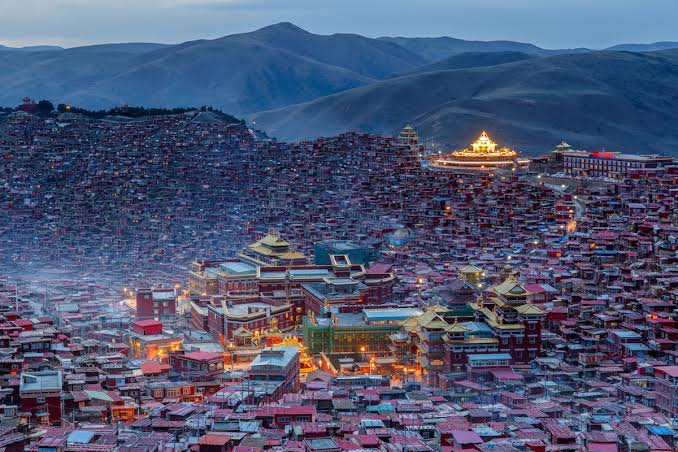
thousand Chinese joined Larung Gar as students of the charismatic
Tibetan religious leader, Khenpo Jigme Phuntsok, in Eastern Tibet. In
2001 the Chinese Authorities demolished the entire religious community
and expelled thousands of monks, nuns and other disciples. Such fears
are embedded in Chinese rulers, who in earlier decades declared that
‘two suns will not exist in the sky’ referring to Buddhism and
Communism. ‘There can be only one sun and that is the Communist Party,’
they claimed.The so-called Order No. Five is an unashamed and
ungloved political hand stretching into Tibetan people’s spiritual
domain. This ‘order’ was categorically repudiated by “the heads of all
the religious schools of Tibetan Buddhism; the monks, nuns, mantra
holders and the other lay followers of the respective schools and the
Department of Religion and Culture of the Central Tibetan
Administration”34 based in Dharamsala, India. The statement notes that “these measures for managing tulkus, is nothing but a deceitful lie” and that such lie will not be “able to fool the Tibetans and the people of the world.”A
resolution was passed by the heads of all Tibetan Buddhist schools and
Bon tradition on May 3 2008 in Dharamsala. Following the age-old
tradition, the resolution stated that “well-known lamas and tulkus who
have been continuously reincarnating in the respective monastic
institutions” need no consents from the head of each school. However,
“recognizing reincarnations of new lamas and tulkus shall not
be done without seeking consent from the heads of the four Tibetan
Buddhist schools and Bon tradition.” It should be noted that the heads
of all the schools of Tibetan Buddhism were exiled by China and live in
India. The most recent one to escape is the 17th Karmapa, the head of
Kagyu school, who stated that one of the reasons for coming into exile
was that there were no competent religious teachers in occupied Tibet.
This also testifies against Beijing’s claim that Buddhism is
flourishing in Tibet.The polarity between Beijing’s ‘order’ and the centuries-old Tibetan traditional methods of recognizing tulkus is not only a question of denial of religious freedom but more importantly it is a question of legitimacy. Since
its occupation, China has suppressed, imprisoned, killed and exiled
hundreds of thousands of Tibetans because of their faith. China has
also demolished, destroyed and damaged thousands of monasteries, and
burnt, melted and sold millions of religious objects. Based on these
and the fact that its founding father considered ‘religion as poison’,
China has neither the moral authority nor the legitimacy to interfere
in the affairs that concern Tibetan spiritual practice.After
the 10th Panchen Lama passed away in 1989, Chadrel Rinpoche headed a
team to undertake the search for his reincarnation. Following the
centuries-old methods and through prophecies and visions they found a
suitable boy. As per the tradition, the Dalai Lama performed the final
process of the identification. And on May 14 1995, the Dalai Lama
confirmed 6-year-old Gendun Choekyi Nyima as the 11th reincarnation of
the Panchen Lama. This left Beijing red-faced and three days
later Choekyi Nyima and his family disappeared. Despite international
pressure, China refuses to acknowledge his whereabouts. In December
1995 the Chinese authorities installed Gyaltsen Norbu as ‘their’
Panchen.Since then Beijing has missed “few opportunities to
promote their choice, Gyaltsen Norbu, as the legitimate Panchen Lama.
In April 2006 he was the keynote speaker at the World Buddhist Forum in
Hangzhou – the first religious conference held in China since 1949.”35However,
in the eyes of the Tibetan people Beijing is still an aggressor. This
lack of legitimacy is clear from the way Tibetans look at Chinese
selected Panchen ─ calling him ‘Panchen Zunma‘ or ‘Fake
Panchen.’ Beijing is forced to send soldiers to monasteries and towns
either to force or to bribe people to welcome ‘their Panchen’ during
his visits. “When the Panchen Zunma makes a visit Tibetans are
commanded to go for his blessings. In the schools, the Chinese
officials distribute scarves and badges, and tell everyone to formally
receive the Panchen Zunma. If anyone disregards this, they are
punished.”36 Though His Holiness’ name is not
explicitly mentioned in the ‘Order No. Five’, the reference to the
Tibetan leader is clear in the directive which mentioned that “those
[reincarnations] with particularly great impact shall be reported to
the State Council for approval.” This shows that at the core of this
absurd ‘order’ is Beijing’s real intention to meddle in the selection
of, and to install ‘their’ Dalai Lama when the present one passes away.
However, the “purpose of reincarnation is to continue and complete the
unfinished work of the predecessor and to help all living beings.”36
To this effect His Holiness emphatically stated that “if I die in
exile…the reincarnation will be born in a free country. He will not
be born under China.” Thus any attempt by Beijing will not only end up
in ‘false idol’ but also create more resentment in the hearts of
Tibetan people.Beijing’s concern is not for Tibetan people’s
spiritual affair, but to manipulate religious practices to meet China’s
political ends. What Tibetan lamas and tulkus have is “moral
authority and a role as unofficial community leaders or initiators.
Local people turned to them for help and advice on both religious and
secular matters.”37 This is a legitimate danger to the
Party’s authority, which Beijing does not want at any cost. This is why
the Party is recklessly determined to control the selection of
reincarnations of lamas and tulkus. Contemporary
Tibetan scholar Geshe Lhakdor-la succinctly sums it up: “An atheist
party wanting to recognize reincarnation is a joke. This is a religious
affair, which has to be handled by someone who is well-versed in
spiritual matters. What the Communist Party is doing now is to use it
as a political tool to force its will. That is absolutely wrong.”38Notes:1. TIBET: proving truth from facts. DIIR. 1993. p. 642. My Land My People by Dalai Lama. Potala Corporation, 1992. p.513. bhod kyi sprul sku’i rnam bshad by Ladrang Kelsang. 1997. pp. 2-34. The Garland of Moon Water Crystal (Tib. dawa chu shel gyi trengwa) by Situ Choekyi Jungnay and Belo Tsewang Kunkhyab5. bhod kyi sprul sku’i rnam bshad by Ladrang Kelsang. 1997. p. 136. ibid. pp. 119-1207. Political History of Tibet by W. D. Shakhabpa. Potala Publications. 1984. p. 1728. ibid p.1729. Talai Lamai Namthar by Ya Angchang. pp. 159-16110. Political History of Tibet. p.17411. Diary of Capt. O’Connor. September 4 190312. Tempest In A Golden Urn by Anthony Spaeth & Meenakshi Ganguly. TIME Magazine. Monday, Dec. 11, 199513. Facts About 17-Point ‘Agreement’ Between Tibet and China. DIIR, Dharamsala. May 22 200114. My Land and My People. p. 11815. A Short History of Tibet by Hugh Richardson. 1962. p. 20116. Tibet and the Chinese People’s Republic. Legal Inquiry Committee of the International Commission of Jurists. 196017. TIBET: proving truth from facts. DIIR, 1993. p. 6418. No Faith in the State. Tibet Watch. 2007. p. 1019. 100 Questions about Tibet by Jing Wei. Beijing Review Press, 198920. Forbidden Freedom: Beijing’s Control of Religion in Tibet. ITC, Sept. 1990 p. 2621. ibid. p. 2822. ibid. p. 5123. Constitution
of the People’s Republic of China; adopted at the Fifth Session of the
Fifth National People’s Congress for the promulgation by the Proclamation of the National People’s Congress on December 4 198224. The Basic Viewpoint and Policy on the Religious Question during Our Country’s Socialist Period (popularly known as Document 19)25. Forbidden Freedom: p.1626. “Strike Hard” Campaign: China’s crackdown on political dissidence. TCHRD, 2004. p. 2727. No Faith in the State. Tibet Watch. 2007 p.1228.
A Golden Bridge Leading to a New Era. guidelines on religious policy
announced at the Third Forum and later published by the TAR Party. p.8129. Introduction to a Contribution to the Critique of Hegel’s Philosophy of Right by Karl Marx30. Lenin Collected Works. Progress Publishers, 1965. Moscow. Volume 10 p. 8331. CHINA’S TIBET? Autonomy or Assimilation by Warren Smith. p. xvii32. Lenin Collected Works. Progress Publishers. 1965. Moscow. Volume 10. p. 8433. Authenticating Tibet: Answers to China’s 100 Questions. University of California Press. 2008. p.18734. Joint
Statement to Repudiate the so-called Order No. 5 of China’s State
Administration of Religious Affairs on Management Measures for the
Reincarnation of ‘Living Buddhas’ in Tibetan Buddhism35. No Faith in the State. p.4536. Public Speech on Reincarnation. Dalai Lama. Office of Dalai Lama. 2008. p.3337. No Faith in the State. p.5138. Interview with Geshe Lhakdor-la, Director of the Library of Tibetan Works and Archives. Dharamsla, India.