
Chauncey Jung, South China Morning Post. Read the original article here.
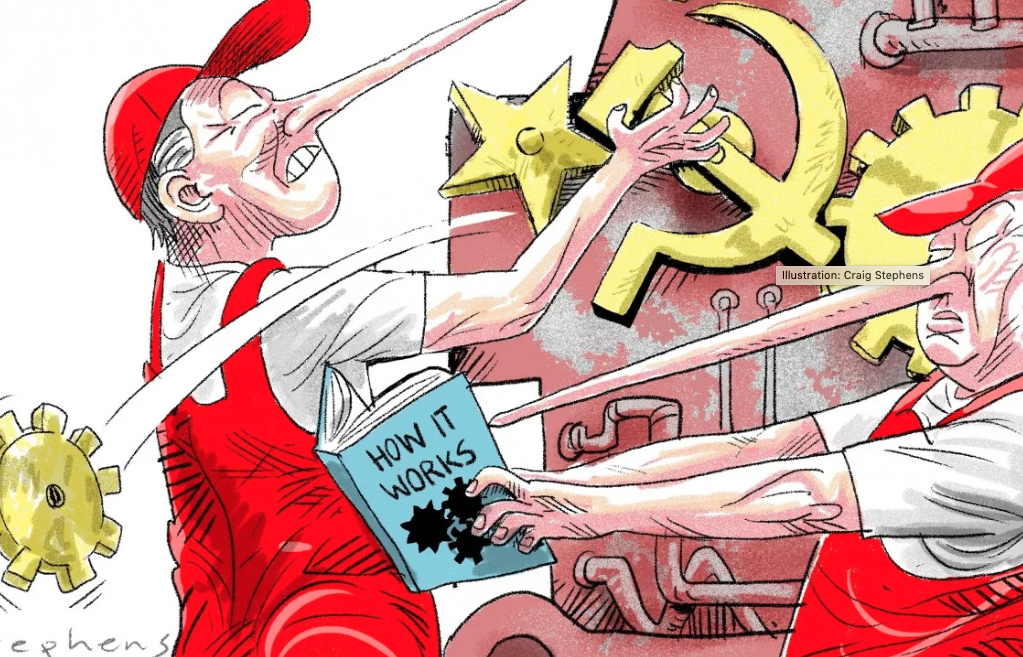
If President Xi Jinping’s team carries out annual job appraisals, China’s overseas propaganda team will surely be found to have performed catastrophically. Whether it is Hong Kong or Xinjiang, Huawei or the trade war with the United States, the Chinese regime has had a string of notable public relations failures this year.
While the regime’s propaganda efforts have worked quite well on the domestic audience, mainly because of the Great Firewall, the overseas propaganda arm has suffered major defeats. Despite deploying numerous resources via official and unofficial channels, the regime has not only failed to achieve its intended purpose of interacting well with the rest of the world but also aggravated its poor international image.
As former Chinese reporter Jasper Jia summed up on Twitter, dozens of government departments with billions at their disposal spent 10 years on the propaganda projects, but they have done a worse job than a little girl.
That girl would be Li Ziqi, the Chinese internet celebrity who has more than 7.5 million subscribers on YouTube and apparently wields more soft power than, say, CGTN, the English-language channel of the state broadcaster CCTV that has 1 million subscribers on YouTube. (However, it remains unclear how Li’s team received official approval to upload videos to YouTube via a virtual private network.)
Xi has declared that Beijing, presumably including propaganda officials and the official media, needs to “tell China’s story well”. But, in the past year, these officials have failed quite spectacularly in this mission.
While more Chinese diplomats and embassies have activated Twitter accounts, they have entered a cold new world: now they know how unwelcome they are on the social media platform, and some of them probably feel like they are talking to a wall. They are unable to get their musty messages across in the free world, and yet they don’t seem to have figured out why.
Beijing’s divisive policy decisions are certainly a major factor in the deterioration of the regime’s image. From playing the politics of fear and division in Hong Kong to incarcerating innocent ethnic minorities in re-education camps in Xinjiang, China fundamentally rejects the path that leads to freedom and equality.
By severely limiting press freedom in the country and constantly harassing reporters and researchers working for the foreign media, the regime seems to think it has ensured fair coverage by the world media. However, fighting the media is the worst political strategy to adopt.
Although the Chinese ambassador to Britain, Liu Xiaoming, insists there are no political prisoners in China, facts seem to suggest otherwise. As the headline of a Freedom House report baldly states, China is “The Global Leader in Political Prisoners”. What was Liu Xiaobo if not a political prisoner? What are the people in the camps in Xinjiang? Chinese officials’ blatant lies are making the world question the regime’s credibility.
Furthermore, the ongoing propaganda campaign has shown that senior Chinese officials have little understanding of how democratic countries work, and this is hampering their ability to accomplish their missions overseas.
As a country with 40 years’ experience of opening up its economy, China is supposed to have a better understanding of how liberal democracy works. But the reality suggests the opposite.
To judge by recent events, China might be going out of its way to make itself look bad. It has detained two Canadians in the hope of getting the Canadian government to abandon its rule of law and extradition treaty with the United States. It has been accused of meddling in the US midterm elections in retaliation for the trade war.
This sounds more like 19th-century diplomacy. Are Chinese officials so clueless about decision-making processes in developed democracies that they will try to gain advantages by abusing power?
This can only backfire on the Chinese. In Canada, the opposition has voted to set up a special committee on China relations. In the US, the Democrats now hold a majority in the House of Representatives and they have shown no more sign of being tolerant of the Chinese regime than the Republicans.
Not only have the Chinese failed to achieve their intended goals, but they have also faced more pressure in those countries consequently. However, their actions feel less like calculated moves and more like misguided decisions that somehow received official approval.
Unlike the old communist regime, the current government is finding that its ideological beliefs are not aligned with those of major political parties in developed democracies. Back in the 1950s and 1960s, Mao Zedong’s China claimed to fight for gender and social equality – ideals that were considered progressive at the time.
The communists were able to generate a lot more interest and support from the West then than they are now. Disturbingly, the current regime’s Western supporters include white supremacists and neo-fascists. In his manifesto, the Christchurch shooting suspect claims he identifies most closely with China’s political and social values.
As long as China stands for neither equality nor freedom, its communication strategy is unlikely to work on any democracies. Meanwhile, its penchant for censorship and disinformation warfare continues to threaten democracies around the world. For those who are fighting to preserve democratic values and electoral integrity, there is much to do.
*Chauncey Jung is a China internet specialist who previously worked for various Chinese internet companies in Beijing