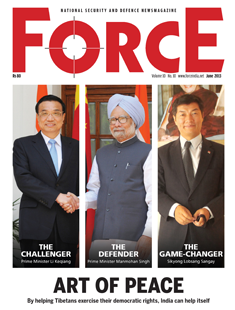
ART OF PEACE
By helping Tibetans exercise their rights, India can help itself
[Force Magazine]Writes Pravin Sawhney and Ghazala Wahab
Democracy at Work
Deng Xiaoping, the strategist par excellence, who is credited with China’s four modernisations in the Eighties which paved the way for present-day China, was also responsible for the tectonic changes in Beijing’s India and Tibet policies, both of which unfolded in 1988, when China was still a weak nation.
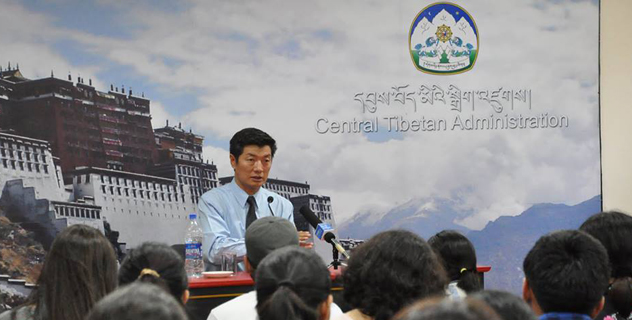
Interestingly, Tibetans changed too, though less dramatically, in August 2011 with the election of Lobsang Sangay, the first dapper and Harvard-educated internationalist to the post of Sikyong (Prime Minister) of the Central Tibetan Authority (government-in-exile) based in Dharamsala. India, unfortunately, continues to resist changes which will benefit its democratic credentials, international profile, China policy, and the Tibetan cause all at once.
An Indian Deng Xiaoping would have realised that after Delhi formally accepted Tibet as a part of China in 2003, the Dalai Lama as the Tibetan spiritual head and Sangay as the Tibetan temporal head are India’s defence against a confrontationist China which will not allow India space in Asia, much less the world. Tibet, after all, is China’s core-interest area.
During the 1988 visit of Prime Minister Rajiv Gandhi to China, Deng made it known that the border resolution was no longer on the table; both countries could now best strive for a peaceful border, something which remains elusive till today. The package deal offered by Deng to India in 1984 for border resolution had been withdrawn following the 1986 Somdorong Chu incident which witnessed a year-long military build-up on the border by both sides.
Similarly, the offer made by Deng in April 1988 to the Dalai Lama that he could live in Lhasa provided he gave up his goal of independence was withdrawn after the Dalai Lama replied to Beijing through his famous 1988 Strasbourg address at the European Parliament where he unveiled his ‘Middle Path’ and declared to forego the independence call made in 1959 from exile in India.
The Dalai Lama said that Tibet could remain with China if Beijing allowed an autonomous status to the whole of Tibet (political and ethnographic), to include Amdo, Kham and U-tsang areas (Tibet Autonomous Region). The Dalai Lama’s Greater Tibet covered the TAR, the whole of Qinghai province, western parts of Sichuan, areas of Yunnan and a slice of Gansu. Beijing immediately cried foul and rejected it saying that it was an indirect call for independence. China could not permit Taiwan’s status of ‘one country, two systems’ to Tibet and have democracy flourishing alongside authoritarian rule. Moreover, the creation of Greater Tibet meant disrespect to Beijing drawn administrative boundaries. The minimum the Dalai Lama was asking was much more than the maximum Beijing could give. Even as China was working on a befitting response to the Strasbourg address, two things happened that undermined Beijing’s credibility: the Dalai Lama was awarded the Nobel Peace Prize in 1989, and there was the Tiananmen Square debacle the same year. China’s internal and external strategies on Tibet had gone awry. It hardened its position and labelled the Dalai Lama as a ‘splittist.’ This was not all. The dithering since 1950 when China ‘liberated’ Tibet on how much freedom should be given to TAR was over, and Beijing embarked on the modernisation drive. Massive funds and non-Tibetan as labour and entrepreneur were pumped into TAR. The results are all too evident: Tibet has been modernised beyond recognition, and there is economic prosperity. The price has been that because of the ‘floating population’ of non-Tibetans, Lhasa has more Han Chinese living there, who control the economy, with fringe benefits going to the Tibetans.
Despite having transformed TAR beyond recognition, Beijing could not win over the Tibetans through doles of good life and prosperity. The religious and cultural groundings were too strong to be uprooted: the self-immolation of 117 Tibetans monks in the last few years protesting against Chinese rule is testimony to it. Buddhism continues to flourish in the godless country. This is where the Dalai Lama’s victory lies. To be sure, the prescient Dalai Lama in his autobiography: “My Land, My people” published in 1977 has made it known that, ‘We (Tibetans) must never allow a belief to grow up abroad that Tibet will ever acquiesce in Chinese communist domination, for I know it never will’; years later Sangay would take on this onerous responsibility wholeheartedly.
Not one to make an idle call, the Dalai Lama, over the years, has reached out to the world. Unlike his predecessors, the 14th Dalai Lama perfected the balance of being both a religious and temporal head of the Tibetans. He has carried the title of ‘His Holiness’ to the US and Europe with ease ensuring not only the eternal loyalties of the Tibetan Diaspora, but also growing reverence for his cause amongst the high and mighty Europeans powerful enough to influence Washington, London, Berlin, Paris and so on. The Dalai Lama’s message to the people is simple: as anything is possible in the future, change your attitude (through meditation) to view things positively.
As a strategy, it has worked brilliantly. Tibetans of all ages regularly undertake the long and hazardous journey from Lhasa to Dharamsala (the abode of the Dalai Lama in India) for an audience with ‘His Holiness’. A few go back satisfied, the remaining either settle down in India or join the Diaspora in other countries. The globe-trotting Dalai Lama keeps the Tibetans-in-exile together. There is a hidden purpose behind the Dalai Lama’s frequent flying as well. Over the years, the Dalai Lama realised that public opinion can force democratic governments to take a call on preservation of Human Rights, which they would otherwise seek to avoid for national interest.
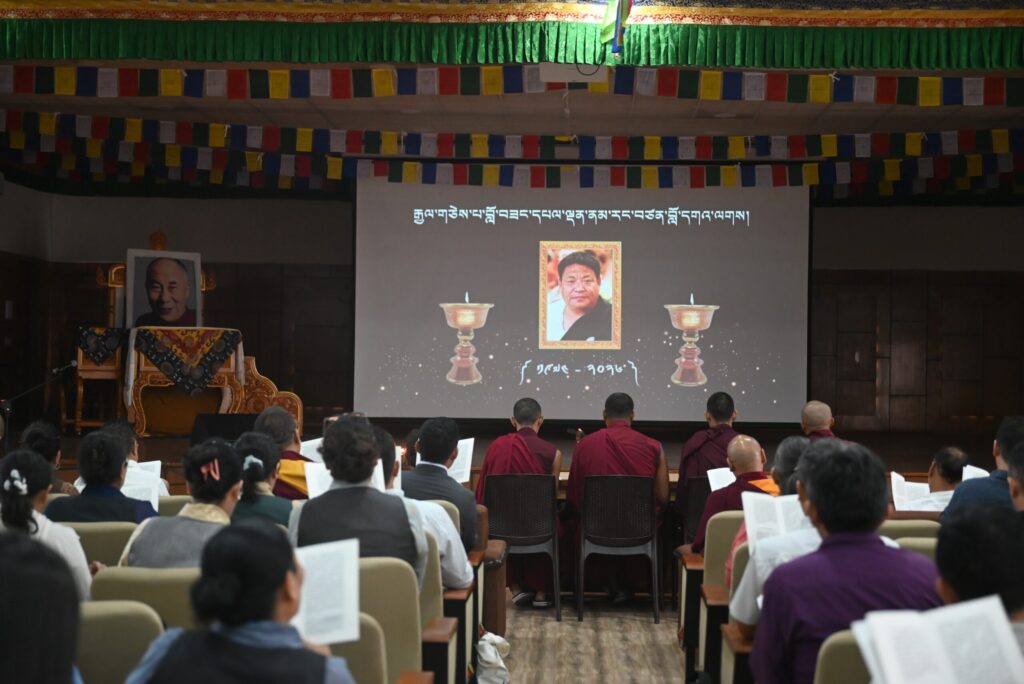
With the arrival of the Dalai Lama on the world stage in 1989, he decided to run a democratic government-in-exile in Dharamsala. The Assembly of Tibetan People’s Deputies, that since decades was nothing more than an administrative headquarters overseeing the functioning of Tibetan settlements and monasteries, was expanded fulsomely in 1990, and in 2001 the Tibetans-in-exile, including the diaspora in 47 countries, held its first election voting Samdhong Rinpoche as Kalon Tripa (head of the government-in-exile). Beijing got the clear message: the Dalai Lama will not compromise on his Middle Path position, which is why he has a government-in-exile to announce to all Tibetans that they can run their own democratic government.
This is probably why Beijing has had nine rounds of unsuccessful dialogue with the Dalai Lama’s representatives between 2002 and January 2011. The China team to the talks invariably comprised low-level officials sending the message of disdain for the Dalai Lama. The unsaid Beijing strategy is to mark time till the passing away of the Dalai Lama, consequent to which they hope to anoint his re-incarnation to finally suppress the Tibetans.
This Chinese strategy for Tibet seems to have been thwarted by two events in 2011. One, the Dalai Lama made it known that his successor would emerge from outside Tibet; could be from India or any of the 47 countries that have Tibetan diaspora. And two, the soft-spoken Lobsang Sangay took over as the Tibetan temporal head. This change sent the signal to China that democracy within Tibetans had both taken roots and was detached from spirituality. While Samdhong Rinpoche was elected the first head of the government in 2001, Sangay’s succession increased the interaction between the Tibetan cause and the world community. Sangay has forcefully been making the Human Rights violations case of Chinese against Tibetans at global fora.
Even as Chinese pretend to be unperturbed by heightened activities of Tibetan government-in-exile, the fact is that they are worried. China today spends more on its internal security than external defence. This is not all. Beijing keeps an eye on the Dalai Lama, and now Sangay meeting with world leaders. Whenever a Chinese leader comes to India, special request is made to keep Tibetan anti-China demonstrations in check. For example, when the Olympics torch was passing through Delhi in August 2008 for the Games in Beijing, Delhi, on China’s request, rounded all suspected Tibetans living in Delhi who could rally people for demonstration. The then foreign minister, Pranab Mukherjee issued a statement on the Dalai Lama days before the Olympics torch arrived for its Delhi leg. He said that: “The Dalai Lama is a respected guest of India. The nation will continue to offer him all hospitality, but during his stay in India, he should not indulge in any political activity, that could adversely affect relations between India and China.” When asked for his reaction, Samdhong Rinpoche told FORCE that, “These statements are not new. Ever since we arrived in India in 1959, the position of the Indian government has been consistent.” This exactly is the problem.
The Dalai Lama and Tibetan government-in-exile are powerful cards that India holds against China. Beijing will not fight with India for ‘South Tibet’ (Arunachal Pradesh), which it claims until it subjugates TAR completely. And this is not possible as long as the Dalai Lama lives and continues to mesmerise the world and his own people about the righteousness of the Tibetan cause. Moreover, the democratic Tibetan government-in-exile is a proof that the Tibetan cause will accept the new Dalai Lama outside Chinese control to take their struggle forward. Their struggle will be long but certainly not self-defeating.
What should New Delhi do? Nothing much, just let democracy prevail. If New Delhi has allowed a Tibetan government-in-exile, it much change its 1959 position to the new realities. Today, Tibetans have both spiritual and temporal heads. The Tibetans should be allowed to demonstrate freely as befitting a democracy, and New Delhi should have little hesitation in meeting with Sangay openly. India certainly does not require Chinese clearance on this.